The Wall That Rewrites the Play

Research prepared by the ArchUp Research Team.
How textual scenography and material architecture negotiate action, time and what an audience can know
An actor stands before a door and tells another person: “Do not open the door.” We do not yet know whether the speaker is protecting someone or keeping them captive. In one arrangement, an opaque door conceals everything beyond it. In another, the door is glazed and the audience can see someone waiting outside. In a third, the door stands alone on an otherwise empty stage, with an obvious route around it. The words remain the same, but the prohibition acquires different possibilities. It might concern an unknown danger, an attempt to control information, or a social boundary that persists without a material barrier. These are proposed readings of an invented scene, not findings from an audience experiment.
This research begins with that difference. Theatre architecture can change the conditions under which a sentence becomes credible, the time required to act on it, and who can challenge its authority. Bringing textual scenography into contact with material architecture means investigating how relationships proposed in writing become bodies, distances and surfaces. It also means following the return journey, when rehearsal reveals what the construction permits or resists and the production revises its interpretation.
The central proposition is that theatre architecture organizes possibilities for action and distributes knowledge. Its design should therefore be assessed through the relationships it makes performable and interpretable, and through what spectators can perceive, alongside its visual force.
Method and the limits of the evidence
This is a conceptual and design research essay, not an exhaustive systematic review or a new empirical study. It combines critical synthesis with direct reading of publisher excerpts, original abstracts, and relevant methods, analysis and discussion sections of an article available in full. It distinguishes what those materials support from our architectural interpretation and from propositions requiring observation in rehearsal. The source notes at the end specify the extent of access. Precise page references are given only where the location was verified.
A limited search that fails to locate a standard definition of “textual scenography” cannot establish that the phrase is absent from all theatrical traditions. Here it is an explicitly stipulated working term: the organization of spatial and sensory relationships and possibilities for action within theatrical writing, through dialogue, directions, silence, sequence and references to what appears or remains absent. We do not attribute this definition to a particular scholar or claim to have invented the field it describes.
A script can write relationships before it writes rooms
“A narrow room” offers a description. “They cannot pass each other” establishes a relationship that can be tested. “She sees him without being seen” specifies an inequality of information. “He returns before anyone notices his departure” connects a route to a duration. A designer can begin with these relationships and search for arrangements that activate them, instead of treating the script as a catalogue of named locations to be furnished.
We propose reading on two connected levels. The first concerns meaning: what does this room represent within the characters’ lives? The second concerns action: what must happen between bodies for that meaning to become available? A character might call a house safe while the action repeatedly interrupts every attempt at solitude. The arrangement of entrances could put that description under pressure. Privacy becomes a relationship that the performance can violate, with consequences visible in action.
Sara Freeman offers a relevant starting point. The opening page of her publisher excerpt discusses contemporary writing that activates a spatial imaginary on the page, through work by Churchill, Iizuka and Ruhl. This supports a spatial reading of writing. It does not establish that every script works alike, and our reading does not extend to the book’s complete case analyses [2, p. 1].
The practical consequence concerns the order of questions. Before deciding what a window looks like, ask who needs it, who watches through it and whether observation is reciprocal. Before fixing a corridor’s length, ask whether crossing involves waiting, pursuit or an opportunity to listen. Many physical solutions remain possible. The choice gains a reason grounded in an action the production wants to investigate.
Material architecture brings interpretation into contact with resistance
Material architecture here means the construction encountered by performers and spectators: floors, platforms, openings, screens, steps, seats and passages, as well as the existing building that accommodates the event. Each has practical properties before it acquires a symbolic interpretation. A surface can be rigid or flexible. An opening admits bodies in particular arrangements. A screen conceals from certain positions. A seat locates a spectator’s view.
Once a relationship acquires material form, the production meets conditions that reading alone has not settled. A script may require a rapid exit, while the arrangement makes the departing character cross an exposed area in front of an opponent. The team can alter the route, the performance or the writing. Whatever it chooses, construction has participated in interpretation. Calling the process implementation alone conceals the decision made along the way.
McKinney and Butterworth provide a useful framework. Their official excerpt places architectural structures, light, sound, images and objects in relation to performing bodies, text, the performance location and audience reception. Our direct reading is of that excerpt rather than their entire book [1]. We therefore treat architecture as an influential component of a larger scenographic arrangement.
The distinction matters. Light does not have a wall’s rigidity, but it may change whether the wall or an opening can be perceived. Sound does not close a passage, but it can signal that passage has become monitored within the fiction. Analysis should distinguish a physical obstacle, a prohibition enacted by characters, and a perceptual boundary established by the production. Otherwise “materiality” becomes too expansive to explain a particular decision.
Four spatial levels that need not coincide
For this research, we propose four analytical levels. The first is the world presupposed by the play, including places mentioned but never shown. The second is the arrangement constructed to represent or question parts of that world. The third is the actual theatre building, with its entrances, balconies, dimensions and services. The fourth is the space experienced by a spectator from a particular position, through what they can see, hear and connect.
A play might describe an extensive palace while the production uses a small platform in a large auditorium, with some spectators close to the actors. These differences do not automatically constitute a technical problem. Their function must be examined. Does the platform diminish the palace’s authority? Does the large room make the audience distant observers? Do the nearby seats offer information unavailable elsewhere?
This separation prevents a design analysis from treating a scenic plan as sufficient evidence of audience experience. A drawing records an arrangement. It does not establish what someone perceived during a dark passage or overlapping dialogue. A photograph from the centre cannot stand for every seat. Claims about reception require a position, a moment and a way of checking the experience.
The door as an architectural test of one sentence
Return to “Do not open the door.” Keep the words, their sequence and the performers’ initial positions as consistent as practicable, then vary the threshold. This proposed exercise asks what architecture contributes to the interpretation of the command. It cannot isolate design perfectly from performance. Actors respond to their surroundings, and that response is part of what must be recorded.
| Arrangement | Relationship made possible | Possible reading | What requires checking |
|---|---|---|---|
| Opaque door within a wall | Visual separation of inside and outside | The command depends on an unseen danger | Does a sound or shadow already reveal what is outside? |
| Glazed door revealing someone waiting | Spectators may possess additional information | The speaker is attempting to control knowledge | Which seats actually reveal the waiting person? |
| Freestanding door without a surrounding wall | A visible route around the threshold | Compliance may depend on a social rule | Does the performance convention recognize that route as available? |
| Door between two audience groups | Different information reaches different spectators | One event may sustain simultaneous readings | Does each group receive enough context to interpret the action? |
The third arrangement needs particular care. Empty space around a door does not prove a character is free to leave. The production may ask spectators to accept an unbuilt wall as present. Alternatively, it may expose compliance with a social rule despite the possibility of walking around it. Interpretation requires attention to the convention and to the performer’s behaviour before the absence of construction can be equated with freedom.
The production could also retain the same door and change who holds its key. That variation clarifies the relationship between architectural and dramatic interpretation. The door supports control of entry, while the distribution of the key, speech and history among the characters determines how that control operates. Architecture works within a set of decisions; its political meaning does not arrive fully determined by its shape.
From plan to section: power also has a vertical dimension
A plan can describe pursuit, but a section reveals different conditions: the platform’s height, the relationship between a performer’s head and a spectator’s eye, and the obstruction created by a railing or balcony edge. An elevated actor may be conspicuous to the audience while unable to see someone near the platform’s base. Spectators can become witnesses to that asymmetry. Vertical difference then distributes information as well as composing an image.
Height should not become a fixed symbolic dictionary in which every platform means domination. An elevated position can isolate a body, expose it to observation, or complicate descent within the event. Someone seated below may control the exit or the light. Each scene requires an account of how elevation interacts with access, sight and sound.
We therefore propose a dramatic section: a drawing of a particular moment that records what each participant can see, what another body or surface conceals, and where sound is intended to be located. It can be checked from multiple positions during rehearsal. Its value is to turn “the character seems isolated” into a specific question about separation, while leaving the success of the intended experience open to observation.
The body tests the difference between an obstacle and a prohibition
A narrow passage does not mean the same thing for every body, costume or movement. Passing depends on turning, carrying, balancing and accepting assistance. A static human figure in a scale model cannot settle that relationship. Performance unfolds through successive positions. The moment when one actor has to make room for another may constitute the scene’s central event.
It is equally important to distinguish resistance actually encountered from resistance performed. A light door can convey weight through movement and sound. A structure that looks massive may be technically easy to move. The aim is not to impose actual danger for the sake of credibility. The team decides what practical resistance the action needs and tests its repeatability under safe working conditions.
Göthberg, Björck and Mäkitalo offer a bounded empirical example. In a Swedish school production, interaction with a plant became part of negotiating a character and its actions. Their analysis follows shared understanding through speech and bodily interaction [3, pp. 250–254, 258–259]. The case supports studying rehearsal as a site where understanding develops. It does not establish that changing any architectural element will produce comparable effects across professional productions.
Our design inference is to leave some decisions revisable after the actual performers encounter them. If a character changes because opening the door requires another person’s assistance, that discovery provides information about a relationship. It is not automatically a failure to execute the drawing. The team must decide whether to retain the discovery or alter the design to recover another intended action.
Light and sound redraw boundaries
Spectators may see through glazing while being unable to distinguish the speech beyond it. They may hear footsteps from a direction where no passage is visible. Such differences allow a production to unsettle the correspondence between the space seen and the space anticipated. Their value depends on the relationship becoming legible within the performance, rather than on the quantity of effects used.
We propose treating lighting as a decision about when information becomes available. When does the handle appear? Does the audience see the reaching hand before hearing the decision to open? Does a face emerge after a movement is already visible? Each choice may reorder knowledge between character and spectator. These remain possibilities to test because reflection, costume, lighting direction and seating position can change what is actually perceived.
Sound analysis must similarly distinguish the technical location of a source from the location a spectator attributes to it. A cue intended to come from behind the door might be heard by some listeners as originating overhead. That difference could change the spatial organization of fear. A cue sheet records an instruction, but the dramatic consequence needs to be checked in the room.
The media need not always agree. Sound can suggest proximity while sight reveals distance, prompting a question about memory or deception. Yet that interpretation requires supporting conditions in the production. An unreadable discrepancy may create technical confusion. A deliberate and interpretable discrepancy can give spectators a reason to construct and reconsider a meaning.
Unbuilt space remains a design decision
Characters refer to cities, roads and rooms that never appear. Their absence can extend the fictional world or leave testimony uncertain. Building or projecting every named location may change how much remains available to imagination. The decision concerns the degree of evidence the production gives to a character’s account, as well as the resources needed to stage it.
Consider another invented scene. A character says a room behind the wall is empty. Keeping it concealed leaves the statement open to trust or suspicion. Opening the wall supplies additional evidence, although even that evidence may represent memory or imagination if the production has established those possibilities. The function of revelation should be specified before investing in its mechanism.
This approach helps question the attraction of comprehensive imagery. An opening that delays a view, a distance left uncrossed or a surface carrying a trace of earlier occupation may contribute more than a complete room. Such decisions require precision because the absent element becomes understandable through the relationships surrounding it.
When words become objects onstage
Textual scenography, as defined here, differs from displaying writing on a wall, although both can operate together. The former concerns relationships organized through writing. The latter gives words visible size, location and duration. Jürs-Munby’s abstract discusses displayed text as a participant in performance and a source of tension between written material and performer. Our access here is to the abstract, not the complete article [4].
If “Do not open the door” appears on a screen while an actor says “Open it,” the disagreement between these authorities becomes available to the production. Reception will depend on who can read the words and when. For Arabic performances, reading direction, line arrangement, any translation, and the movement of attention between text and body need to be tested. Increasing type size alone does not resolve every relationship.
Displayed writing might function as an institutional command, a memory or a statement contested by action. The designer needs to determine its status within the theatrical world. Can characters see it? Can someone erase it? Does its meaning change when it can be touched? These questions give writing a working relationship to the event rather than leaving it as commentary suspended above an image.
The audience belongs to the architecture of the argument
A frontal auditorium distributes attention differently from a space in which spectators surround performers. When some can see what others cannot, the difference can become material for the production. It can also produce an unintended loss of necessary information. Distinguishing those outcomes requires a deliberate choice followed by checks from multiple viewing positions.
Design should not assume an ideal spectator who sees every detail, hears all dialogue and reads displayed writing at a single shared speed. It can provide several routes into an event, for example by making the use of a key legible through bodily action and sound, or by reviewing the position of captions in relation to movement. Such decisions help distinguish artistic ambiguity from difficulty accessing its constituent information.
Arrival, waiting and taking a seat can also frame reception when the production includes them within its organization. A visible entrance route observed by performers could make arrival reciprocal, while another route keeps it unobserved. These possibilities must be assessed in a particular building. They do not imply that every entrance ritual produces the same social meaning.
Time, transformation and what remains after a scene
Design needs an account of transitions between spatial states. Who moves the wall? Does the audience watch the labour? Does a trace of the previous room remain? A surface changed through lighting produces a different event from one dismantled or pulled away in view. The act of transformation may carry greater significance than the arrangement eventually achieved.
We propose distinguishing three temporal registers: the time claimed by the story, the duration of action onstage, and the operational time needed to change the arrangement. They can coincide or diverge. If a transformation requires an extended interruption, the team must decide how that interval belongs to the performance’s rhythm instead of leaving it as an unexamined consequence of construction.
Material can continue to work through memory. A door retained after the room disappears may carry a relationship from the previous scene, provided the production makes that continuity available. Removing every trace might establish a deliberate break. The design question consequently expands from what will be built to what should remain available to memory and through which sign.
The actual building and the conditions of possibility
The operational argument connects with Before the First Note: The Concert Hall’s Hidden Footprint, which examines the material and backstage conditions that make performance possible.
Design does not begin on an abstract stage. Routes for moving components, storage, waiting areas, suspension facilities and technicians’ circulation influence what can be constructed and repeated. A service passage that permits a change without interrupting an actor’s action may preserve an entire scene’s continuity. Dramatic thinking therefore needs contact with the building’s operational realities from the beginning.
For a touring production, the question becomes which relationship must survive and which physical arrangement can change. The essential condition might be visual separation between characters rather than carrying an identical wall into every venue. Defining that relationship supports investigation of local alternatives, while still requiring new checks of sound, sight and movement.
Reuse belongs to this analysis as a material and artistic decision. An existing component might accommodate a new function or obstruct it through its weight, dimensions or modification time. Environmental performance cannot be established from appearance or an announcement of reuse alone. A defensible claim requires a defined assessment boundary and information about materials, labour, transport, storage and the components’ lives after performance.
Who can change the text?
Fischer-Lichte’s abstract identifies a history of reorganizing the relationship between text and performance and asks about its consequences for performance and writing [5]. That provides theoretical context, not automatic authorization to alter a particular work. Interpretive freedom, usage permissions and artistic agreements need to be distinguished, as do an explicit collective decision and a change caused by involving a discipline too late.
We propose recording the reason alongside a revision. If a sentence is removed because an action supposedly makes it clear, what observation supports that judgment? If an opaque wall becomes transparent, which relationship should change? The writer, director, designer and performer can then discuss a specific consequence rather than relying only on general claims about serving the text or realizing a vision.
Sometimes the useful decision is to retain tension between speech and image. A character calls the place open, while action reveals that movement requires permission. The team can test whether the difference produces a meaningful reading before removing it. Rehearsal may equally reveal that a contradiction is accidental and that revising it clarifies the intended relationship.
A practical protocol for design research
The proposed method begins with a short unit containing a clear spatial action. Record the necessary words, the sequence of events and the information available to each participant. Draw access and concealment relationships before selecting materials. Build a test arrangement at a scale appropriate to the movement under examination, identifying what it cannot reproduce about weight, sound or light.
Try a limited set of alternatives and record changes rather than attributing every difference to the arrangement. If acting, sound level or audience position varies between trials, document those variables too. Where practical, vary the order in which participants encounter alternatives, since prior knowledge of the scene may influence interpretation. The exercise should not be described as a controlled causal experiment unless its design justifies that description.
After each trial, ask spectators about specific information. Who knew that someone was behind the door? At what moment did that become apparent? Compare answers with the recording and the plan. An open question about the meaning of the command can follow, reducing the risk of teaching participants the preferred reading. Distinguish failure to perceive a cue from perceiving it and interpreting it differently.
Performers can record changes in attention, timing, effort and coordination. Their accounts do not constitute an objective measure of every effect, but they reveal aspects unavailable to a frontal recording. End with a decision note separating what was observed, what remains plausible and what needs further investigation. This is more useful than an undifferentiated judgment that a design “works.”
| Question in the text | Spatial decision | Observable material | Limit of inference |
|---|---|---|---|
| Who can leave? | Exit location and access route | Movement onset, obstacle or permission | The route alone cannot explain motivation |
| Who knows what is behind the wall? | Transparency and viewing angles | Information reported from different seats | Visibility does not guarantee one interpretation |
| How does waiting become perceptible? | Body position and route continuity | Sequence of action, silence and attention shifts | Measured duration does not exhaust experienced time |
| When does the place change meaning? | Lighting, component movement or displayed writing | Timing relative to speech and action | Coincidence alone does not establish causation |
Propositions that allow the research to be challenged
The first proposition is that changing visibility beyond a threshold can alter an audience’s interpretation of a prohibition while the words remain constant. Evidence that interpretation stays stable because tone or prior knowledge dominates would qualify that proposition. The relevant question concerns interaction between architecture and performance, rather than expecting the spatial variable to determine every outcome.
The second proposition is that changing access to an element can produce changes in coordination between performers. This does not imply that every change improves the scene; some may add effort without artistic value. The third is that preserving a specified dramatic relationship across venues can be more useful than replicating scenic dimensions. Testing it would require comparison of actual performances and reception, which this research has not undertaken.
The framework also has conceptual limits. Its emphasis on action and information may be less suitable for a work organized primarily around sensory density, rhythm or abstraction. Some questions may remain useful there, but narrative clarity should not become a universal measure of performance. Nor does this essay collapse different theatrical traditions into one Western model or offer a comprehensive history of them.
What does the wall make possible?
The value of joining textual scenography to material architecture becomes apparent when a drawing can answer a question within the event. Why did the character not see? Why did they wait? Why did they need someone else? Writing can in turn interrogate the construction. Does the scene need this wall, or the concealment it produces? Such questions establish concrete work shared by writing, design and performance.
The proposed unit of analysis is a relationship changing over time: a body before a threshold, information behind a surface, a spectator to one side, and an action awaiting its possibility. This connects what language proposes with what material arrangements permit, while leaving observation able to revise the interpretation. The image retains its force, and its assessment develops as a person enters and acts within it.
Theatre architecture negotiates with the text over what a body can do and what an audience can know. The wall worth building is one whose presence, opening and disappearance we have learned to account for.
Sources
References use APA bibliographic conventions with consistent numbering across both versions. An article’s page range is not a pinpoint citation. Reading scope: [1] official excerpt; [2] opening excerpt page and publisher summary; [3] relevant sections of the original article; [4] and [5] publisher abstracts rather than complete articles.
- McKinney, J., & Butterworth, P. (2009). The Cambridge introduction to scenography. Cambridge University Press. DOI: 10.1017/CBO9780511816963.
- Freeman, S. (2023). Playwriting, dramaturgy and space. Cambridge University Press. DOI: 10.1017/9781009370257. Online publication: 19 December 2023; print publication: 18 January 2024.
- Göthberg, M., Björck, C., & Mäkitalo, Å. (2018). From drama text to stage text: Transitions of text understanding in a student theatre production. Mind, Culture, and Activity, 25(3), 247–262. DOI: 10.1080/10749039.2018.1480633.
- Jürs-Munby, K. (2010). Text exposed: Displayed texts as players onstage in contemporary theatre. Studies in Theatre and Performance, 30(1), 101–114. DOI: 10.1386/stap.30.1.101/1.
- Fischer-Lichte, E. (2001). Reversing the hierarchy between text and performance. European Review, 9(3), 277–291. DOI: 10.1017/S1062798701000278.
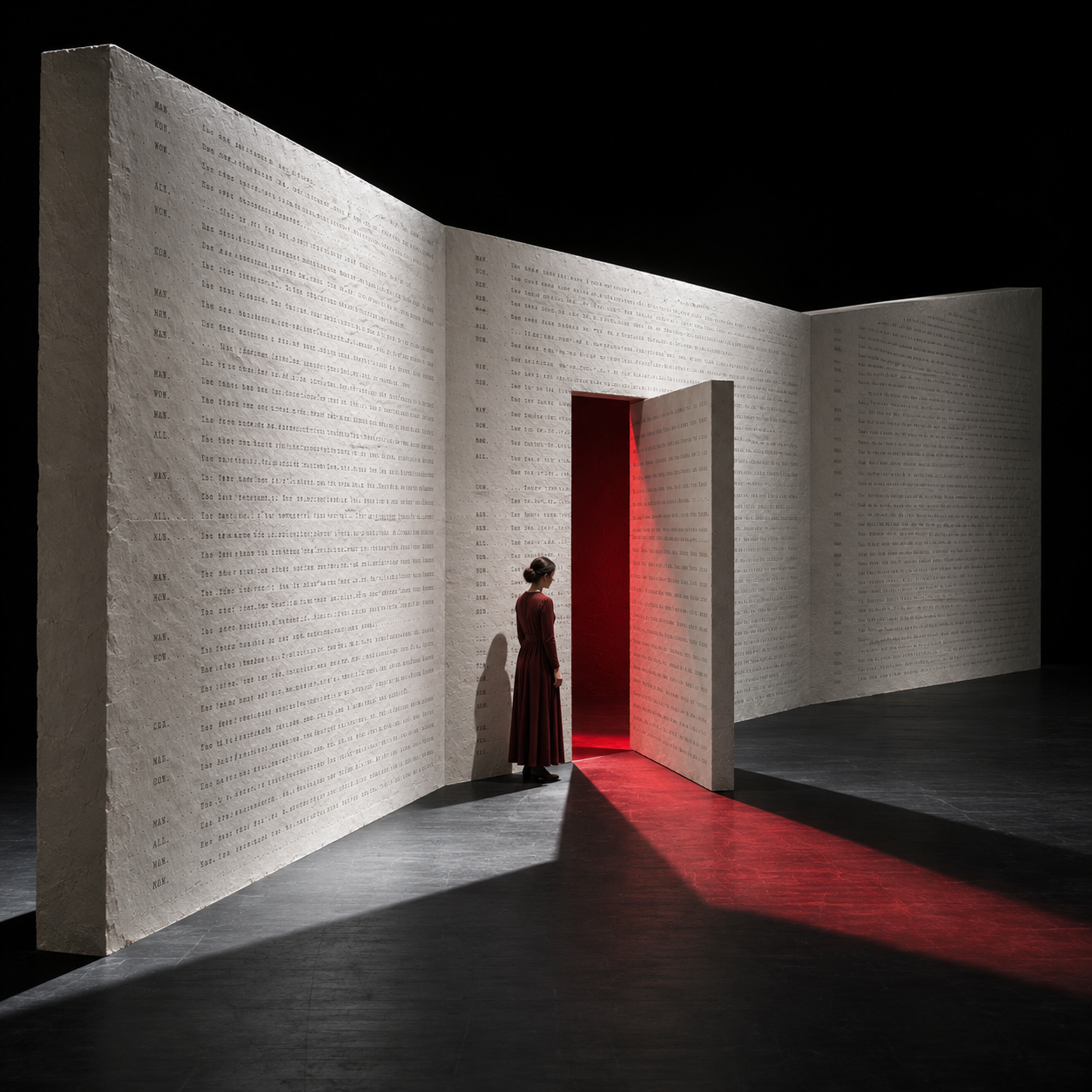
Cover: an editorial illustration supplied for this research, showing theatrical text as a wall and a red-lit threshold. The image is illustrative and does not document a built stage or the hypothetical rehearsal exercise discussed here.