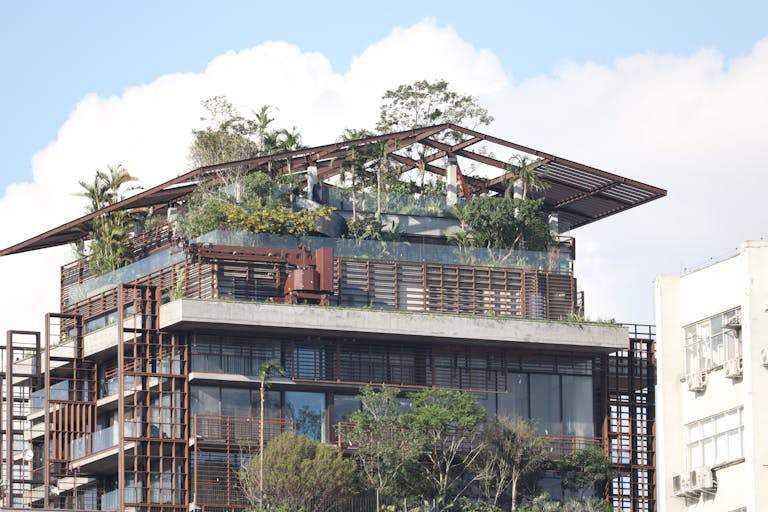
The Infinite Scroll and the Infinite Corridor: What Architects Can Learn From Screen Addiction

How Digital Psychology Research Reveals the Hidden Logic of Public Space Design and Studio Culture
Inside a large shopping mall, there are no windows facing the street, no wall clocks, and lighting that remains constant throughout the day. This is not a design oversight but a calculated spatial decision meant to disrupt a visitor’s sense of time passing — the same function performed by “infinite scroll” in mobile apps. The irony is that architects and app interface designers share, often without ever meeting, a single psychological toolkit: how do you keep a body, or an attention span, inside a space for as long as possible? This overlap becomes more urgent when reading recent literature on the relationship between social media use and the mental health of adolescents and young adults. The findings emerging from this field are not simply about screens — they point to design principles governing space itself, whether digital or physical, principles that could reshape how architects think about the school, the studio, and the city.
From “Likes” to the Crit: When Architectural Critique Becomes a Social Feed
A comprehensive review conducted by researchers Yue and Rich found that each additional hour of daily social media use is associated with a 13 percent increase in the risk of depressive symptoms among adolescents, based on a meta-analysis covering more than fifty-five thousand teenagers. The primary driver behind this relationship, according to the study, is a mechanism known as “upward social comparison,” in which users measure their daily lives against carefully curated, idealized portrayals of others’ lives — producing dissatisfaction and diminished self-esteem.
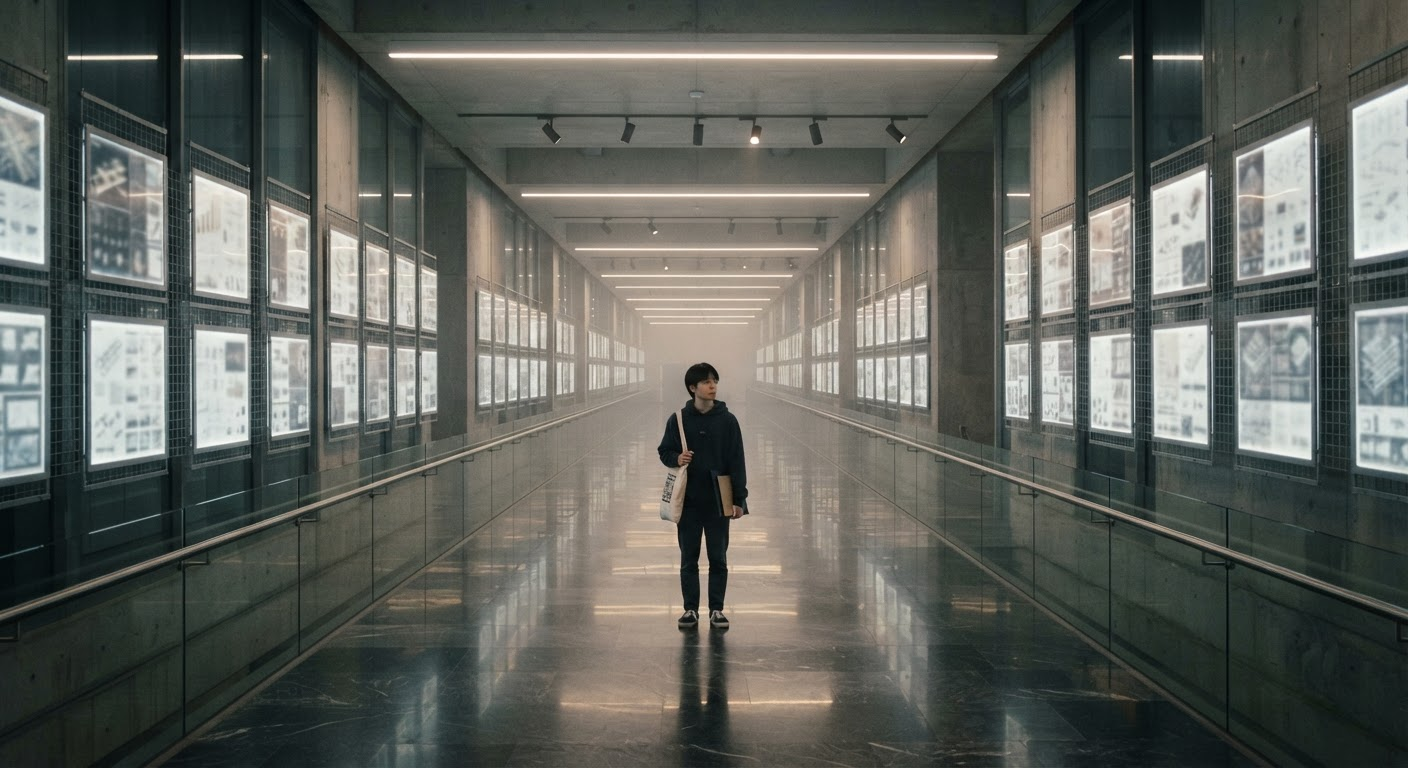
This mechanism is not foreign to architecture school corridors. The “crit” — the public critical review of student projects before a jury and peers — reproduces the same psychological structure: a carefully selected product displayed before an audience that judges it openly, alongside immediate comparison with classmates’ work pinned to the adjacent wall. The difference is that the “like” here takes the form of a professor’s comment or an evaluative glance, but the psychological effect — anxiety about judgment, upward comparison, and self-esteem fluctuating based on momentary feedback — carries a structure similar to what research documents about online social feedback.
Engineering Anxiety: Psychological Mechanisms That Extend Beyond the Screen Into Space
Researchers identify several intermediary mechanisms that explain the relationship between heavy social media use and declining mental health, chief among them “fear of missing out,” commonly abbreviated as FoMO — the anxiety produced by the belief that others are experiencing rewarding moments from which one is absent. This anxiety correlates positively with symptoms of depression, anxiety, and neuroticism, and drives compulsive phone-checking.
From a design standpoint, this mechanism recalls the principle of “persuasive design” adopted by technology companies through infinite scroll, autoplay, and push notifications — elements specifically engineered to exploit adolescents’ heightened sensitivity to social reward at a time when their cognitive control systems are still developing, according to research by Skeggs and Orben. Urban planners practice a parallel form of this design when they engineer pedestrian pathways through shopping malls to force visitors past the maximum number of storefronts, or when they calibrate lighting and music in markets to encourage lingering and impulse buying. The essential difference is that the architect works within a physical space that changes slowly, while the app designer tests modifications on millions of users daily — a gap that demands from architects a form of anticipatory ethical vigilance rather than after-the-fact correction.
Another element worth pausing on is the sleep disruption caused by nighttime screen use, whether from blue light exposure or the cognitive arousal produced by engaging content. This revives the importance of an almost-forgotten architectural principle: designing bedrooms and residential spaces to clearly separate zones of “digital wakefulness” from zones of rest — a matter of interior planning rather than mere behavioral advice.
Active Versus Passive Use: A Lesson in Designing Active Public Space
Among the most significant findings in the literature is the distinction between “passive use” of social media — scrolling and browsing without interaction — and “active use,” which includes direct messaging, commenting, and genuine participation. The former is more consistently linked to negative psychological outcomes, while the latter can be neutral or even beneficial, particularly when it strengthens existing relationships.
This distinction carries a direct lesson for designers of public space and cities. “Passive” urban space — the vast, empty plaza that pedestrians cross without pausing, or the wide sidewalk devoid of any prompt for interaction — resembles passive scrolling in its effect: physical presence without genuine engagement. By contrast, spaces designed to encourage “active use” — closely arranged seating that fosters conversation, informal markets that require direct exchange, community gardens that demand actual participation in planting or upkeep — generate what might be called genuine social capital, following the same logic that makes direct messages between friends online less harmful than blindly scrolling through strangers’ posts.
No One Size Fits All: A Critique of Ready-Made Design Solutions
One of the most striking findings in recent research is the discovery that the impact of social media on psychological well-being varies dramatically from person to person. In one experience-sampling study, 44 percent of adolescents reported no change in their psychological state after using social media, 46 percent felt better, and only 10 percent felt worse. This variation undermines the notion that “screen time” alone is the decisive variable, and calls for individualized approaches rather than blanket generalizations.
This is a distinctly methodological lesson for architectural and urban planning practice, where design standards are still largely built around a hypothetical “average user.” According to studies, girls use social media more intensively for relational purposes and show a stronger correlation between such use and depressive symptoms, while younger adolescents (ages 10 to 15) appear more vulnerable than their older counterparts. Research by Fassi and colleagues further found that adolescents with internalizing conditions such as anxiety and depression display higher social comparison and less control over their time online, while those with attention-deficit/hyperactivity disorder spend longer periods on platforms with heightened sensitivity to feedback. Projecting this diversity onto architecture means that a single school or residential neighborhood cannot be designed around one user model; a space that comforts an introverted teenager might deepen the isolation of another who needs greater social stimulation.
The Third Place as Antidote: Why Planners Need to Rediscover the Street
Despite these risks, research indicates that the relationship between social media and face-to-face interaction is not necessarily one of replacement. The “social displacement” hypothesis — which holds that social media substitutes for direct interaction — has found weak causal support in the literature. Instead, individual-level analyses suggest that digital use more often fills a void created by the prior absence of opportunities for direct interaction, rather than displacing interaction that would otherwise have occurred. In other words, when the “third place” is absent — that space between home and work or school that allows for spontaneous encounter, such as a café, a public square, or a lively sidewalk — digital space becomes a default substitute rather than a competitor to it.
This places direct responsibility on urban planners. If contemporary cities have shrunk their third places through car-dependent, isolated residential neighborhoods and commercial streets replaced by enclosed shopping centers, then part of “digital addiction” may stem not from the apps themselves but from the absence of a living spatial alternative. A report from The Lancet warns against the danger of reducing the youth mental health crisis to social media alone, noting that other environmental factors — worsening economic inequality, a tightening job market, and climate anxiety — have contributed in parallel. This means an architectural solution alone will not suffice, but it remains a necessary part of the equation.
Toward a Humane Design Charter: From “Reducing Screen Time” to “Improving the Quality of Space”
The latest direction in designing psychological interventions moves beyond the idea of “reducing usage time” toward “improving the quality of use,” grounded in self-determination theory, which focuses on meeting core psychological needs: autonomy, competence, and belonging. Rather than imposing strict limits on screen time, researchers Skeggs and Orben propose removing “addictive” features from design, fostering authentic self-expression, and building positive digital communities.
This conceptual shift closely parallels a long-standing debate in architecture over the difference between “restriction” and “empowerment” in urban design: instead of closing public squares or limiting their use out of fear of misuse (the equivalent of reducing screen time), many contemporary planners propose designing “enabling” spaces that grant users autonomy in how they engage, allow for a diversity of activities, and build a genuine sense of community belonging. A study by Shoemaker Brino and colleagues on a “digital hygiene” protocol delivered via telehealth showed strong results in reducing the severity of problematic internet use and symptoms of depression and anxiety among adolescents. Yet the deeper significance lies in the fact that the intervention was not merely prohibitive but restructured users’ relationship with digital space — precisely what planners need when redesigning neighborhoods that have historically neglected the needs of younger and more vulnerable populations.
On a practical level, researchers recommend that clinicians routinely ask about social media use, screen for cyberbullying, and assess benefits and harms on an individual basis, alongside supporting school-based programs and family guidelines that favor autonomy over absolute restriction. Translated into the language of urban planning, these principles mean that the design of schools and neighborhoods must balance protection with openness, giving the most vulnerable populations tools to control their environment rather than isolating them from it entirely.
✦ ArchUp Editorial Insight
What appears here as a discussion about screens is, in fact, an inquiry into governance through attention. Social media platforms, retail interiors, studio culture, and car-dependent urbanism operate under the same pressure system: prolonged engagement has become a measurable asset, whether monetized through advertising, retail exposure, institutional prestige, or behavioral data. That pressure then passes through decision frameworks — platform metrics, commercial leasing models, academic review rituals, zoning patterns, and risk-averse planning — before hardening into corridors without temporal cues, juries built around public comparison, and neighborhoods with too few third places to absorb social life offline. The resulting architecture is not the cause of anxiety or compulsive use; it is the spatial residue of institutions optimized for retention rather than well-being. Any serious design response therefore requires changing incentives, not merely rearranging form.
References
Yue, Z., Rich, M. “Social Media and Adolescent Mental Health.” Current Pediatrics Reports, 2023.
Sala, A., Porcaro, L., Gómez, E. “Social Media Use and Adolescents’ Mental Health and Well-Being: An Umbrella Review.” Computers in Human Behavior Reports, 2024.
Harness, J., Domoff, S. E., Rollings, H. “Social Media Use and Youth Mental Health: Intervention-Focused Future Directions.” Current Psychiatry Reports, 2023.
Parry, D. A., Fisher, J. T., Mieczkowski, H., Sewall, C. J. R., Davidson, B. I. “Social Media and Well-Being: A Methodological Perspective.” Current Opinion in Psychology, 2022.
Hall, J. A., Liu, D. “Social Media Use, Social Displacement, and Well-Being.” Current Opinion in Psychology, 2022.
Shoemaker Brino, K. A., Derouin, A. L., Silva, S. G. “Problematic Internet Use in Adolescents and Implementation of a Social Media Hygiene Protocol.” Journal of Pediatric Nursing, 2022.
Rajamohan, S., Bennett, E., Tedone, D. “The Hazards and Benefits of Social Media Use in Adolescents.” Nursing, 2019.
The Lancet. “Unhealthy Influencers? Social Media and Youth Mental Health.” The Lancet, 2024.
Fassi, L., et al. “Differences in Social Media Use Between Adolescents With and Without Mental Health Conditions.” Nature Human Behaviour, 2025.
Skeggs, A., Orben, A. “Social Media Interventions to Improve Well-Being.” Nature Human Behaviour, 2025.