House with a Glade: Forest-Light Architecture Redefined


Mass Formation and Light Movement
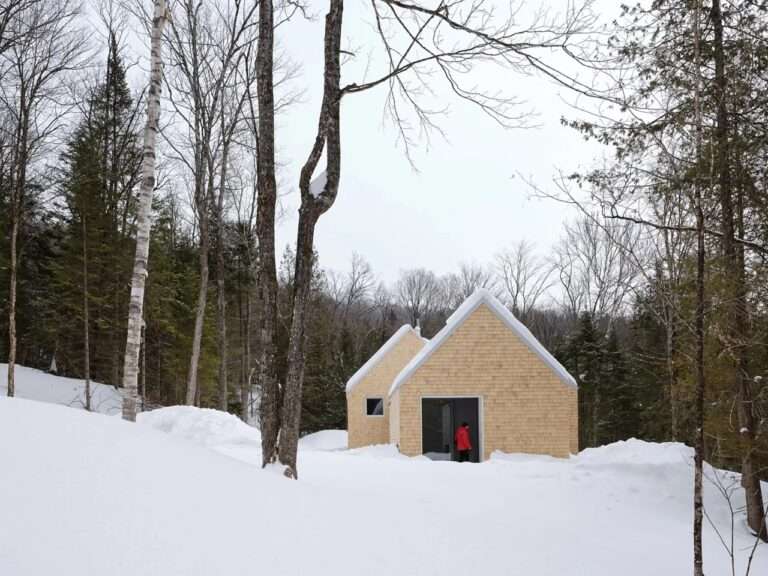
The architectural entity of the building is established as a structural response to its forested environment, where the masses abandon their linear rigidity and adopt a curvilinear configuration that wraps around the discovered natural clearing. This curvature does not function as a purely visual gesture, but rather as a guiding instrument that enables the internal space to capture natural light and distribute it dynamically throughout the day. The extended glass façades merge with their surroundings, dissolving the boundary between solid built mass and the pine forest; thus, light transforms from an external physical element into a living Design material that continuously redraws the interior spatial details and the intersections of shadows with solid surfaces.
Material Scenography and Spatial Experience
The materials used in the façades integrate with the surrounding environment to create a sensory and material experience that tests the depth of visual sustainability. Hand-formed brick and fiber-cement panels provide a rough, enduring texture that echoes the resilience of natural tree trunks, while wooden surfaces and green roofs offer a living extension that connects the building horizontally and vertically to the ground and the existing vegetation. The user moves within this space through carefully designed circulation paths, beginning with the entry and transitional passage, and extending to the interior spaces that provide residential comfort supported by automated systems, where the movement of air and light intersects to give the occupant a constant sense of calm integration without imposing an abrupt Architecture presence on nature.
| Field | Details |
|---|---|
| Architects | 77 Studio |
| Area | 380 m² |
| Photography | Piotr Krajewski |
| Lead Architect | Paweł Naduk |
| City | Warsaw |
| Country | Poland |

Spatial Dynamics and Discovery of the Natural Void
Here, the architectural approach transcends predefined formal templates to emerge as a direct field response to the complexity of the site. The critical reading of the site began with dismantling the initial constraints represented by the dense visual mass of pine trees and limited light penetration, in addition to the presence of an existing structural framework. The act of removal and demolition was not merely a process of clearing the site, but a radical act of revelation that produced an unexpected spatial condition: an open forest clearing immersed in natural light and surrounded by a towering ring of trees. This emergent void became the guiding nucleus of the entire design and a primary driver in reshaping the relationship between solid mass and emptiness, offering a unique dialogue between Buildings and their natural context.
Light Scenography and Path Orientation
This discovered clearing transforms from a mere ground condition into an active scenographic element that directs the human experience within the building. The masses are designed to orbit around this flow of light, allowing the user to experience space through a conscious transitional movement; from the darkness of dense forest shadows to a full visual openness toward directed architectural light. The circulation path is shaped to enhance sensory awareness of the surrounding woodland, where the daily movement of the sun intersects with the open architectural volumes, producing a shifting visual experience that redefines the concept of living within nature through a continuous dialogue between Architecture and its environment.

Curvature Geometry and Scenographic Enclosure
The mass response to site conditions is embodied in a semi-circular configuration that fluidly follows the perimeter of the discovered forest clearing, abandoning sharp edges in favor of lines that wrap around the natural void. The curved façade is not limited to an abstract visual effect; through large glazed surfaces it becomes a permeable membrane that deeply integrates the forest landscape into the daily scenography of the dwelling. This spatial formation required precise structural treatment through the use of curved glass panels and sliding doors moving along the arc, making the building envelope flexible and interactive with external environmental changes and responsive to the movement of air and shadows, highlighting the importance of Building Materials in achieving such fluidity.
Solar Orientation and Spatial Dynamics
The internal spatial organization aligns with the flowing geometry of the external structure, guiding the trajectory of human experience and movement within the house. This curvilinear sequence ensures the penetration of sunlight into the deepest parts of the living spaces, a critical architectural solution in a naturally shaded forest environment. The inhabitant experiences light as a temporal, moving element that changes over the hours across interior surfaces; where solid masses intersect with transparent façades to generate shifting shadows that animate the space and materially and psychologically influence the design language and the experience of living within nature. Such integration of light and form often becomes a central theme in Research and contemporary Projects, while the resulting spatial qualities are frequently discussed in Discussion forums. The overall composition also draws attention to the evolving role of Interior Design in shaping sensory experiences, and such innovative approaches are regularly featured in Top News within the architectural community.


Horizontal Extension and the Intermediate Space
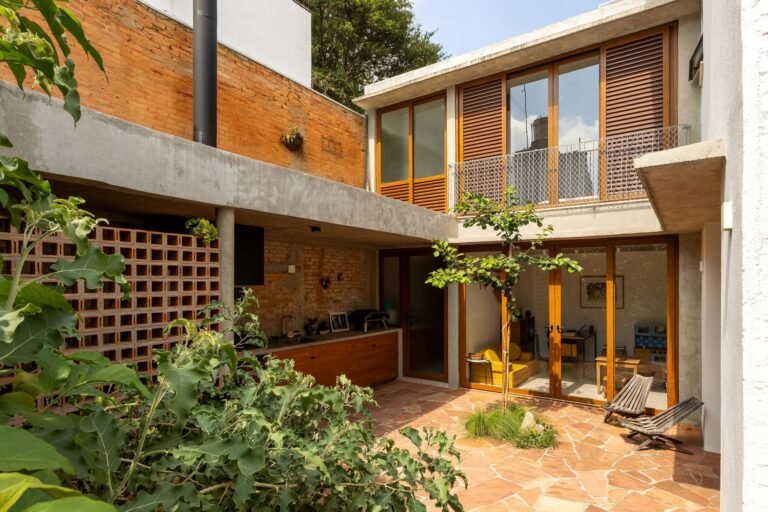
The boundary between architecture and landscape dissolves through a transitional garden courtyard embraced by the structural curvature of the building, transforming the exterior space into an open yet semi-private room. This scenographic space is shaped in response to the movement of surrounding shadows and tree masses; where the canopy of tall pine trees acts as a natural filter that diffuses sunlight, casting ever-changing light rhythms across the ground plane and façades. The human experience of this passage becomes a semi-sheltered zone that enables a vivid interaction with nature, where air and light flow fluidly between solid and vegetative elements, a quality often explored in Interior Design strategies that blur indoor-outdoor boundaries.
Evening Scenography and Psychological Effect
The fire pit positioned at the center of the courtyard becomes a visual and material anchor and a focal point of activity after the disappearance of daylight, reshaping the nocturnal atmosphere of the dwelling. This fire pit transcends its utilitarian role to become a luminous element whose scenographic glow is reflected across the extended glass façades, maintaining a visual connection between interior and exterior even in darkness. This precise temporal orchestration of light sources, from daylight sun to evening fire, leaves a profound psychological and material imprint on the user, reinforcing the connection between human experience and the natural rhythms of the forest site, a theme frequently addressed in Research on sensory architecture.


Material Essence and Visual Contrast
In this project, materials are transformed from rigid structural components into scenographic instruments that evoke the contrast of the forest environment, where the building is shaped to resemble a partially hollow tree trunk. This concept is embodied through the use of dark, solid exterior surfaces that gradually open toward brighter and more light-permeable interior spaces. The material contrast becomes clearly evident at the intersection of graphite-toned fiber-cement panels and cold metal cladding with the warmth of wooden surfaces overlooking the garden, creating a visual equilibrium that enriches the user’s sensory experience when moving between the building’s different edges. Such material dialogues are central to many contemporary Projects that prioritize haptic richness.
Permeability and Spatial Layering
The street-facing façade is formed of hand-crafted brick, whose rough textures and earthy tones were selected to precisely reflect the language of the surrounding pine bark, achieving a morphological integration with the site. This brick envelope transcends its protective function, as parts of it transform into perforated architectural screens that act as visual filters, modulating natural light and airflow. This treatment gives the building envelope a gradual layered permeability that conceals more private zones behind it, such as the protected loggia, allowing the user a transitional moment of movement and perception characterized by ambiguity and privacy without a complete separation from the external environment. The innovative use of Building Materials here demonstrates how texture can mediate privacy and exposure.

Material Continuity and Visual Integration
The organic integration of the building within its surroundings is reinforced through detailed construction strategies that seamlessly transfer the language of flooring and materials from the external courtyard into the internal depth with fluid spatial and visual continuity. This is clearly expressed in the radial arrangement of ash wood planks surrounding the central fire pit, which extends geometrically to connect with the oak flooring in the living spaces, eliminating material boundaries and creating a unified visual extension that links the experience of living between house and garden. This carefully orchestrated material sequence has both a psychological and physical impact on user movement, turning the act of transitioning between interior and exterior into a continuous and flowing experience, a principle often highlighted in Design discussions about threshold spaces.
Environmental Efficiency and Architectural Experience Formation
Environmental strategies and technical building systems integrate to form a complementary dimension of the spatial phenomenon without disrupting the existing natural condition. Green roofs emerge as a living layer that enhances thermal and waterproof insulation performance, while the preservation of dense trees and native vegetation maintains site equilibrium and its natural shading system. This sustainable approach is synchronized with the building automation system, which regulates consumption efficiency and residential comfort according to external variables; thus, technology and environment interrelate to allow the characteristics of the forest landscape to guide the architectural experience and massing composition of the project in a contemporary and restrained manner. Such integrated solutions are increasingly featured in Top News covering sustainable residential innovations.

✦ ArchUp Editorial Insight
The project embodies a functional spatial morphology that rejects predefined geometric templates, allowing an emergent forest clearing to dictate its structural trajectory. Through the use of a curved envelope and sensory material tactics such as hand-formed brickwork, the mass operates as a visual device that integrates the seasonal performance of the forest, prioritizing phenomenological immersion and local climatic conditions over real estate-driven calculations or rigid compositional models. This approach resonates with ongoing Discussion about the role of site-specificity in contemporary practice.
However, this reliance on an idealized, non-replicable clearing reveals a certain blind romanticism within contemporary residential design mechanisms. By favoring exclusive architectural customization, such as complex curved glazing, over scalable and standardized frameworks, the architecture becomes dependent on specific natural contingencies, risking the transformation of site responsiveness into an isolated aesthetic commodity detached from the demands of environmental density and the realities of collective housing systems. This critical perspective is often examined in Architectural Jobs discourse and professional debates about the ethics of customization versus standardization, and it challenges the very notion of Architecture as a universally applicable discipline.