
How Iran Designed a Modern Identity: Art and Architecture in the Pahlavi Era
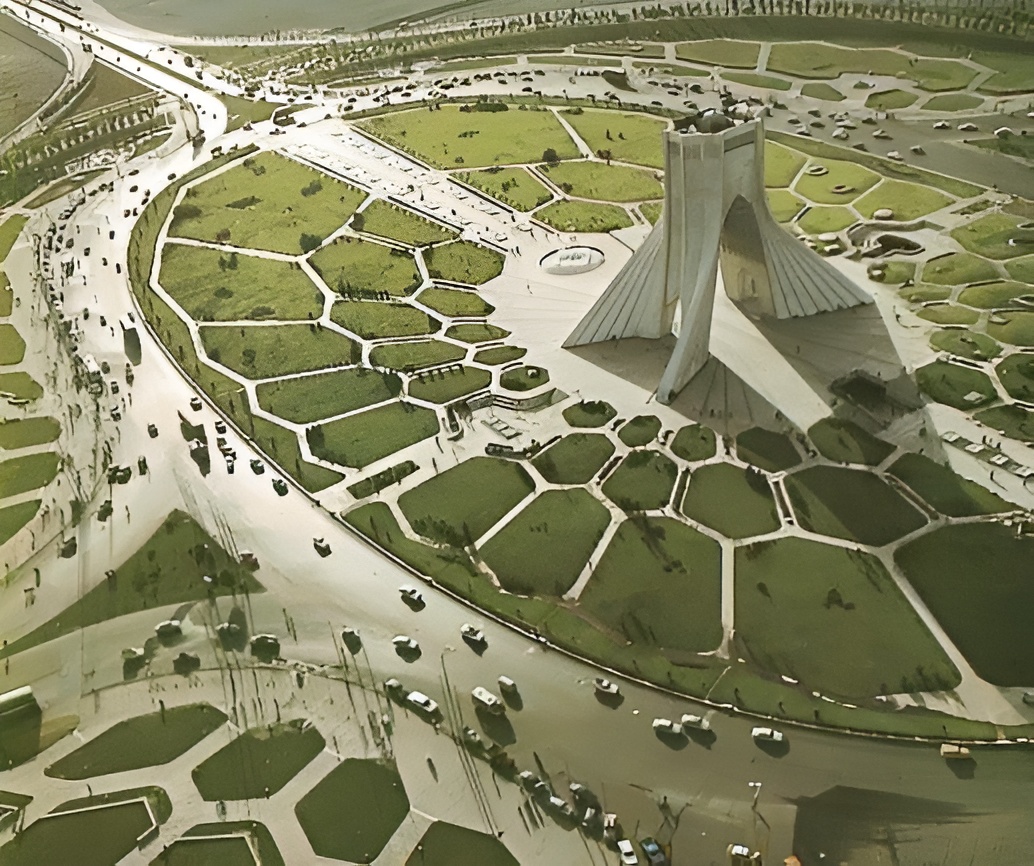
The tower in the photograph is surrounded by a carefully ordered landscape. Paths divide planted ground into geometric pieces, traffic circles the composition, and the monument occupies its centre. The building presents an image of national identity, but the photograph also reveals the machinery required to make that image public: land, infrastructure, circulation, maintenance and a position within the capital. Modern identity is not simply carved into stone. It is organised around it.
Iranian art and design under the Pahlavi dynasty, from 1925 to 1979, offer an unusually rich setting for examining this relationship. Architectural education, modern painting, carpet production, graphic design, cinema and performance developed through different institutions and at different speeds. Together, they made a question unavoidable: how could a work be recognisably Iranian without being required to repeat the past?
The answer was never a single style. It emerged through arguments about who could interpret heritage, who financed experimentation, which audiences counted and how international recognition affected local choices. The most useful legacy for architects and designers lies in those arguments. A visual identity can be commissioned relatively quickly. A culture capable of questioning and renewing it requires much more.
A period is not a movement
The expression “Pahlavi art” is a chronological convenience, not the name of a coherent artistic programme. It includes the centralising state projects of Reza Shah, the changing cultural conditions after his abdication in 1941, and the expanded institutions and international exchanges of the later monarchy. A public building, a commercial film poster and an independent gallery could inhabit this period while pursuing incompatible objectives.
Three distinctions prevent confusion. Modernisation concerns changes in institutions, infrastructure and professional organisation. Modernism concerns artistic and architectural experiments. Nationalism concerns claims about collective identity and political belonging. These processes intersected, but none automatically guaranteed the others. An advanced art school could coexist with censorship. A modern building could employ historical imagery. A work drawing on popular religious objects could circulate among elite collectors.
This matters because cultural history becomes misleading when every formal innovation is credited to the government or every state commission is dismissed as obedience. Patronage creates opportunities and dependencies. Artists still make choices within them, while audiences can attach meanings that patrons never intended.
Before a national style, a new profession
Peyman Akhgar’s study of architectural education identifies the importance of architects trained in the French Beaux-Arts system, including André Godard, Maxime Siroux, Roland Marcel Dubrulle and Mohsen Foroughi. Their institutional work helped establish architectural education at the University of Tehran. State demand for ministries, schools and other public buildings provided an important context for this professional transformation. [1]
The consequential change was not simply the arrival of foreign forms. Architecture increasingly depended on the school, the studio, the drawing, the jury and the recognised professional qualification. These mechanisms established who could speak authoritatively about design and how competence would be demonstrated. They reorganised the relationship between the educated architect, the patron and the building trades.
For architectural practice, this offers a useful distinction between importing a method and copying an appearance. A teaching method can accommodate different historical references. Conversely, a facade covered with local motifs can still be produced through an imported system of judgement. The question of identity therefore begins before the elevation. It starts with how a brief is written, whose knowledge enters the studio and what the jury rewards.
New Painting needed rooms, journals and opponents
The painters associated with New Painting in the 1940s did more than change the surface of the canvas. Alice Bombardier describes a generation that developed public exhibitions, associations and periodicals, initially using foreign cultural centres and later creating independent settings such as the Apadana Gallery Club. Their reception was uneven, and artistic experimentation encountered financial difficulty, controversy and censorship. [2]
Jalil Ziapour is a central figure in this history, alongside painters such as Mahmoud Javadipour and Hossein Kazemi. The Fighting Cock association and its publications made artistic disagreement visible. The importance of this activity is easily underestimated when history is reduced to a sequence of celebrated paintings.
A movement needs places where work can be compared, criticised, bought and remembered. The gallery is therefore more than a neutral container. It regulates proximity between artist and audience, makes a temporary gathering possible and gives an unfamiliar practice a public address. A journal extends that encounter beyond the room. These small infrastructures can change cultural life without resembling monumental architecture at all.
Saqqakhaneh: turning familiar objects into another visual language
Saqqakhaneh became a defining current in Iranian modern art during the 1960s. Its name evokes public devotional water fountains and the objects associated with them. Artists explored letters, numbers, seals, locks, popular imagery and other elements of material culture within modern compositions. Hamid Keshmirshekan’s study places this work within the debate over cultural identity and neo-traditionalism. [3]
Hossein Zenderoudi and Faramarz Pilaram made writing a visual resource; Parviz Tanavoli developed a sculptural language in which familiar signs and objects acquired new spatial presence. Mansour Ghandriz and Massoud Arabshahi pursued different relationships with abstraction and inherited imagery. These names identify varied practices, not a production line delivering one approved national style.
The Metropolitan Museum’s account emphasises the movement’s fluidity and the role of education, exhibitions and exchange. It also discusses adjacent practices, including Monir Shahroudy Farmanfarmaian’s transformation of mirror mosaic and reverse glass painting. Proximity to this cultural field should not be confused with identical membership or artistic intention. [4]
The design lesson is more demanding than “use local ornament”. Moving an object from a devotional, domestic or commercial setting into a gallery changes how it is encountered. A lock ceases to be only an object that fastens. A letter may cease to be read as a word. Familiarity becomes material for experimentation. The resulting work can preserve a reference while altering its function, audience and meaning.
Who gets to define the national?
Combiz Moussavi-Aghdam examines the connections between artists, art historians and cultural custodians in the 1960s, including the influence of competing nationalist, modernist, nativist and Marxist positions. This makes “national art” a field of disagreement rather than a settled description. The alternative intellectual activity associated with Talar-e Iran, later Talar-e Ghandriz, belongs within that contested field. [5]
For designers, the issue is not whether heritage should be used. It is who selects it and what disappears during selection. A canon may privilege monuments over ordinary buildings, decorative objects over working tools, and easily recognisable symbols over practices that are harder to photograph. Once selected, these fragments can begin to stand for an entire society.
Consider a hypothetical cultural centre whose brief requests a traditional identity. One response adds a recognisable pattern to every surface. Another studies how people gather, how entrances mediate public and private life, and how shade changes occupation throughout the day. Both may refer to history, but they make different commitments. The first primarily promises recognition. The second proposes a way of organising use. Neither can be evaluated adequately by the presence of motifs alone.
Architecture between the emblem and the inhabited place
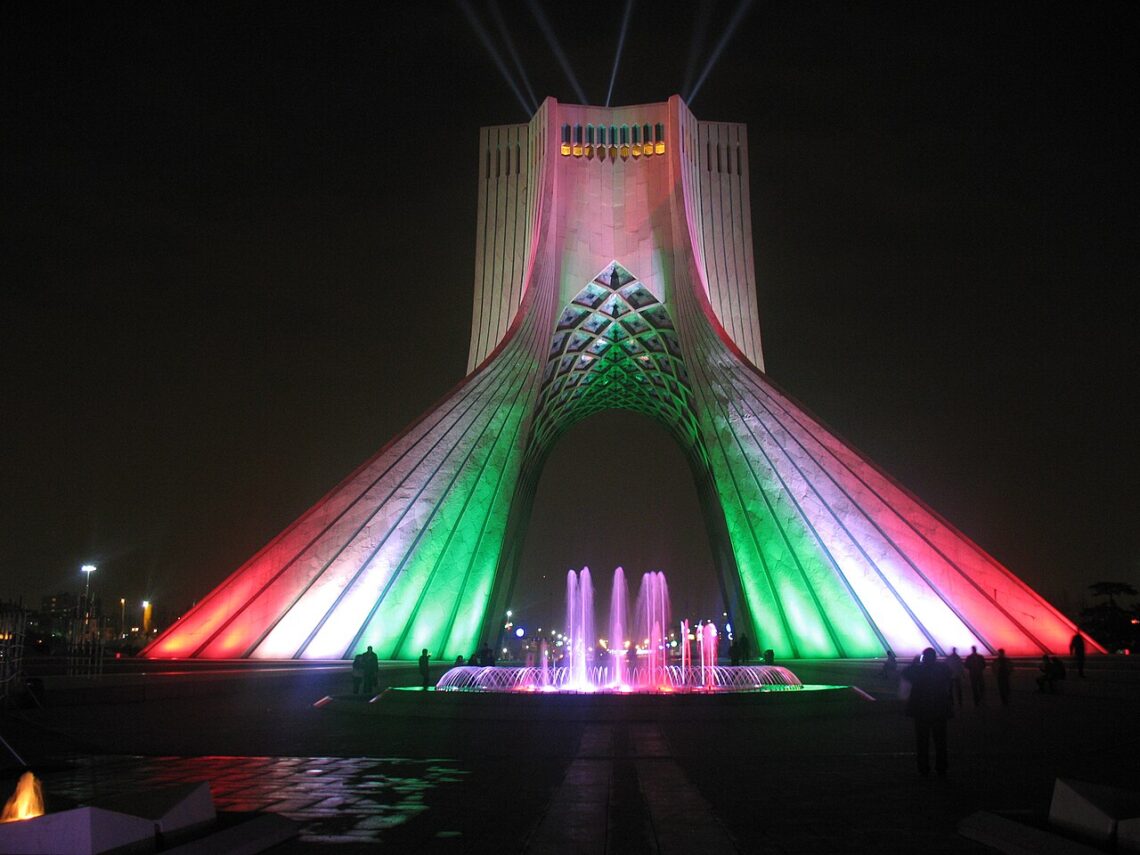
Hossein Amanat’s Shahyad monument, now known as Azadi Tower, makes the representational ambition especially visible. Amanat won the design competition in 1966, and the completed monument became a major symbol of Tehran. Its changing name and public associations demonstrate why architectural meaning cannot remain the exclusive property of its original commission. [6]
The archive image shows more than an isolated silhouette. The broad setting gives the tower distance, while the surrounding roads make it visible within the movement of the city. That is an architectural reading of the image, not proof that every visitor experienced the space in the same way. A monument can be visually accessible while its immediate surroundings impose different practical conditions on pedestrians.
Kamran Diba’s work offers another entry into the period’s architectural ambitions. Shushtar New Town, documented by the Aga Khan Award for Architecture, places housing and urban organisation at the centre of the discussion. The project received the award in 1986, showing how recognition and architectural afterlives can cross the political boundary of 1979. [7]
The contrast is useful without turning either project into a caricature. The emblem asks how a collective identity becomes visible. The neighbourhood asks how people can inhabit a spatial order. Architects need both representational judgement and practical attention, but success in one does not establish success in the other. A powerful silhouette is not evidence of comfortable daily movement; a familiar courtyard is not evidence of social inclusion.
The carpet was also an economic institution
Martin Rudner’s study of the Persian carpet industry between 1925 and 1945 connects changes in carpet production with state centralisation, modernisation and the emergence of new administrative and managerial groups. The carpet belongs to this history as an object of design, trade and changing domestic demand, not simply as an inherited craft surviving outside modernity. [8]
This shifts attention from the motif to the conditions of making. A design reaches the floor through labour, materials, quality expectations, distribution and a buyer’s judgement. What appears timeless in a showroom may depend on very particular economic arrangements. Calling an object authentic does not explain who produced it or who had authority to change its design.
For interior designers, that distinction remains practical. Specifying a traditional carpet can support a living skill or merely reproduce a marketable appearance. The difference is not visible in a mood board. It requires questions about provenance, technique, repair and the maker’s scope for variation. Heritage becomes more credible when its producers retain agency, rather than being asked to manufacture an unchanging image of themselves.
Graphic design made social hierarchy visible
Graphic design connected artistic experimentation with publishing, cultural institutions and commercial circulation. Morteza Momayez, Farshid Mesghali and Ghobad Shiva are important names in the development of Iranian visual communication. Their work belongs to a broader field in which the poster could promote a product, establish an institution’s voice or offer a distinctive interpretation of a film.
A recent study by Sara Sadeghi Nia and Mitra Alavi Talab examines more than one hundred commercial cinema posters from the 1960s and 1970s. Their analysis identifies gendered patterns in the representation of women, including sexualisation and marginalisation within male-centred narratives. The finding concerns that corpus and analytical approach; it should not be extended to every Iranian poster or every designer’s practice. [9]
The architectural relevance is immediate. Graphic hierarchy allocates attention in much the same way that a prominent entrance or ceremonial axis does. Scale, position and framing tell the viewer who matters. A poster may appear stylistically modern while repeating a restrictive social order. Innovation in layout is therefore not sufficient evidence of innovation in representation.
Cinema opened a different window onto modern life
Iranian alternative cinema developed in dialogue with international film languages while attending to local everyday life. Golbarg Rekabtalaei argues for understanding its history on its own terms, rather than making every film merely a preliminary scene in the political revolution of 1979. [10]
Dariush Mehrjui, Bahram Beyzaie, Sohrab Shahid Saless, Amir Naderi and Parviz Kimiavi represent different approaches within this expanded cinematic field. Their inclusion in a shared history does not mean their films offered the same view of the village, the city or modernisation. Commercial cinema and alternative cinema also addressed different expectations while sharing parts of the wider production and exhibition environment.
Cinema matters to architectural history because it makes space unfold through duration. A building photograph can isolate a facade. A film can follow a person waiting, crossing a threshold, returning home or failing to find a place in the city. Such scenes do not substitute for surveys of actual living conditions, but they reveal how spatial experience becomes a subject of cultural interpretation.
Shiraz turned performance into a spatial question
The Shiraz Arts Festival ran from 1967 to 1977, bringing traditional and experimental practices into a programme that included Iranian artists and international participants. Robert Gluck documents its role in presenting avant-garde performance and electronic music, as well as the interrupted plans for further institutional development. His account also recognises a legacy carried by younger artists. [11]
Iannis Xenakis, John Cage, Karlheinz Stockhausen, Peter Brook and Merce Cunningham were among the international figures associated with the festival. Their presence should not eclipse Iranian practitioners or the wider range of traditions presented there. Hormoz Farhat’s account stresses Persian music, ta'ziyeh and participation from Asian and African countries alongside Western work. [12]
For architecture, the festival raises a question that exceeds stylistic borrowing: what happens when a setting becomes an instrument of performance? Distance, light, sound and the movement of spectators can temporarily reorganise a place. This is an analytical implication of performance, not a claim that every festival production used space identically. The event produces a temporary public, while its funding and access determine who can participate.
Patronage is neither innocence nor total control
The monarchy’s cultural institutions enabled education, commissions, exhibitions and international contact. They also operated within a political order that constrained expression. A serious assessment has to retain both facts without turning them into a formula that explains every artist’s position.
Shawhin Roudbari’s research on Iranian architects shows why professional institutions and transnational networks deserve attention alongside the state. His account examines how architects pursue professional power through mobility, publications, competitions and institutional activity. It complicates the assumption that architectural culture is simply transmitted downwards from government. [13]
The relevant contemporary question is how an institution can support work without requiring every result to confirm its own image. A commission that permits technical experimentation but excludes uncomfortable subjects offers a particular kind of freedom. A gallery with varied funding, an independent editorial programme and durable archives may create different conditions. These are institutional design questions, not judgements that can be read directly from a work’s formal appearance.
What survived the political rupture?
The revolution transformed patronage, public symbolism and professional opportunities. Some institutions ended, some practitioners emigrated, and others continued under changed conditions. It would nevertheless be inaccurate to say that an entire artistic culture vanished or that all its participants followed the same trajectory.
Buildings remained in use, skills moved between generations, works circulated and earlier practices acquired new interpretations. A change of name could alter a monument’s official meaning without removing its physical presence. An artist’s migration could interrupt a local network while extending another. Continuity and rupture can therefore coexist within the same career, institution or object.
For historians and designers alike, the better unit of analysis is often the specific practice: a teaching method, a workshop, a publication, a building or a body of work. These reveal what endured more precisely than a sweeping verdict about a golden age or a total collapse.
Identity is the capacity to keep making
The enduring achievement of this period was not the discovery of a final Iranian style. It was the multiplication of ways in which Iranian artists and designers could argue with inherited forms and international practices. Its tensions are part of that achievement, not an inconvenience to be edited out.
The useful test for a cultural project today is consequently broader than resemblance. Does it sustain skilled work? Does it create places for discussion? Can its users appropriate it? Can its institutions tolerate interpretations that exceed the original brief? Does its archive preserve disagreement as carefully as success?
The tower, the carpet, the painting and the poster become most revealing when considered together. Each makes identity visible, but each depends on an organisation of labour, authority and attention. A culture becomes modern not when it acquires a recognisable image of itself, but when it develops the capacity to remake that image without losing the people and practices that give it substance.
Sources
- Akhgar, Peyman. “Beaux-Arts System and Professionalisation of Architectural Education in Twentieth-Century Iran.” The Journal of Architecture, 29(7–8), 1110–1136. Published online 2025. DOI: 10.1080/13602365.2025.2485101.
- Bombardier, Alice. “L’essor d’une avant-garde picturale dans les années 1940 en Iran : premières galeries, associations et revues d’art.” Asiatische Studien – Études Asiatiques, 70(4), 2016, 1159–1178. DOI: 10.1515/asia-2016-0032.
- Keshmirshekan, Hamid. “Neo-Traditionalism and Modern Iranian Painting: The Saqqa-Khaneh School in the 1960s.” Iranian Studies, 38(4), 2005, 607–630. DOI: 10.1080/00210860500338408.
- Rooney, Julia, and Maryam Ekhtiar. “Artists of the Saqqakhana Movement.” The Metropolitan Museum of Art, 2014.
- Moussavi-Aghdam, Combiz. “Art History, ‘National Art’ and Iranian Intellectuals in the 1960s.” British Journal of Middle Eastern Studies, 41(1), 2014, 132–150. DOI: 10.1080/13530194.2014.878511.
- Stanford Humanities Center. “Memorializing Ancient Persia and the Modern Iran Shahyad (now Azadi) Monument: Its History and Its Meaning.” Event record featuring Hossein Amanat, 2015.
- Aga Khan Award for Architecture. “Shushtar New Town.” Project record, DAZ Architects, Planners, and Engineers / Kamran Diba. Award cycle 1984–1986.
- Rudner, Martin. “The Modernization of Iran and the Development of the Persian Carpet Industry: The Neo-Classical Era in the Persian Carpet Industry, 1925–45.” Iranian Studies, 44(1), 2011, 49–76. DOI: 10.1080/00210862.2011.524491.
- Sadeghi Nia, Sara, and Mitra Alavi Talab. “The Discourse Order of the Image of Women in Iranian Movie Posters in the 1960s and 1970s.” Cultural and Social History, 22(5), 2025, 701–726. DOI: 10.1080/14780038.2025.2562613.
- Rekabtalaei, Golbarg. “Cinematic Revolution: Cosmopolitan Alter-Cinema of Pre-Revolutionary Iran.” Iranian Studies, 48(4), 2015, 567–589. DOI: 10.1080/00210862.2014.895539.
- Gluck, Robert. “The Shiraz Arts Festival: Western Avant-Garde Arts in 1970s Iran.” Leonardo, 40(1), 2007, 20–28. DOI: 10.1162/leon.2007.40.1.20.
- Farhat, Hormoz. “Shiraz Arts Festival.” Encyclopaedia Iranica, 2015.
- Roudbari, Shawhin. “Renegade Cosmopolitans: Iranian Architects, Professional Power, and the State.” Iranian Studies, 51(6), 2018, 905–930. DOI: 10.1080/00210862.2018.1539620.

