SE House: Restraining Tropical Openness

Departure from the Open Tropical Model
Most homes in tropical environments tend to rely on visual and spatial openness, such as floor-to-ceiling glass façades and terraces surrounding the building. As a result, this approach has become so widespread that it is now close to a fixed Design formula. In this context, the SE House emerges as a design case that deliberately moves away from this general direction, making it notable in terms of concept rather than form.
Internal Organization Around the Central Courtyard
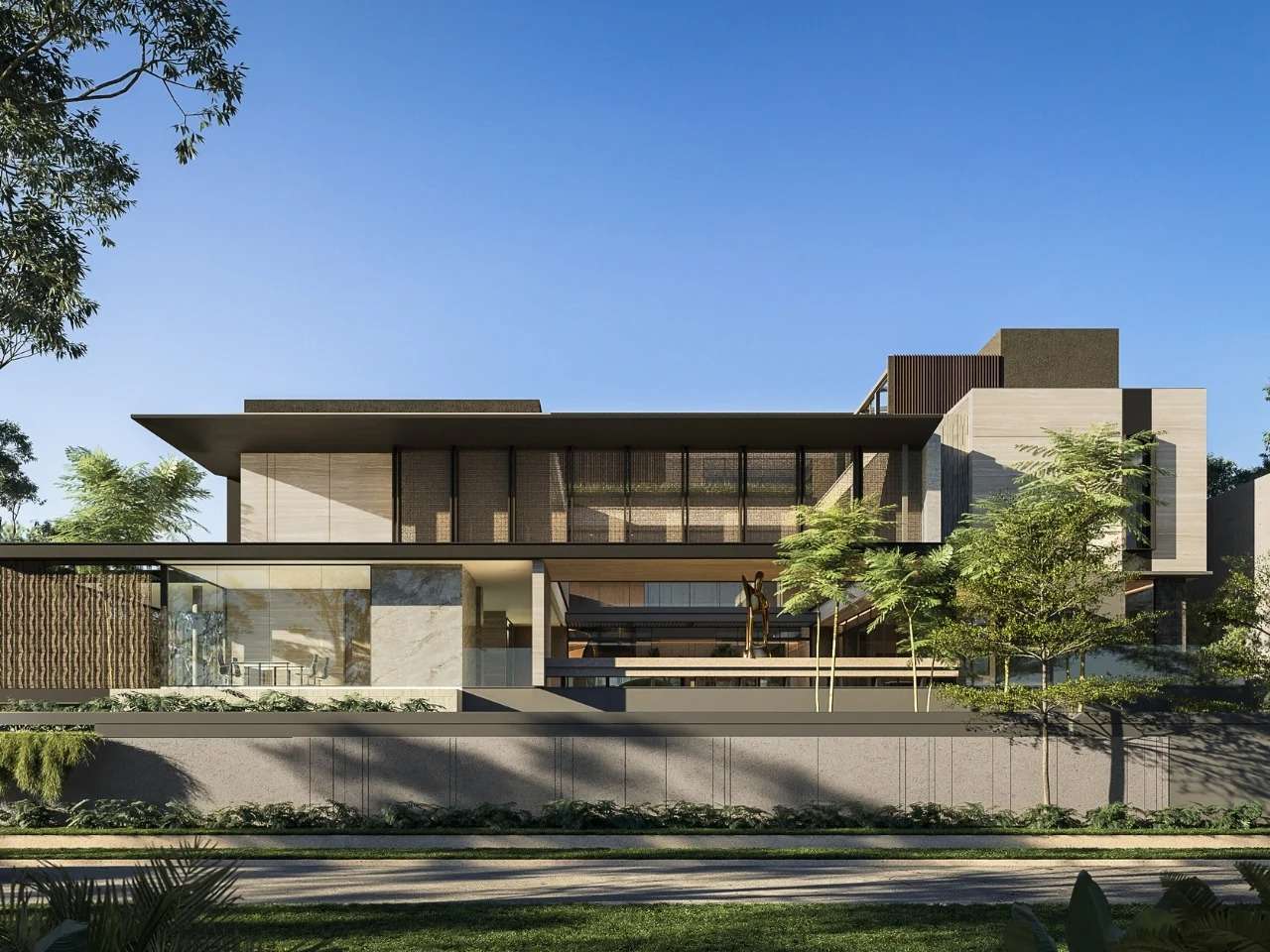
SE House, designed by architect Giovanni Gunawan of the Surabaya-based studio KantorGG, is organized around a central internal courtyard. Instead of full openness to the outside, movement and spatial arrangements are directed inward while still maintaining natural airflow. In this way, the courtyard becomes an organizing element of spatial experience rather than just an additional void, a principle often discussed in Architecture.
Intentional Voids and Reframing Tropical Living
The project introduces dry gardens and empty spaces between architectural masses, using these voids as deliberate design elements rather than the result of arbitrary distribution. This allows an experience of outdoor air within a more controlled interior environment. Through this approach, the project raises questions about the quality of living in tropical climates, particularly regarding the gap between architectural image and the actual readiness of these environments for daily use. For more on similar topics, visit the Archive.


Engaging the Site as a Found Design Condition
KantorGG’s design approach is grounded in the idea of “living with nature, both inside and outside,” and SE House appears as a practical realization of this concept. Rather than removing mature trees to reshape the site, they are preserved within the overall composition. This decision limits certain architectural options, but in return integrates natural elements as part of the spatial organization from the very beginning, a method explored in various Projects.
Integrating Natural Elements into the Lived Experience
Existing trees and filtered shade become active components in shaping spatial conditions, such as seating areas and semi-outdoor circulation paths. As a result, the spatial experience becomes directly tied to the presence of fixed natural elements that cannot be replaced or added later after construction is completed. This makes the relationship between building and site foundational rather than secondary, highlighting the importance of Buildings that respect their environment.
Cultural Intersections in Shaping Architectural Language
The project also reflects educational influences from Australian Architecture in the work of Giovanni Gunawan, although these influences appear within a local context without turning into direct replication of models. Instead, these references are reinterpreted within a design language rooted in the Indonesian context, resulting in a multi-referential architectural composition without exclusive alignment to a single direction.


Courtyard Organization as a 360-Degree Perceptual System
The 360-degree courtyard organization in SE House creates a condition in which no single view dominates the overall composition, and no façade is given visual priority. As a result, all rooms relate to a single central void as a primary reference point, transforming the relationship between interior and exterior into a continuous negotiation rather than orientation toward a single framed view. This approach is reminiscent of Interior Design strategies that focus on central voids.
Reducing Image Centrality in Favor of Lived Experience
This organization prevents architecture from becoming a purely image-driven composition based on views or snapshots, redirecting attention toward how space is actually used. Consequently, spatial experience becomes more closely tied to daily movement within the house rather than its visual perception from fixed points, reducing its “formalist conceptual” character in favor of use. The Construction techniques employed here support this philosophy.
Critical Reception Based on Quietness Rather Than Spectacle
Although the project has received attention similar to buildings with strong formal ambition, it does not rely on immediate visual impact or expressive presence. Instead, it presents itself as a quiet-performing mass, closer to a “low-volume architectural statement” on tropical living. In this sense, its impact is not derived from expressive intensity, but from the continuity of experience and its everyday livability. Stay updated with similar discussions via Top News.


Constraint as a Tool for Producing Spatial Richness
SE House proposes a broader argument that constraint in design does not contradict spatial richness, but can actually be one of its tools. The absence of visual noise does not imply negative emptiness; rather, it points to a constructed and intentional void that functions as a structural element within the composition. In this sense, voids become essential parts of the design, helping to highlight and balance other elements rather than reducing them. Detailed Material Datasheets can reveal how such voids are constructed.
Design Logic Rather Than Architectural Image
The project does not rely on a single striking visual image, but on a clear organizational logic governing the relationship between spaces and architectural elements. Therefore, its value is not read through a single snapshot or façade, but through the way the entire composition is structured. This gives it a presence based on gradual understanding rather than instant impression. Explore related Research for deeper insights.
Reconsidering Directions of Spatial Openness
This type of project encourages a rethinking of excessive openness in residential architecture. Instead of constantly pursuing outward visual expansion, the house proposes inward orientation as a complete organizational strategy. In this way, its impact extends beyond architecture itself to influence how everyday spaces are conceived and shaped over time.


✦ ArchUp Editorial Insight
SE House operates less as a design project and more as an organizational outcome resulting from the intersection of climatic constraints, real estate market pressure, and risk-reduction logic in tropical housing development. The model of open glass façades does not appear as an aesthetic choice as much as a repeated alignment between market expectations of spatial transparency, thermal performance protocols, and differentiation strategies in real estate production. Within this context, the internal courtyard is not a formal deviation but a redistribution of environmental control mechanisms, where ventilation, shade, and vegetation preservation become embedded mitigation systems within the spatial structure. The preservation of existing trees and the reuse of spatial voids reflect a negotiation with site capital as a pre-existing condition, transforming environmental stability into a functional organizational solution. What appears as formal restraint is, at its core, a redistribution of operational risks between visual expression, comfort, and maintenance cost within the housing production chain. For professionals, Architectural Jobs and the Architects Lobby provide platforms to discuss such innovations.