The Word Belongs to the Owner

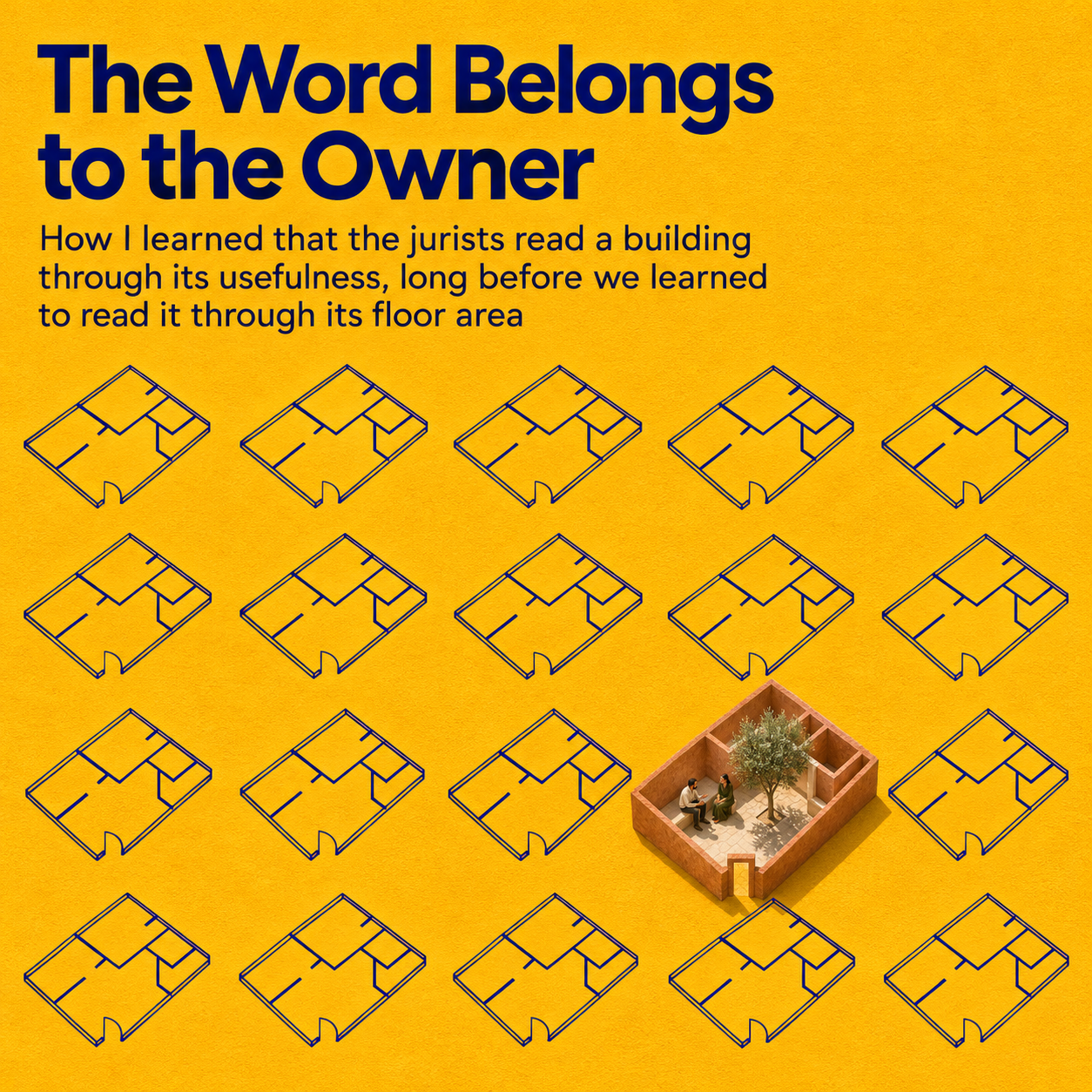
How I learned that the jurists read a building through its usefulness, long before we learned to read it through its floor area
At an earlier stage of my working life I found myself entangled in the world of arbitration and legal disputes, and it was not the part of practicing architecture I loved. Architecture, for me, usually begins with an idea, then becomes a drawing, then becomes a building. In arbitration you begin at the end. There is a building already standing, a contract already signed, money already paid, and two parties each convinced the other has wronged them, and your task is to read what happened, not to design something new but to discover where the old thing broke down. That world was tedious at times, a procession of briefs and pleadings and documents and objections, long legal sentences you could read three times without understanding why the author did not reduce them to two lines. Yet I left it with a knowledge I never expected would serve me, as an architect, so deeply.
Among the books I returned to in that period was the great jurist Ibn Qudama’s work of Islamic jurisprudence, and in particular its chapter on leasing. I read that chapter in full in the year 2015, then returned to it two or three times while reviewing matters tied to tenancy and arbitration disputes, until a kind of familiarity grew between us. Because roughly eleven years have passed since that first reading, I have gone back now to a number of its sections, not because I wish to play the jurist, but because some of the ideas I kept from that reading deserve to be lifted off the shelves of law and looked at again inside the building. As long as the dispute concerns real property, and as long as that property is a building, and as long as someone, one day, designed that building, then welcome to my field.
You are not renting the walls
The most important thing that stayed with me from the chapter on leasing is an idea that seems utterly simple. Usefulness. When you rent a house you are not buying the walls, when you rent an office you are not buying the columns, when you rent a shop you are not buying the floor and the glass and the door. You are paying for a usefulness you can draw from this place over a defined period of time. And that is an enormous distinction, because a building can exist physically while being incapable of performing the purpose for which it was rented. It may have four walls and a roof and a door and still not be fit to live in, it may have a beautiful glass façade and still not be fit for the agreed commercial activity, and in both cases the image is not enough to prove that the usefulness exists.
Here I found that the jurists treated real property with a striking functional clarity. The leased thing matters not because it exists, but because it is fit for the intended use. That is a sentence every architect should write on the wall of the studio, because we have grown used to describing a building by what we see in it, by its area and its material and its elevation, while those who came before us described it by what can be done in it. We read the building from the outside inward. They read it from its purpose down to its stone.
Ibn Qudama and the roof that fell
Among the cases the jurist presents in the chapter on leasing is that of a house that collapses, or land that floods, or a water source that is cut off. The issue is not that the property lost its beauty, nor that the finishes grew old, but that a defect struck the leased thing and so affected the usefulness on which the contract was founded. Here the jurisprudence distinguishes between situations. If the intended usefulness disappears entirely, the lease may be dissolved, and if a partial usefulness remains, other options may arise, including dissolution or retention with allowance made for the reduced usefulness, according to the juristic detail and the circumstances of the case at hand.
Indeed Ibn Qudama goes further, and discusses the possibility that a different use of the place survives. If the house collapsed and its land remained fit to store firewood, is that enough to continue a contract of residence? Not necessarily, because the man did not rent the land to store firewood on it, he rented it to live. And this single point deserves the pause of every architect and every property investor, because it says that not every possible use of a building is the usefulness the two parties agreed upon. The building may remain standing while the contract loses its purpose, the area may stay exactly as it is on the deed and the drawings while its use value changes at the root. The area is fixed on paper, but usefulness is a living thing that can die while the walls still stand.
Today I do not want a palace with no electricity
Let us step for a moment out of the sixth century of the Islamic calendar and into a contemporary building. Suppose I rented an office inside a modern tower, excellent façades, marble, elevators, parking, a beautiful lobby, and then I entered the office and discovered that the electricity was not available in the manner the agreed activity required. How am I to work? Where are the computers? Where is the network? Where is the air conditioning? Where is the lighting? The same could happen with water, or safety systems, or licensing, or access to the property, depending on the nature of the activity and the agreed terms. These are not cosmetic details. They are parts of the usefulness itself.
But we must be precise, because not every passing interruption of a service is grounds for cancelling the whole rent, just as the landlord’s responsibility cannot be settled without looking at the contract, the cause, the duration, the harm and the applicable legal framework. What matters to me as an architect is the idea that precedes all of this detail, that a building does not become fit for lease merely because its construction is finished, but becomes fit when it can perform the agreed usefulness. This is the difference between the certificate of completion and real completion. The first is a paper that says the building is finished, the second is a condition that says the building has become capable of being lived.
You leased me the usefulness, not the profit
Here we reach the other face of the equation, a face the tenant forgets as surely as the owner forgets the first. Suppose I rented a shop, signed the contract, took possession, found it fit for the agreed purpose, and was able to make use of it, then opened my store, and sold nothing. No customer, no revenue, no profit. Do I return to the owner and say I will not pay the rent because my trade failed? In principle that is not enough, because the owner, in an ordinary lease, did not sell me commercial success. He sold me the right to make use of the place, and he does not necessarily become a partner in the profits or losses of the activity.
Here Ibn Qudama establishes a meaning of great importance, that the rent becomes due once the tenant has obtained the usefulness, and may indeed become due simply upon being enabled to use it and the passing of the term without impediment, even if the place was not in fact used. This is one of the matters that explain why the concept of usefulness differs from the concept of profit. Making use is a contractual right, while economic success is another kind of risk, carried by the one who takes it. Of course the two parties may agree on a rent tied to revenue or to a share of profit, under the valid terms and the applicable system, but that is a different arrangement from the fixed lease we are discussing. The owner leased you the possibility, not the outcome, and between the possibility and the outcome stand your own will, the market and luck, and the wall is not asked to answer for what the merchant did not do.
The word belongs to the owner of the house
I return now to the phrase I chose as the title. In Ibn Qudama’s work there is a striking question. The owner says, in the sense of the text, I leased you the house for a year for a dinar, and the occupant replies that he did not rent it to live in, but was hired to guard it for a dinar. Here the jurist relays, on the authority of the Imam, that the word belongs to the owner of the house unless the occupant has proof. The matter is extremely delicate, because the two do not merely differ over an amount, they differ over the very nature of the relationship. Is this person a tenant drawing usefulness from the house, or a watchman working on the owner’s behalf? The building is one, the person is one, but the description of the relationship reverses the direction of the money, for in the first case the occupant may pay, and in the second he may be owed a wage for his work, and here the importance of proof and circumstance and the nature of the use appears.
But we should not read the phrase as a rule that makes the property owner the victor in every dispute, for when Ibn Qudama discusses the two parties differing over the amount of the rent itself, he presents another ruling founded on mutual oath, and details it according to the stage the contract has reached. This is why the title appealed to me, the word belongs to the owner, not as an absolute ruling in court, but as a doorway into the question we so often forget. Who owns the thing? Who owns the right to make use of it? And who can prove what the two parties agreed? The phrase is, on its surface, a victory for the owner, and in its depth a demand to free the question before freeing the verdict.
The believers are bound by their conditions
Then we come to contracts. In modern property practice, many problems arise not because the text is missing, but because one of the parties did not read it well, or read it and then assumed he could change the rules of the relationship after the use had begun. Take a simple example, a person who rented a residential unit and owns a pet. If there are clear, lawful and valid conditions in the contract regulating the presence of animals or certain uses of the property, those conditions enter into defining the permitted scope of use. The same holds for commercial activities, where a shop may be designated for a specific activity, and the contract may impose restrictions on changing the activity or on modifications or on the nature of use, within what the system permits.
But the landlord does not necessarily hold the right to impose any new condition during the term of the contract simply because he owns the property, for ownership is one thing and the contractual right of use is another. And in return, the lease does not grant the tenant an absolute authority to do as he pleases, for there are conditions, and limits of use, and obligations relating to safety and maintenance and not harming the thing or others. What matters is that this relationship be defined from the beginning, not that one wake every morning to a new interpretation of the contract. A contract is not a document to be signed and then forgotten, it is a map of the relationship, and whoever alters the map after people have walked it creates not a road but a wilderness.
Before the long contracts there was a word
Sometimes I think about the distance we have crossed between the old contracts and the contemporary ones. Today a single commercial lease may run to dozens of pages, annexes, drawings, schedules of area, operating requirements, service charges, insurance, maintenance clauses, breach scenarios and dispute resolution mechanisms. In earlier ages many contracts were concluded by offer and acceptance, spoken, once their conditions were met, and no digital file was required for two people to agree on a known usefulness for a known rent.
But the simplicity of the means of contracting does not mean that all relationships were simple, nor that disputes did not exist, and it is enough to open these old juristic works to see the scale of the questions the jurists faced. They differed over the amount of rent, they differed over the term, they differed over the type of work, the thing was damaged, the owner prevented the use, the water was cut off, the usefulness changed, then another question came, and another. And after centuries we are still arguing over matters very close to them. What has usually changed is the form of the document, while the human being is still perfectly capable of producing the same dispute. We have advanced the paper astonishingly, and left human nature exactly as it was.
Even the well was inside the account
Among the details I loved in the chapter on leasing is that the discussion was not confined to the house and the room, but ranged over the land, the crop, the well, the water, the animals, the crafts, and the use of things that may seem to us today far from the modern property economy. Yet when I read them as an architect I find them connected to a single idea, that the place does not work on its own. Agricultural land may need water to achieve its purpose, a house may need what is necessary for habitation, and a well may be an independent usefulness defined by a contract.
Here the discipline of architecture enters the relationship, because the design of a property does not stop at the edge of its walls, but extends to the systems of water and power and access and services and maintenance. These elements are no longer mere engineering requirements, they may be essential conditions for achieving the usefulness on which the property investment rests. The old jurist who placed the well inside the account was saying, in his language, what we say today in the language of systems, that usefulness is an apparatus and not a wall, and that the building whose water or power or route is cut off loses more of its value than it would lose if its marble cracked. The construction is the visible thing, but the usefulness is the system that keeps the visible thing alive.
From David and Solomon to the ruined field
There is a verse that stayed present in my memory through those readings. It speaks of David and Solomon when they gave judgment concerning the field, when the sheep of certain people grazed in it by night, and of how understanding of the matter was granted to Solomon. This is not a property lease dispute at all, but a case of damage to a crop, treated in the works of interpretation in the context of assessing harm and compensating for it, and the accounts of interpretation mention that Solomon’s judgment turned toward enabling the owners of the field to take the benefit of the sheep for the period of restoring the crop, then returning each property to its owner once the state was restored.
What I admire here is the way of thinking about harm, for the question is not only who erred, but how the situation can be returned to what it was, and how the usefulness lost during the repair is to be handled. These questions are not far from our contemporary world, for in landscape projects, in commercial real estate, and in construction contracts, we constantly discuss restoring the state to what it was. But we should not transplant the ruling of an ancient incident directly onto a modern property dispute, for the value here is in the method that inspires the thinking, not in treating every incident as identical to another. What survives of Solomon’s judgment is not the ruling but the mind behind it, the mind that does not stop at fixing blame but asks after the road back.
The problem the designer does not know
There is a matter at which I want to pause. An architect may design an excellent building, obtain the approvals, finish the drawings, follow the execution and hand over the project, and then, years later, that building enters a tenancy dispute, not because of a collapse, nor because of a visible structural defect, but because the tenant could not achieve the usefulness he believed he was paying for. Perhaps because access to the premises became complicated, or because the operating systems were unsuitable, or because the area was not fit for the described activity, or because necessary services were not available as the obligations required. And here the building returns to the table of dispute, but this time the architect does not sit before it alone, the lawyer sits there, and the expert, and the accountant, and the valuer, and the arbitrator, and each of them tries to redefine the same thing, what was this building supposed to provide?
Here I sometimes feel that architecture enters the courtroom late, because it was present from the very beginning, in the design of the space, in the distribution of services, in the decisions that determined, in the first place, what could be done inside the property. The architect does not draw walls alone, he draws the boundaries of what will be said in a courtroom ten years later without knowing it. Every decision about access and light and ventilation and the path of a service is a silent clause in a contract not yet written.
The building that no one makes use of
Among the economic paradoxes that most interest me is that a property may hold a high capital value and yet fail to achieve a use value proportionate to it. A beautiful building, costly materials, an excellent location, and then you find its spaces unleased, or its tenants leaving it, or its operating costs devouring its revenue. Not necessarily because its design is poor, for the problem may lie in management or the market or the pricing or the nature of the tenants, but all of that returns us to the question of usefulness.
The one who buys the property buys an asset, and the one who rents it is seeking a usefulness, and between the asset and the usefulness lies a whole apparatus of architectural, operational and economic decisions. It is not enough for a property to be expensive for it to be useful, and it is not enough for it to be useful for it to become a successful investment, but the property investment that does not understand usefulness remains exposed to confusing the value of the building with the value of its use. And that confusion is the most expensive of errors, because it is an error committed in the moment of pride in the building, not in the moment of admitting its incapacity.
Who really owns the building?
There is a philosophical question I like to leave open. When a person rents a home for ten years, who owns the daily experience of the place? The owner owns the property, that is clear, but the tenant is the one who wakes in it, eats in it, receives his guests in it, arranges his furniture, and lives years of his life inside it. Legal ownership of the asset does not make the owner the owner of the life that happens inside it, and so the right of use is not a small detail within the property relationship, it is what grants the tenant a space of independence in using the place, within the limits of the contract and the system.
Here I see that the old jurisprudence offers us a distinction worth thinking through, architecturally, that owning the thing, and owning its usefulness for a defined period, are not the same. And how many a contemporary dispute began because one of the parties did not understand this difference, the owner imagining that his ownership of the stone was ownership of everything that happens within it, and the tenant imagining that his use of the place was possession of it. The truth is between them, that the stone belongs to one, and the life inside it to another, for a known period and for a known rent.
The word belongs to the usefulness
After roughly eleven years I returned to the chapter on leasing remembering the cases that first drove me to read it, and I was no longer searching for a wording to support one side of a quarrel, nor for a point to use in an arbitration brief. I was searching for something else, for the way those who came before us thought about the relationship between the human being, the place and money. And although the language of jurisprudence differs from the language of architecture, I found a clear intersection between them. We architects speak of function, and the jurists spoke of usefulness, we speak of fitness for use, and they examined the inability to obtain the usefulness, we speak of the systems of the building, and they discussed what happens if the water is cut off or the house collapses.
I do not say the jurists were architects, nor that works of jurisprudence are a substitute for modern legal and engineering systems, but I do say that the question of the useful building is far older than the terms we use today. And so I find in that old reading something worthy of respect, that the owner does not receive the rent merely because his name is written on the deed, without regard for the terms of the contract and the enabling of the usefulness, and the tenant cannot withhold the rent merely because he did not achieve the profit he imagined, if he was enabled to obtain the agreed usefulness and no other valid cause existed. And between these two parties stands the building, not always a silent witness, but sometimes the very subject of the whole dispute.
This is why I chose the title, the word belongs to the owner, a title carrying something of juristic memory and something of the language of the disputes I knew at an earlier stage. But after I closed the book and returned to my architectural work, I arrived at another thought. Ownership may belong to the owner of the property, the right of use may belong to the tenant, and the court may settle the dispute between them, but there is a third party that does not usually take part in the pleading, the building itself, for it is what determines, in the end, much of what a person can do inside it. And if the building is incapable of the purpose for which it was built or leased, no beautiful façade will save it, nor a high price, nor a long marketing description, because architecture, however much we exaggerate the talk of its beauty, remains obliged to one essential thing, to be useful.
Perhaps, after all these centuries of disputes and contracts and legislation, we still return to the same question. What did you buy when you paid the rent? The wall? Or the life that was supposed to happen behind it? And I suspect that the word, in the end, belongs neither to the owner alone nor to the tenant alone, but to the usefulness, the usefulness that, when present, settles the money in its place, and when absent, is replaced by no stone, no deed and no eloquence. The architecture news will keep celebrating the most expensive tower and the design competitions will keep rewarding the most striking façade, while the quieter measure, the real sustainability of any building and the deepest test of all the architectural research we undertake, remains whether the place can still do what it was built to do, and the cities that forget this are filled with buildings that are admired and unused, costly and incapable, owned by everyone and useful to no one.
A note on method. This essay is an architectural and historical reading of questions of leasing, not a religious ruling nor a legal opinion on any specific dispute, and the application of these principles to contemporary contracts is subject to the law in force, the terms of the contract and the facts of each case.
✦ ArchUp Editorial Insight
The essay draws on classical Islamic jurisprudence, and its own careful method note — that this is an architectural and historical reading rather than a religious ruling or legal opinion, subject to the law in force and the facts of each case — is the correct editorial posture, because it lets the juristic material serve as a lens on building economics without being flattened into either doctrine or legal advice. Its governing insight is a reclassification with real structural force: that a lease transfers usefulness rather than walls, so a building can exist physically while being incapable of performing the purpose for which it was built, the area fixed on the deed while the use value dies with the walls still standing. This separates two things the contemporary field routinely conflates, the certificate of completion from real completion — the paper that says the building is finished against the condition that says it can be inhabited — which is precisely the gap this archive traced in A Building Becomes an Asset and The Shoeshine Problem, where a building reports itself finished and operational while failing at the level where a person actually uses it. The sharpest architectural observation is that usefulness is an apparatus and not a wall, that the old jurist who placed the well inside the account was saying in his language what we say in the language of systems, so a building whose water or power or route is cut loses more of its value than if its marble cracked — the same inversion of the visible-surface priority this archive reached in Marble Is Manufactured by Geology and The Economics of Ceilings. What makes the piece more than a legal curiosity is its recognition that the architect drafts silent clauses in a contract not yet written — every decision about access, light, ventilation, the path of a service becoming the boundary of what a tenant can later prove they were paying for — which connects to the temporal displacement this archive has documented throughout: the decision made at design stage by a party long exited materializes years later in a dispute the drawing already decided. The durable verdict, that the word belongs neither to owner nor tenant but to the usefulness, that no façade or price or marketing eloquence replaces a building’s capacity to do what it was built to do, is the same measure this archive has repeatedly set against the photogenic monument — the cities that forget it filling with buildings admired and unused, costly and incapable, owned by everyone and useful to no one.
Ibrahim Fawakherji — ArchUp