Bali’s Tri Hita Karana: Engineering Resilience Before the World Knew the Word “Sustainability”

Long before “sustainability” became a buzzword echoing through United Nations conferences and design studios, the Indonesian island of Bali had been practicing it for over a thousand years without giving it a modern name. The philosophy governing this practice is called Tri Hita Karana, a Sanskrit phrase literally meaning “three causes of well-being and happiness.” The philosophy rests on three interconnected pillars: Parahyangan, the harmonious relationship between humans and the Creator; Pawongan, the harmonious relationship between humans and their fellow humans; and Palemahan, the harmonious relationship between humans and the surrounding environment. These are not abstract religious injunctions but a complete operating system that governed the planning of villages, buildings, fields, and water sources across the island for centuries, making Bali one of the most resilient built environments in the face of crisis.
The Architectural Translation: How a Balinese Village Is Built
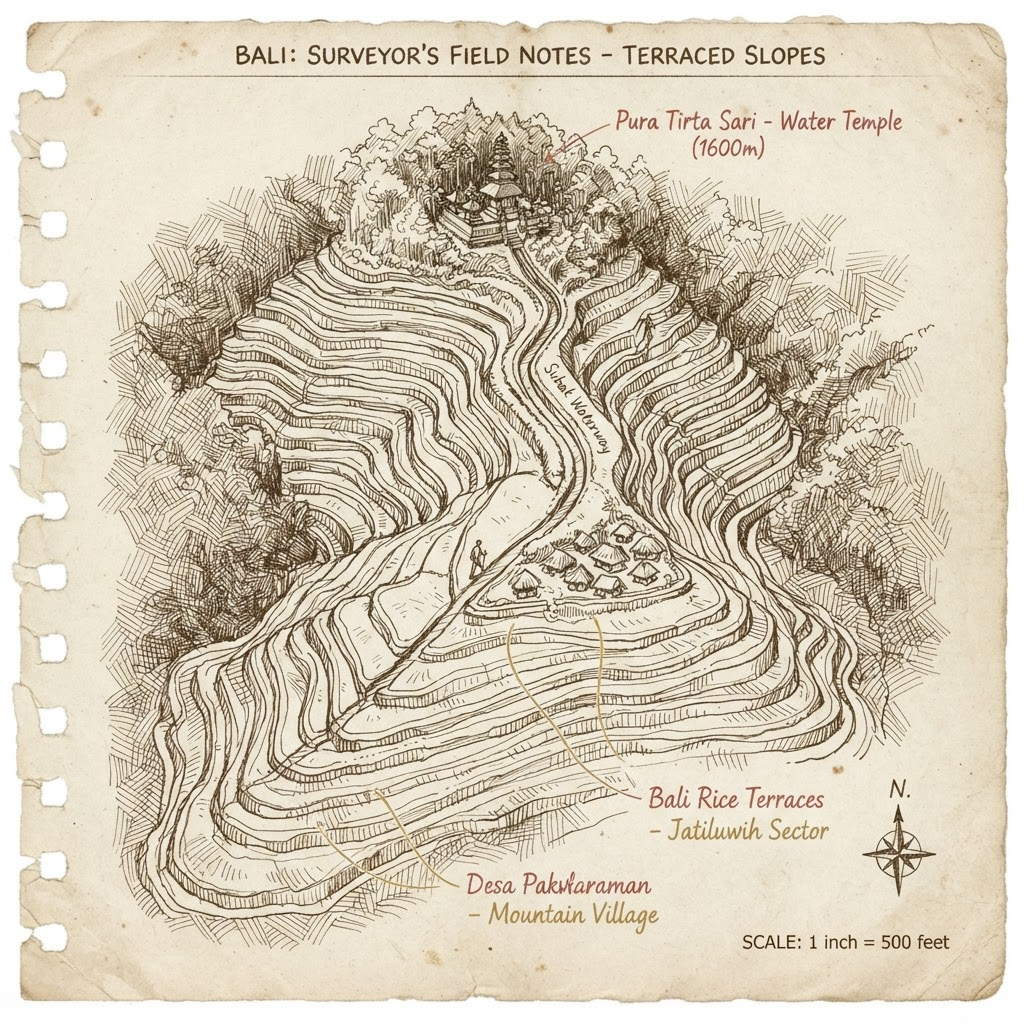
When a visitor walks through a traditional Balinese village, they are not looking at random buildings that grew over time, but at Tri Hita Karana translated into stone, brick, and wood. The traditional village is planned according to the Tri Mandala concept, which divides space into three sacred zones: the mountainward zone oriented toward kaja, where the temples stand; the middle zone for human habitation; and the seaward zone oriented toward kelod, reserved for cemeteries and mundane uses. This division is not merely aesthetic but an intelligent ecological system: temples are built in the highlands protected by forests that preserve rainwater, homes occupy the flood-safe middle ground, and agricultural land cascades along the terrain in a network of terraces connected to an integrated irrigation system.
Subak: The Oldest Democratic Irrigation Network in History
The most striking application of Tri Hita Karana is the Subak system, the rice farmers’ federation that has managed the island’s irrigation network for over a thousand years. Subak is not merely a water channel but an integrated socio-religious-agricultural institution: water is distributed from source to sea through a network of water temples lining the river, and every decision about planting schedules and water allocation is made collectively in meetings held under the umbrella of these temples. Asmiwyati and colleagues documented in a 2015 study how this system protected the rice terraces on the slopes of Mount Batukaru from environmental degradation for over a millennium, through a harmonious vertical arrangement of forests, temples, terraced fields, irrigation networks, and human settlements, each element playing its role in water conservation, erosion control, and nutrient cycling. When drought intensifies, the water temple network regulates fair distribution from upstream to downstream; when water grows scarce, farmers shift to transitional crops that need less water. Resilience here is not a reaction to crisis but a property embedded in the system’s design itself.
When Faith Becomes a Planning Rule: Sacred Forests and Awig-Awig Ordinances
At the level of natural resource management, Tri Hita Karana operates as an effective conservation mechanism through quasi-legal instruments. In the Balinese village of Tigawasa, researchers Wanadjaja and Samputra documented in a 2021 study how the community protects its forests through four pillars: treating the forest as a temple without walls, called pura mretiwi; holding regular religious ceremonies within it; transmitting beliefs that forbid cutting its trees because it is a sacred forest, or alas tenget; and finally the awig-awig rules, traditional ordinances carrying binding force within the community. The practical result is that most of Bali’s forests remained preserved for centuries while their counterparts on other islands vanished. What is striking is that these instruments were never designed as environmental policy in the modern sense; they grew from an understanding that humans are but one link in a larger chain, and that harming nature is a direct offense against the divine order that grants life its stability.
Green Buildings Before the Age of Green Certificates
When the global hospitality industry attempted to import the “green building” concept to Bali, it discovered that locals already possessed an indigenous system ready for comparison. Kristinayanti and colleagues’ 2020 study of hotels in Badung Regency measured the impact of applying green building environmental management standards on the three dimensions of Tri Hita Karana, finding that the environmental aspect of green buildings influences the Palemahan pillar by 75.3%, while the impact on Pawongan reaches only 20.2% and on Parahyangan a mere 5.1%. The numbers reveal that the contemporary application of international standards serves the philosophy’s environmental dimension strongly but leaves the social and spiritual dimensions nearly untouched, opening a wide door for designing more complete sustainable buildings that combine the efficiency of international certifications with the depth of local philosophy.
Social Resilience: When Crisis Turns Community into a Safety Net
The value of any philosophy is tested in moments of hardship, and Bali faced this test twice in painful succession: the bombings of 2002 and 2005 that froze the tourism industry forming the island’s economic lifeline. Researcher Yvette Gurtner traced in a 2016 longitudinal study how Balinese society coped with the sudden economic collapse, finding that families lost their income sources but did not break, because collective kinship networks rooted in Hindu belief operated as a social safety net absorbing the shock. The most significant observation is that participation in religious rituals and ceremonies rose during the crisis to become the primary coping mechanism for those affected, what researchers call “inherent resilience.” Local organizations such as Parum Samigita and the IDEP Foundation moved from material aid to capacity-building programs in education, health, sanitation, and poverty alleviation, transforming crisis into an opportunity to rebuild social capital.
Economic Resilience: Ethics Before Profit
In the villages of the Bali Aga, the ancient indigenous communities of the island’s highlands, Hartawan and Utama documented in 2018 an economic model that defies prevailing capitalist logic. These residents do not separate economics from ethics: the values of karma yoga, the work ethic; tri kaya parisuda, the purity of thought, word, and deed; and artha sastra, wealth management, are embedded directly into production, distribution, and consumption activities. The result is a local economic system based on labor intensity, targeting the satisfaction of basic needs of food, shelter, and clothing; giving priority to local labor and local raw materials at competitive prices; and recycling profits within the village rather than letting them leak outward. The study concluded with a clear finding: the stronger the Hindu economic ethic, the stronger the economic resilience grounded in Tri Hita Karana.
The Other Side of the Coin: When Philosophy Becomes a Political Slogan
Every intellectual system has a dark side when exploited, and Tri Hita Karana has faced this test too. Researchers Roth and Sedana offered a bold academic critique in 2015, documenting how the philosophy is sometimes used as an ideological and political instrument more than a genuine practice. Their analysis reveals that Tri Hita Karana in its circulating form today is an “invented tradition” formulated in the 1960s by a local religious organization, later transformed into official discourse adopted by government policies. The danger is that this usage obscures real conflicts over land, water, and unequal resource distribution, presenting a fake idealized image of a “harmonious culture” that covers structural fragility within society. When the philosophy becomes a slogan raised at conferences while agricultural land is sold to property developers, it loses its capacity to build genuine resilience and turns into a mask hiding weakness rather than treating it.
A Mountain of Challenges: Mass Tourism, Modernization, and Generational Rupture
Contemporary challenges press on the philosophy from three directions. First, mass tourism, which brought prosperity also brought serious environmental pollution and pressure on agricultural land converting year after year into hotels and resorts. Gurtner documented how excessive dependence on tourism, constituting up to 80% of the island’s income, led to serious environmental strain: saltwater intrusion into groundwater layers, falling water tables, and the conversion of thousands of hectares of rice fields annually. Second, generational rupture: Surata and Vipriyanti’s 2017 study covering 718 participants — teachers, student teachers, and students — revealed that 96% of students do not want to become farmers, citing the profession’s stigma, unstable income, and the conversion of farmland into tourist zones, and that their knowledge of the Subak system and its governing philosophy is limited despite positive attitudes toward its preservation. Third, the risk of hollowing into an empty slogan: Wulandari and Mahagangga observed in 2021 that the philosophy is frequently used in contemporary life as a “mask for material interests” rather than actual practice, and that its values have begun eroding in the daily life of modern Balinese society.
Place-Based Education: The Bridge to the Future
The most mature response to these challenges came from the place-based education movement, which sees the Subak cultural landscape as a living educational laboratory. Instead of teaching sustainability from abstract textbooks, students are taken to the terraced fields and water temples to witness with their own eyes how the balance among the three pillars works. Teachers themselves need training in this kind of education, because the knowledge gap is not limited to students. This pedagogical approach invests in the fact that knowledge rooted in a tangible place is more durable than abstract information, building a new generation that sees in its heritage not a past to contemplate but a future to build. Researchers see in this model a practical answer to a disturbing question: how does a thousand-year-old philosophy pass to a generation living in the smartphone era without losing its essence?
From Bali to the World: What Do Designers and Planners Learn?
The deepest lesson from Bali’s experience goes beyond the island itself to a question of contemporary design: can genuine resilience be built without an ethical and spiritual dimension? While global cities race toward expensive technical solutions to confront climate change and disasters, Bali offers evidence that resilience flows from connecting people to their place, to each other, and to something greater than themselves. Kenney and colleagues affirmed in a 2023 chapter in the “Disaster Risk Reduction for Resilience” series that indigenous, traditional-knowledge-based approaches must be integrated into global policy frameworks like the Sendai Framework for Disaster Risk Reduction, not treated as cultural nostalgia. The Balinese philosophy offers a reference model: holistic, multidimensional resilience, with roles distributed among the three pillars so each covers one type of resilience, all cooperating in building a social-ecological system capable of absorbing, adapting, and recovering.
Conclusion: Philosophy as Invisible Infrastructure
In the end, Tri Hita Karana remains a testament that the greatest infrastructures are not built with reinforced concrete but with shared meanings connecting humans to what is greater than them: to the Creator, to people, and to the land. The island that withstood terrorism, pandemic, and tourism pressure did not stand because its buildings were stronger, but because its philosophy was deeper than any crisis. The real challenge today is not preserving the philosophy as a preserved text but reviving it as a living practice capable of adapting to an economic and social reality radically different from the one it was born in. Perhaps this is the hardest test: to remain faithful to the spirit of a place while rebuilding it.
✦ ArchUp Editorial Insight
Bali’s experience reads like a pre-existing answer to questions not yet asked. The philosophy examined in this research predates the global sustainability discourse by centuries, yet it does not rest on historical precedence alone — it challenges it. The global discourse divides sustainability into economy, society, and environment, while Tri Hita Karana adds a fourth pillar absent from all modern frameworks: the spiritual dimension that grants commitment the binding force of religious obligation. When researchers compared the philosophy to the famous triple bottom line model in business management, they found the latter lacks this ethical lever that makes forest preservation not regulatory compliance but worship.
Deeper still, resilience in the Balinese model is not a technical property to be purchased and installed but a byproduct of profound social design. The water temple network managing the Subak system resembles a decentralized distribution algorithm predating modern network science: each node makes decisions locally and harmonizes with the whole without a single control center. When tourism collapsed after the 2002 bombings, society needed no centralized emergency plan because kinship networks and rituals were the emergency plan, operating automatically like a natural cooling system for social crises.
Yet academic fairness demands reading the critical face too. The philosophy itself can become a tool of soft repression when used to embellish an unequal developmental reality, and the “invented tradition” Roth and Sedana warned about reminds us that the sacred is as deployable politically as it is venerable. The message for architects and planners is not to replicate temples and terraced fields but to grasp the deeper principle: architectural and urban resilience succeeds when it first succeeds as a meaning system that makes people defend their place because they see in it an extension of themselves. Here the oldest philosophy meets the newest design tools: a city protected by its residents’ awareness is cheaper and tougher than any city protected by steel alone.
References:
- Wulandari IGAA, Mahagangga GAO. Tri Hita Karana In Bali Arts Festival. IOP Conference Series: Earth and Environmental Science. 2021;724(1):012100. DOI: 10.1088/1755-1315/724/1/012100
- Wanadjaja TL, Samputra PL. Examining tri hita karana as the critic to the triple bottom line of sustainable development. IOP Conference Series: Earth and Environmental Science. 2021;716(1):012121. DOI: 10.1088/1755-1315/716/1/012121
- Roth D, Sedana G. Reframing Tri Hita Karana: From ‘Balinese Culture’ to Politics. The Asia Pacific Journal of Anthropology. 2015;16(2):157-175. DOI: 10.1080/14442213.2014.994674
- Asmiwyati IGAAR, Mahendra MS, Arifin NHS, Ichinose T. Recognizing Indigenous Knowledge on Agricultural Landscape in Bali for Micro Climate and Environment Control. Procedia Environmental Sciences. 2015;28:623-629. DOI: 10.1016/j.proenv.2015.07.073
- Dharma Hartawan IGM, Suyana Utama IM. Ketahanan Ekonomi Masyarakat Bali Aga Kecamatan Banjar Kabupaten Buleleng. Buletin Studi Ekonomi. 2019:283. DOI: 10.24843/bse.2018.v23.i02.p10
- Kristinayanti WS, Mas Pertiwi IGAI, Santiana MA, Aryawan IGMO. Tri Hita Karana-based green environment building management model. Journal of Physics: Conference Series. 2020;1450(1):012024. DOI: 10.1088/1742-6596/1450/1/012024
- Rosilawati Y, Mulawarman K, Sofyan N, Mulyantari E. The role of local Balinese culture amongst sustainable communities in preservation efforts of Ayung River. International Journal of Sustainable Society. 2020;12(2):93. DOI: 10.1504/ijssoc.2020.107895
- Gurtner Y. Returning to paradise: Investigating issues of tourism crisis and disaster recovery on the island of Bali. Journal of Hospitality and Tourism Management. 2016;28:11-19. DOI: 10.1016/j.jhtm.2016.04.007
- Surata SPK, Vipriyanti NU. The subak cultural landscape as environmental education: Knowledge, attitudes, and experiences of Balinese teachers, student teachers, and students. The Journal of Environmental Education. 2017;49(1):59-70. DOI: 10.1080/00958964.2017.1406890
- Kenney C, Phibbs S, Meo-Sewabu L, et al. Indigenous Approaches to Disaster Risk Reduction, Community Sustainability, and Climate Change Resilience. In: Disaster Risk Reduction for Resilience. Springer International Publishing; 2023:37-59. DOI: 10.1007/978-3-031-22112-5_2