Why Cooking Odour Follows Clothes: From Textile Sorption to Kitchen Planning

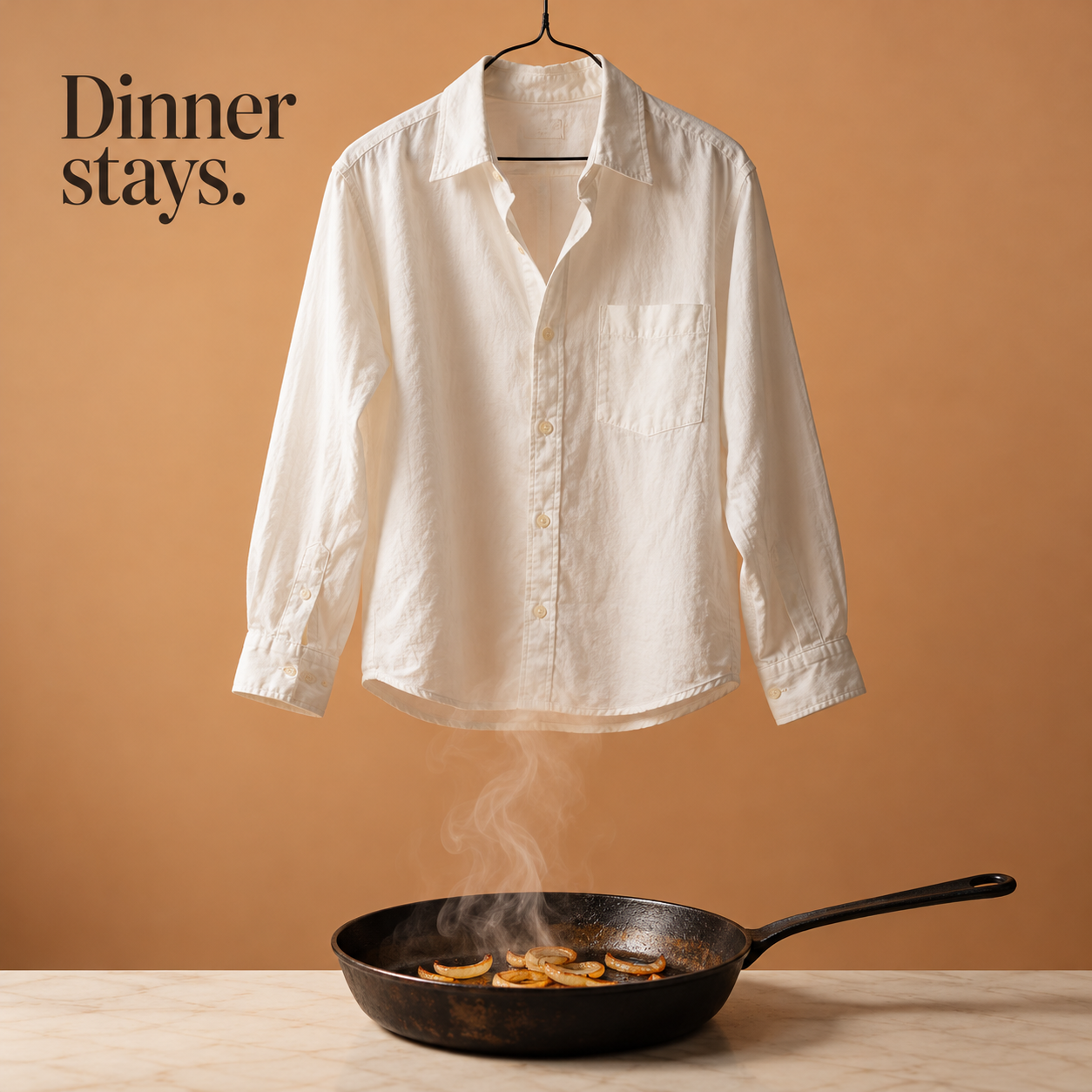
Cooking odour on clothes is usually treated as a domestic nuisance, but it begins as a building problem: volatile compounds leave the pan, escape or bypass the extract plume, travel through connected air, and interact with textile fibres. A wardrobe beside an open kitchen does not merely share a view. It may share an exposure path whose duration depends on doors, pressure differences, supply air and hood capture.
What the textile study actually did
Wenjuan Huang, Shuaitong Liang, Hongjuan Zhang, Xuemei Ding and Jiping Wang examined how cotton, wool and polyester fabrics released compounds after exposure to tobacco smoke or hot-pot vapour. For the cooking-odour experiment, the researchers used terry-towel specimens of the three fibres. A 150-gram bag of hot-pot soup base and 750 millilitres of purified water were heated to boiling in a closed 50-centimetre cube chamber. The fabrics were exposed for one hour, then central 4 × 7 centimetre samples were placed in headspace bottles and analysed by gas chromatography–mass spectrometry.
The method identified compounds desorbing from the fabrics after exposure. It did not measure the full concentration in a dwelling, the amount first adsorbed by each textile, or how strongly people perceived the resulting smell.
The compounds did not leave every fibre in the same pattern
All three fabrics released hexanal, myrcene, β-pinene, nonanal and anethole. Cotton produced higher reported peak-area ratios for hexanal, nonanal and anethole than wool or polyester. The respective values for cotton, wool and polyester were 5.14%, 2.58% and 1.61% for hexanal; 13.44%, 3.69% and 4.91% for nonanal; and 3.74%, 1.69% and 0.94% for anethole. Wool produced a much larger β-pinene ratio: 34.82%, compared with 7.32% for cotton and 6.93% for polyester.
These numbers are chromatographic peak-area ratios under one experimental protocol. They are not a ranking of total odour intensity. A lower release at the sampled moment can mean less compound was adsorbed, stronger retention inside the fibre, or a different release rate. The researchers linked the differences to fibre chemistry, polarity, hygroscopic behaviour, surface structure and the water vapour generated by heating.
Cooking creates the airborne source before fabric stores it
A separate investigation by Felix Klein, Urs Baltensperger, André S. H. Prévôt and Imad El Haddad conducted more than 100 experiments on emissions from cooking processes. It found that frying was a major driver of aldehyde emissions, while condiments contributed strongly to terpenes. This supports the chemical bridge between the source and the textile study: several compound classes detected in cooking air can later interact with indoor surfaces and clothing.
The bridge still has limits. Klein and colleagues studied emissions and indoor concentration modelling, not wardrobes. Huang and colleagues exposed fabrics in a closed chamber, not along a measured route from cooker to dressing room. Their dynamic airflow model used nicotine from tobacco smoke as the example compound; its airflow results should not be presented as a validated model for hot-pot odour.
Architectural application: reduce the textile exposure dose
ArchUp proposes treating clothing odour as the product of source strength, capture efficiency, transfer path and exposure time. This is an architectural hypothesis derived from the studies, not a tested residential formula.
- Place the extract inlet where the cooking plume enters it before crossing the occupant’s breathing and circulation zone.
- Coordinate make-up air so it supports capture rather than pushing the plume away from the hood.
- Keep wardrobes and open clothes storage outside the likely airflow path from kitchen to return grille or exhaust route.
- Use a closable boundary, buffer or pressure strategy where strong cooking and textile storage are adjacent.
- Specify door undercuts and transfer paths together with the ventilation concept; as ArchUp’s study of the soundproof door and return-air path shows, a boundary can fail when separate packages assign it incompatible duties.
A closed kitchen is not automatically odour-proof, and an open kitchen is not automatically defective. A poorly supplied closed room may leak toward bedrooms when its door opens, while a well-captured open-kitchen plume may produce less transfer. The relevant question is what the installed pressure and capture pattern does during the intended cooking event.
How a project could test the proposition
- Define a repeatable cooking protocol: ingredients, oil, temperature, duration, hood setting, doors and supply-air condition.
- Visualise the plume and measure airflow at the hood and connecting openings. Record pressure direction between kitchen, circulation and clothes storage.
- Place clean, standardised cotton, wool and polyester witness swatches at the wardrobe and at a control location before each test.
- Log particles and total VOCs as comparative indicators, while stating that a generic sensor does not identify the individual odour compounds.
- Seal and analyse the swatches using the same laboratory method, or use a blinded sensory comparison where laboratory analysis is unavailable. Compare alternative door, supply-air and extract conditions.
The proposition would gain support if a design change repeatedly lowers both transfer indicators and compound release or perceived odour from the witness textiles. It would not establish a universal safe distance between a kitchen and wardrobe. Cooking method, textile type, humidity, cleaning, air change and user behaviour all alter the outcome.
Limits that should remain visible
The primary textile experiment used one hot-pot mixture, one-hour exposure, terry structures and a small closed chamber. Reported compounds met a library-match threshold, but the study did not follow real garments through wear, laundering and repeated household cooking. It did not establish dose–response thresholds for smell or health. Its fibre comparisons cannot be applied unchanged to blended fabrics, coatings, dyes, finishes or densely packed wardrobes.
The architectural test proposed here also needs controls. A portable total-VOC meter can show that a condition changed without identifying which molecule changed. Human odour ratings vary and should be blinded and repeated. Hood airflow alone does not prove capture if the plume escapes at the edge. For these reasons, planning, ventilation and textile evidence should be read together rather than reduced to one product claim.
✦ ArchUp Editorial Insight
Odour complaints often appear after occupation as a housekeeping problem, although the decision chain begins earlier. Open kitchens are sold as visual continuity; wardrobes and circulation are fitted close by to protect usable area; extraction is procured by nominal airflow; doors and pressure paths are divided among architectural and mechanical packages. Each decision can satisfy its own drawing while no party is asked to limit the textile exposure dose during an actual cooking event. The Huang study does not prove that moving a wardrobe will eliminate odour, but it shows that fabric is not passive: compounds are retained and released differently by fibre. That makes exposure time, plume capture and air transfer legitimate project variables. The same interface logic appears when a soundproof door must also serve return air: one boundary receives conflicting duties from separate specifications. An auditable response would define a representative cooking test, measure capture and pressure direction with connecting doors in realistic positions, and place fabric storage outside the predicted transfer path. This remains an ArchUp hypothesis. It shifts responsibility from later washing or fragrance masking to the design, procurement and commissioning decisions that control how much contaminated air reaches clothing. The party selecting an open plan or a lower-cost hood may leave before repeated odour appears; the resident and operator remain with the cleaning time and altered use of rooms.
Prepared by ArchUp Research Lab.
Editorial correction — 14 October 2026: Removed the image-pending notice after confirming that the featured image is attached. ArchUp Editorial Committee.
References
Wenjuan Huang, Shuaitong Liang, Hongjuan Zhang, Xuemei Ding and Jiping Wang, “Tobacco and Hot Pot Odor Adsorbed by Cotton, Wool, and Polyester Fabrics: Desorption Components and Dynamic Analysis,” AATCC Journal of Research, 2023.
Felix Klein, Urs Baltensperger, André S. H. Prévôt and Imad El Haddad, “Quantification of the Impact of Cooking Processes on Indoor Concentrations of Volatile Organic Species and Primary and Secondary Organic Aerosols,” Indoor Air, 2019.