Laundry Takes Space: Clothes, Shared Laundries and Water Reuse


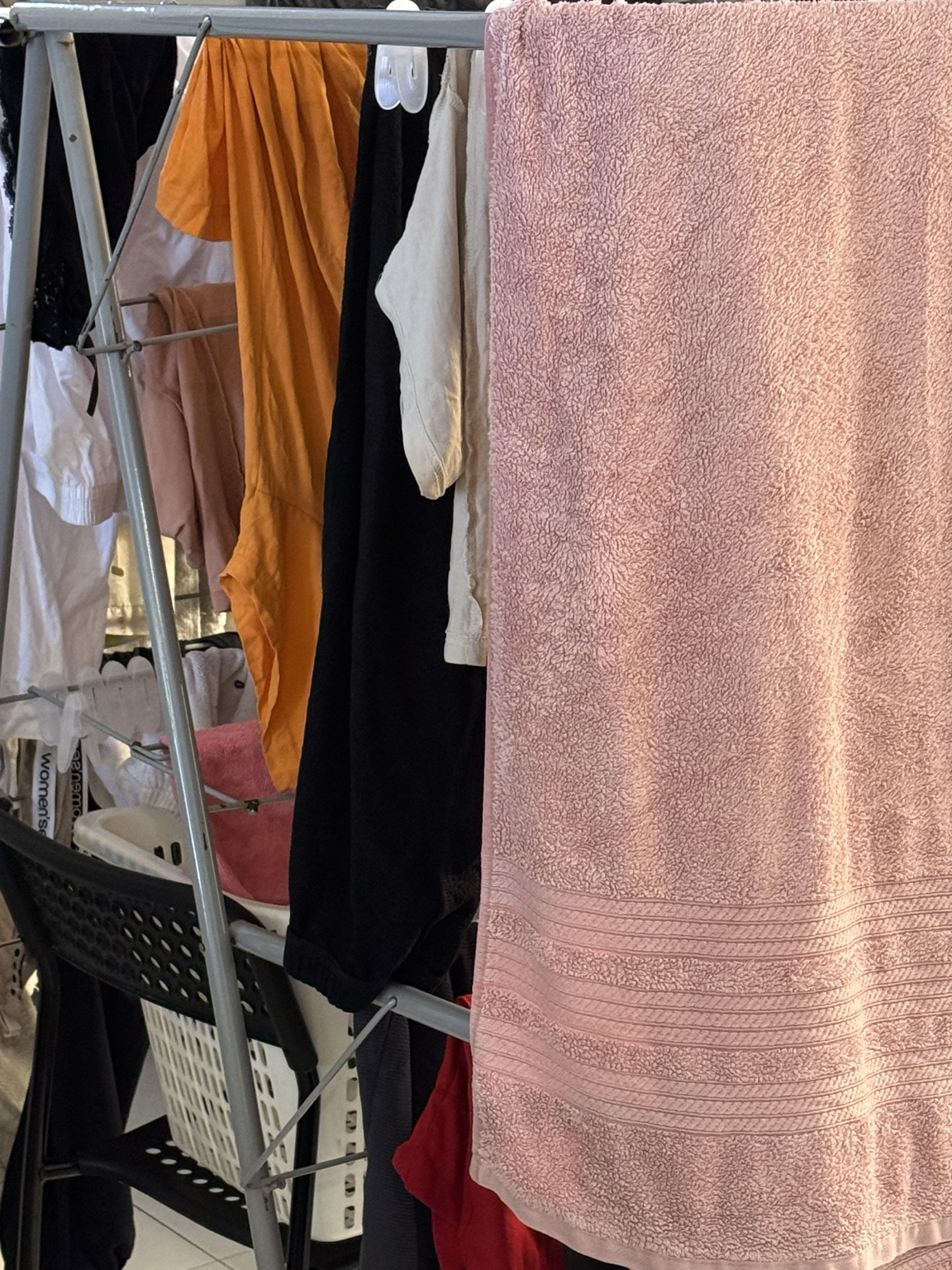
The photograph shows a pink towel stretched over a drying rack, clothes hanging behind it and baskets gathered below. It records an ordinary arrangement, not a measured indoor climate. We cannot infer humidity, ventilation performance, drying time or a health problem from this image. What it makes visible is simpler: clothing continues to occupy architectural space after it leaves the washing machine.
A wardrobe accommodates clothes when they are ready to disappear. Domestic life also contains clothes waiting to be washed, garments worn once and intended for reuse, wet textiles awaiting drying, and clean loads awaiting folding. These intermediate states need somewhere to happen. When the plan makes no provision for them, chairs, doors, corridors and living rooms become the missing infrastructure.
Research and analysis: ArchUp Research Lab.
A research question larger than the laundry room
This article begins with the relationship between clothes and space, then develops two connected subjects: shared and self service laundries, and the treatment and reuse of laundry wastewater. Its argument is that laundry room design must coordinate movement, time, air, water and responsibility. Selecting an appliance is only one decision within that system.
The starting material consists of two supplied research overviews. We checked selected claims against accessible publisher abstracts, research repository records and public technical guidance. This is an analytical synthesis, not a systematic review, a claim to have read every original paper in full, or an engineering specification. Numerical findings remain attached to their study conditions. Spatial recommendations are identified as design interpretations, rather than presented as experimentally established universal rules.
Before washing: the space between clean and dirty
The useful unit of design is the journey of a garment. It arrives, is stored, worn, set aside, sorted, washed, transferred, dried, folded and returned. Some garments skip washing after a single use. Others require separate care. A home that provides only a wardrobe and a machine has planned two endpoints while leaving the work between them to chance.
A small place for airing clothes intended for another wear can prevent them from being mixed immediately with either fresh clothing or dirty laundry. Sorting containers can reduce repeated handling. A clear transfer surface can make unloading easier. These are design possibilities, not guarantees of reduced washing. Their value depends on the household's habits, available space and willingness to use them.
Storage should also respect the condition of its contents. A closed basket does not make wet towels dry. A cupboard does not become a drying room because a rack fits inside it. Concealment is an aesthetic operation; moisture removal is a physical one. The designer must resolve both if the resident is not to choose between a tidy photograph and a workable home.
Consider carrying as carefully as storage. A basket may occupy both hands. Steps, heavy doors, narrow turns and remote machines can turn a short route into a repeated burden. A usable layout provides somewhere to set the load down and enough room to operate doors without backing into an obstruction. Accessibility belongs to this whole sequence, not merely to the height of a control panel.
Drying transfers water somewhere
Spinning removes part of the water in a load. The water remaining in clothes must subsequently leave through evaporation or a drying appliance. Indoor rack drying transfers moisture into the surrounding air. Moving that air can accelerate evaporation, but a fan alone does not remove the resulting water from the building.
A controlled study published in 2025 measured water release during indoor laundry drying in a room of approximately 40 cubic metres. One cotton load scenario involved roughly two kilograms of evaporated water. That observation illustrates a potentially significant moisture source; it is not a standard value for every load or a ventilation sizing rule. Fabric, load size, spinning and room conditions all matter. [1]
The practical question is therefore not simply whether drying happens indoors. It is whether the room can remove the released moisture without persistent dampness elsewhere. Heating can initially reduce relative humidity by warming the air while leaving its water content unchanged. A dehumidifier collects water. Suitable extraction removes moist air and replaces it with air whose moisture content must also be considered.
Opening a window can help when incoming air offers useful drying capacity. In humid weather it can add moisture instead. Relative humidity alone is not enough to compare two air streams at different temperatures. Local climate, dew point, surface temperature and the actual ventilation arrangement deserve attention. Air conditioning that recirculates room air should not be mistaken for fresh air ventilation. Its moisture removal also depends on operation. [2]
Dampness, microbes and hygiene are different questions
Persistent building dampness is associated with respiratory and allergic problems. WHO guidance supports preventing persistent moisture and microbial growth in buildings. This does not establish that every indoor drying rack causes disease. The concern is the condition created and maintained in a particular room, especially around cold surfaces and poorly ventilated corners. [3]
A monitored Glasgow study connected domestic laundering practices with energy and indoor environmental questions in a limited housing sample. Its findings support taking drying space seriously, while its local conditions and sample size limit broad generalisation. A dedicated drying location is useful only when it has a credible moisture removal strategy. Moving a rack into an unventilated cupboard merely relocates the problem. [4]
Three microbial questions should remain separate. Microorganisms can be present on textiles and inside machines. Building materials can support mould when conditions remain damp. Wastewater can carry organisms that require control before reuse. Evidence about one does not establish the risk or treatment requirement of the others. An unpleasant smell is a reason to investigate maintenance and drying, not a laboratory identification of a pathogen.
For ordinary household laundry, CDC guidance emphasises detergent, an appropriate recommended washing temperature and complete drying. Wash hands after handling dirty laundry and clean the hamper as needed. Specific illness, vulnerable occupants and contaminated textiles may require additional guidance. A universal instruction to sterilise every garment would obscure these differences and can damage textiles or waste resources. [5]
In practice, follow textile care labels and appliance instructions, avoid leaving wet loads waiting unnecessarily, and maintain accessible seals, drawers and filters. Keeping a door ajar for drying must also be compatible with child and pet safety. These are operating decisions that a designer can support through access and visibility, but cannot replace with a decorative specification.
Choosing how the load becomes dry
| Method | Architectural requirement | Question to resolve |
|---|---|---|
| Indoor rack | Space for unfolding, air movement and a moisture removal route | Where does the evaporated water go? |
| Outdoor or balcony drying | Safe access, weather protection and consideration of privacy | Is it usable across relevant seasons and household routines? |
| Vented dryer | A suitable exhaust route to outdoors and access for cleaning | Can the duct remain effective and maintainable? |
| Condenser or heat pump dryer | Correct clearances, drainage or tank access and manufacturer specified conditions | Can heat, condensate and servicing be managed? |
| Rack with dehumidification | Suitable equipment, condensate handling and operating space | Is the room managed as a drying zone rather than an open moisture source? |
Heat pump dryers typically use a closed air circuit and collect moisture as condensate. Being ventless does not mean they can be sealed into any cabinet without regard to installation requirements. Vented dryers need an appropriate outdoor discharge, not an exhaust into a ceiling void. Lint removal and accessible ducts are maintenance provisions with safety consequences. [6, 7]
The appropriate choice is not identical for every home. A household may combine outdoor drying for some items, a rack for delicate garments and a dryer for towels. The architectural task is to accommodate the real combination, including the time each method takes, rather than specifying a single ideal routine that residents cannot maintain.
First focus: the shared laundry as everyday infrastructure
A shared laundry changes the scale of the same journey. It can be a room serving an apartment building, a neighbourhood self service shop, or a service where staff handle clothes. These models distribute travel, waiting, labour and responsibility differently. They should not be evaluated as if they were interchangeable rows of machines.
Research on laundry practices in London and New York treats washing as part of public and private social life, shaped by objects, routines and unequal circumstances. That perspective helps explain why a laundry is more than equipment. It does not mean that placing machines together automatically creates a successful social space. [8]
For residents, the attraction may be access to equipment without a private purchase, a place to handle bulky textiles, or a way to recover space at home. The disadvantages can include carrying loads, unavailable machines, restricted hours and discomfort around strangers. The designer should compare the full experience with the alternative, including who performs the carrying and waiting.
Capacity belongs to the complete cycle
A laundry can have enough washing capacity and insufficient drying capacity. Imagine, as a design scenario rather than a measured case, several machines finishing together while the available drying equipment remains occupied. Wet loads accumulate even though the washing machines themselves are working properly. A plan based only on the number of washers misses the actual bottleneck.
Equipment selection should therefore follow expected arrival patterns, load types, washing and drying durations, opening hours and downtime. Average daily use can conceal concentrated demand after work or on a particular day. Provision for an unavailable machine matters because maintenance temporarily changes the capacity residents experience.
Booking systems can reduce uncertainty, but they introduce their own questions: late collection, missed reservations, payment access and support when a phone fails. A digital system should not be the only way to understand whether a machine is available or seek help. Clear local instructions and an accountable operator remain part of the service.
A room to work in, not just a room to wait in
Space is needed for sorting, transferring, temporary baskets and folding. Someone should be able to open a machine without blocking the passage of another person carrying laundry. Clean folding surfaces should not become the default place for dirty loads. This does not require turning ordinary housing into a clinical facility; it requires making incompatible activities easier to separate.
Lighting should support checking controls and reading care labels. Acoustic and vibration design should consider adjacent bedrooms and living spaces. Water connections, shutoff points, drainage and leak detection need to be accessible. Ventilation and dryer servicing routes must survive the final fit out, rather than being squeezed behind decorative panels.
Seating can help users who need to remain nearby, but waiting is not equally comfortable for everyone. Visibility can support reassurance while exposing private domestic activity. Children, older people, disabled residents and those working unusual hours may have different needs. Good shared laundry design offers dignified choices instead of assuming every user wants conversation.
The room needs an operating agreement
Who cleans the machines and surfaces? Who removes abandoned loads? Who pays for breakdowns? Who responds to a leak at night? These questions are architectural because their answers affect access, storage, service rooms and costs. A shared facility without an operator can transfer unpaid management to residents who never agreed to provide it.
Sharing can improve the use of equipment, but environmental savings should be assessed rather than presumed. Include travel, actual load sizes, energy, water, replacement, cleaning and service reliability. A larger drum is not a saving if it encourages frequent small loads. Equally, a modest private arrangement may work well when it avoids unnecessary journeys and suits the household's actual needs.
Second focus: laundry wastewater as a building resource
Water leaving a washing machine is no longer equivalent to its incoming supply. It can contain lint, fibres, detergent residues, dissolved substances, soil and microorganisms. The mixture depends on what was washed and how. Domestic clothing, heavily soiled workwear and commercial linen services are different inputs, even when each system is called a laundry.
Greywater reuse begins with an intended destination. Toilet flushing, irrigation and reuse in a washing process have different exposure pathways and quality requirements. Drinking water use is outside the ordinary proposal discussed here. A system should be selected against the permitted end use and local requirements, not against the appearance of clear water. EPA and NSF guidance frame onsite reuse around treatment performance and intended applications. [9, 10]
A treatment train has several jobs
| Problem | Possible treatment function | What it does not prove |
|---|---|---|
| Lint and suspended particles | Screening, separation or filtration | Dissolved chemicals and pathogens have all been removed |
| Biodegradable organic matter | A properly operated biological process | Water is microbiologically safe for every use |
| Selected dissolved contaminants | Suitable adsorption or other targeted treatment | The medium will work indefinitely without replacement |
| Microorganisms requiring control | A validated disinfection barrier | Salts and every chemical have disappeared |
| Variable production and demand | Controlled storage and routing | Water quality will remain stable without management |
These are functions, not a universal sequence or a household construction recipe. Some systems combine them; others require additional processes. Filtration captures material rather than necessarily destroying it. Adsorption media can become exhausted. Disinfection effectiveness depends on the technology and operating conditions. Storage can reintroduce a problem if it is treated as a passive bucket at the end of the process.
Chemical oxygen demand, often abbreviated COD, indicates an aspect of the organic pollution burden. Reducing it does not establish pathogen removal. A percentage reduction also needs an initial concentration and a final value: a large improvement may still fail the requirement for a particular use. The phrase “treated water” is incomplete without stating treated for what.
Biological treatment is not a list of beneficial bacteria
The supplied wastewater overview proposes combinations of Bacillus and Pseudomonas species for a possible biological process. Such proposals are research hypotheses unless the specific strains, wastewater, reactor conditions and target performance have been tested together. Evidence that an organism performs one useful function does not establish that a proposed mixture will reliably treat household laundry effluent.
Species names alone do not resolve stability, pathogen control, aerosol exposure or maintenance. Recognition of safety for a particular food use is also not blanket approval for an organism in a domestic water treatment system. FDA explanations of GRAS status make the intended conditions of use central to that assessment. [11]
The practical architectural recommendation is to work with a validated treatment system and qualified water professionals, not to cultivate or add a speculative microbial mixture at home. This preserves the distinction between a promising research direction and equipment that a resident can responsibly operate.
What the case studies establish
The LaundReCycle pilot investigated a combined laundry and water reuse arrangement over five weeks, operating five washing cycles per day. It reported recovering 69 percent of the water. This is evidence of performance under the pilot's conditions, not proof of complete water independence or a universal recovery rate. Its value lies in testing the connected system rather than presenting treatment as an isolated object. [12]
Another study examined a combined biological and advanced oxidation system at an industrial laundry over 55 days. Its industrial input, process train and operating conditions distinguish it from a small domestic installation. It supports investigating combined treatment; it does not validate the particular household bacterial mixture proposed in the supplied overview. [13]
For design decisions, ask what each study measured, for how long, under which loading conditions, and with what maintenance. Water recovery, pollutant removal, microbial safety and energy autonomy are separate outcomes. A strong result in one cannot silently stand in for all the others.
Microfibres require a destination too
Textile fibres released during washing can include both natural and synthetic material. Research on washing machine filters shows that performance depends on factors including pore size and polymer. A captured mass is not automatically the same measure as the number of fibres captured, and no single quoted efficiency should be transferred to every device and load. [14]
The architectural implication is practical: filters need access, cleaning space and a waste route. Material removed from a filter should not simply be washed back into the drain. Collection shifts responsibility from a water stream to a solid residue; it does not make that residue disappear.
Reuse must fit the building's demand
A building may produce reusable water when there is little permitted demand for it. Storage volume alone cannot solve every mismatch because water quality and residence time matter. Conversely, a reuse system may need a safe alternative supply when production is insufficient. Safe separation from drinking water, protection against cross connections and a route for rejected water belong in the initial design.
Untreated greywater should not be regarded as water that can be stored indefinitely. Australian public guidance, for example, warns against prolonged storage and uses 24 hours as an important limit in its local advice. This is a jurisdiction specific warning, not a substitute for project requirements or the operating limits of a certified system. [15]
Architects should reserve maintainable space for equipment, tanks where applicable, inspection and sampling, drainage and replacement. The operating plan must identify who checks performance, changes consumables and responds to failure. A concealed plant area that cannot be serviced is not a completed circular water strategy.
Bringing the two subjects back into one plan
Shared laundries and water reuse intersect because concentrating washing can make a managed treatment system conceivable. Yet concentration also concentrates noise, heat, demand peaks and operational consequences. The correct scale follows service conditions. It cannot be determined solely by an ambition to call the building sustainable.
For an existing small dwelling, the first useful intervention may be a clear drying zone, better moisture management and easier machine maintenance. For a residential building, it may be a shared room with realistic capacity and accountable management. For a larger staffed facility, water reuse may become credible when demand, treatment, monitoring and maintenance are all supported. These are assessment pathways, not a ranking that every project must climb.
The brief should record the complete clothes journey, the people performing it, expected loads, available drying methods, moisture removal, accessible routes, noise sensitivity and service responsibility. If water reuse is included, add source quality, permitted end use, performance criteria, monitoring and failure response. Each item should have an owner before equipment is procured.
The room succeeds when the clothes can return
A beautiful laundry is not necessarily a usable one, and an efficient machine does not make the whole process efficient. Clothes take space while they wait, release water while they dry, and carry labour between rooms. Shared services redistribute that labour. Water reuse adds another system that must remain legible and maintained.
The architectural opportunity is to design these transitions deliberately. A home does not finish caring for clothes when it hides them in a wardrobe. It completes that care when garments can move through use, cleaning and drying and return ready to be worn, without making the room, the resident or the water system absorb an unresolved problem.
Sources
- Thévenet F, Caron F, Gaudion V, Nicolas M, Verriele M. Indoor laundry drying: Full-scale determination of water emission rate and impact on thermal comfort. Indoor Environments. 2025;2(2):100089. DOI: 10.1016/j.indenv.2025.100089. Publisher abstract consulted.
- US Environmental Protection Agency. Mold Course, Chapter 9. Public guidance on moisture control and ventilation. Guidance consulted.
- World Health Organization. WHO Guidelines for Indoor Air Quality: Dampness and Mould. 2009. Public overview consulted.
- Porteous C and colleagues. Energy and environmental appraisal of domestic laundering appliances. Building Research & Information. 2012;40(6):679–699. DOI: 10.1080/09613218.2012.708599. Research repository abstract consulted.
- US Centers for Disease Control and Prevention. When and How to Clean and Disinfect Your Home. Public laundry guidance consulted.
- ENERGY STAR. Clothes Dryers. Public guidance on dryer technologies consulted.
- US Department of Energy, Building America Solution Center. Proper Clothes Dryer Venting. US Fire Administration. Clothes Dryer Fire Safety. Public installation and safety guidance consulted.
- Watson S. Mundane objects in the city: Laundry practices and the making and remaking of public/private sociality and space in London and New York. Urban Studies. 2015;52(5):876–890; published online 2014. DOI: 10.1177/0042098014531630. Publisher abstract consulted.
- US Environmental Protection Agency. Onsite Non-Potable Water Reuse Resources. Public overview consulted.
- NSF. NSF/ANSI Standard 350 Certification: Water Reuse Treatment Systems. Public explanation of certification scope consulted; full standard not reviewed.
- US Food and Drug Administration. Generally Recognized as Safe; Microorganisms and Microbial-Derived Ingredients Used in Food. Public explanations consulted.
- Buehler D, Antenen N, Frei M, Koller C, Rousseau DPL, Schoenborn A, Junge R. Towards Water and Energy Self-Sufficiency: a Closed-Loop, Solar-Driven, Low-Tech Laundry Pilot Facility (LaundReCycle) for the Reuse of Laundry Wastewater. Circular Economy and Sustainability. 2021;1:1037–1051. DOI: 10.1007/s43615-021-00077-2. Publisher abstract consulted.
- Zoroufchi Benis K, Behnami A, Aghayani E, Farabi S, Pourakbar M. Water recovery and on-site reuse of laundry wastewater by a facile and cost-effective system: Combined biological and advanced oxidation process. Science of the Total Environment. 2021;789:148068. DOI: 10.1016/j.scitotenv.2021.148068. Publisher abstract and accessible introductory material consulted.
- Browne MA, Ros M, Johnston EL. Pore-size and polymer affect the ability of filters for washing-machines to reduce domestic emissions of fibres to sewage. PLOS ONE. 2020. DOI: 10.1371/journal.pone.0234248. Abstract consulted.
- Victorian Building Authority. Greywater. Queensland Government. Greywater guidance. Public jurisdiction specific guidance on handling and storage consulted.