The Object That Is Dry and Fragile at the Same Time

Research and analysis: ArchUp Research Lab.
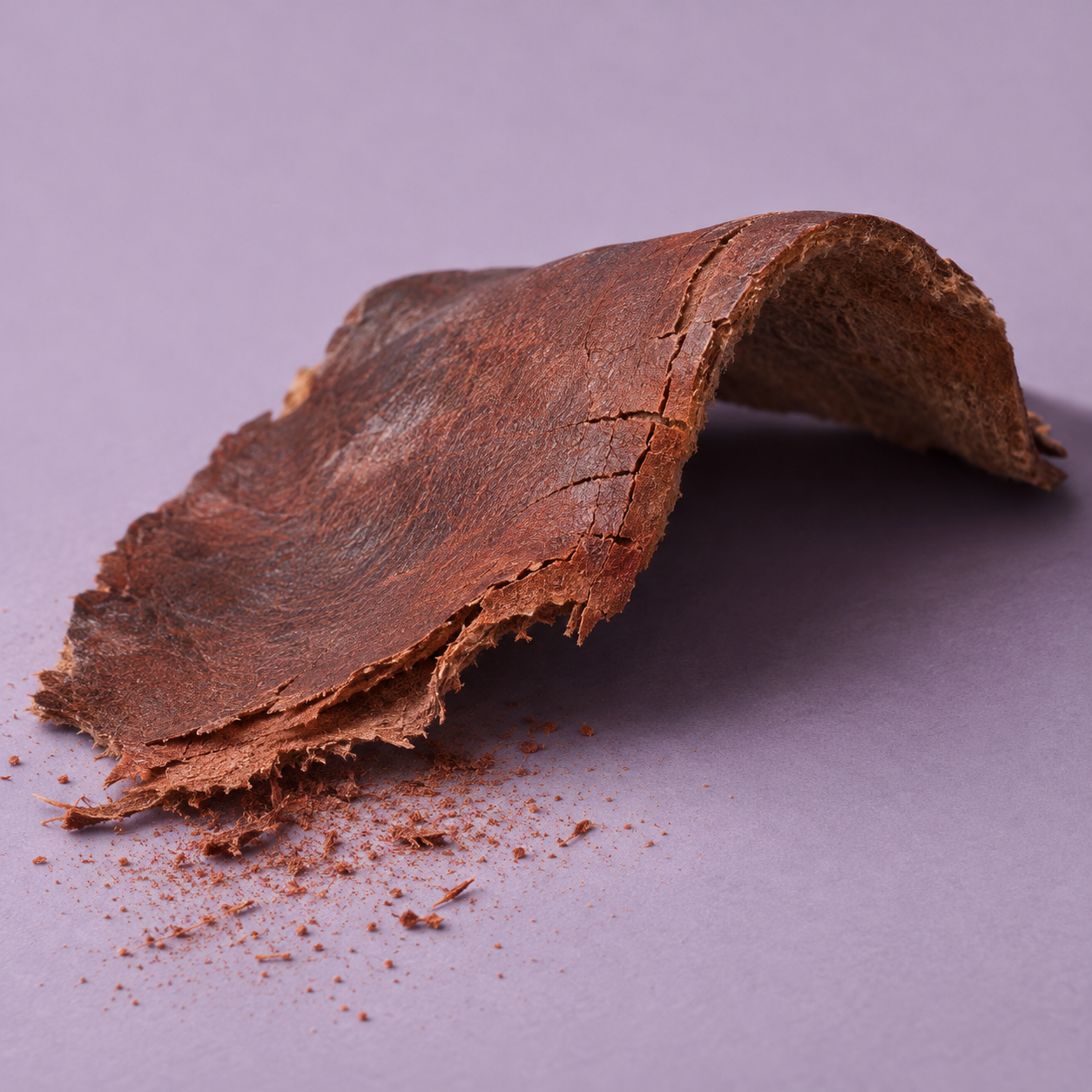
The cover shows a curled fragment of brown leather, a cracked surface and loose particles resting below its edge. It makes a conflict visible without diagnosing its cause: a material can look rigid enough to hold a shape while losing the connections that keep it together. The image is an editorial illustration, not a laboratory record of a documented collection object. Its relevance is the question it raises for conservation and interior design. When an old surface becomes both stiff and friable, what exactly should an intervention restore?
A piece of old vegetable tanned leather does not necessarily fail in one way. Loss of flexibility and loss of cohesion may occur together, but they are distinct conditions. A surface may crack when bent, shed particles during handling, or retain a convincing finish above weakened fibres. Recent research identified the characteristic powder associated with red rot as short, thin collagen fibres and showed that a substantial dye layer can conceal deterioration below it [1]. Appearance is therefore an incomplete measure of condition. This is the difficulty behind a proposal to combine sesame oil with polyvinylpyrrolidone, or PVP: lubrication and consolidation address different aspects of failure, but combining their ingredients does not establish that either function will be delivered safely.
Vegetable tanned leather combines collagen with tannins. Hydrolysis, oxidation and changes in the organisation of its fibres can contribute to deterioration, with the object's processing, exposure and previous treatments influencing the outcome. This does not mean every dry object needs oil or every powdering surface needs the same consolidant. Diagnosis comes first. Reduced handling, a supportive mount or a better storage environment may offer more benefit than adding another material.
The appropriate research question is consequently narrower than whether a promising mixture can make leather feel softer. It is whether a defined formulation improves a defined condition without unacceptable changes to appearance, chemistry, future treatment or the evidence retained by the object. This distinction connects bookbinding conservation to the care of leather wall coverings, furniture and historic interiors. The material belongs to a larger spatial and operational system.
Why sesame oil, and why the worry about it is justified
The case for investigating an oil begins with lubrication between fibres. In leather manufacture, fatliquoring helps fibres move relative to one another and contributes to the properties expected of finished leather. However, the sesame study cited in the supplied research investigated chemically sulfonated sesame seed oil applied during the processing of goatskin for shoe upper leather [2]. It did not establish a treatment using raw sesame oil on aged, powdering museum leather. Its reported comparison with a commercial fatliquor belongs to that manufacturing experiment.
This boundary changes the argument. A chemically modified formulation, a newly processed substrate and a heritage object with an uncertain treatment history are different experimental situations. Success in the first is a reason to investigate the others, not permission to treat them as equivalent. Nor does an improvement in elongation automatically answer the conservator's question: an original decorated surface may be damaged by the movement that a modern shoe leather is designed to accommodate.
Oxidation is one reason that distinction matters. Unsaturated oils can undergo chemical change, and the performance of a dressing depends on more than its initial lubricity. Research on commercial fatliquors examines oxidation induction time and changes in iodine and acid values, and investigates chemical modification and antioxidants [3]. These are useful approaches to evaluating formulation stability. They do not demonstrate that adding an antioxidant to sesame oil makes it suitable for a particular historic object.
An iodine value is not a clock that predicts the lifetime of a treated binding. Processing, storage, additives, exposure and the interaction with the substrate also matter. Yellowing, stiffening, surface tack, migration and changes in acidity are risks to examine rather than outcomes that can be asserted for every sesame formulation. Lower loading may reduce some effects but cannot, by itself, prove compatibility. The essential unit of assessment is the complete formulation on the relevant material, before and after ageing.
Research on collagen spacing provides another useful boundary. Sizeland and colleagues compared water, lanolin, urea, proline, paraffin and fatliquor, finding different responses as humidity and treatment changed [4]. Sesame oil was not one of the treatments named in that comparison. The findings help explain why water interactions deserve attention, but they cannot be used to claim that sesame oil will behave like lanolin. A proposed mechanism remains a hypothesis until the proposed material is actually tested.
Why a polymer, and why this one
The fragile part of the problem raises a different question: can a consolidant improve connections within a weakened structure without imposing a damaging stiffness or changing its surface? PVP is considered here as a candidate film forming polymer, not as a validated treatment. Its grade, molecular characteristics, concentration and carrier would all need to be specified. Naming the polymer is not the same as defining the intervention.
Solubility must also be distinguished from reversibility. A polymer that dissolves in a laboratory solvent may be difficult to extract after it penetrates a porous, weakened object. Removal may mobilise dyes, disturb fibres or require more liquid than the original can tolerate. Ageing and mixing with another ingredient introduce additional uncertainty. The defensible goal is to preserve future treatment options and test practical removability, rather than award a mixture the label reversible because one component is soluble.
The apparent elegance of combining the two materials is that each might cover a different weakness. The oil is intended to support flexibility while the polymer is intended to improve cohesion. Yet the mixture could also separate, distribute unevenly or form a film whose behaviour differs from either ingredient alone. Compatibility cannot be inferred from complementary job descriptions. The combination requires its own evidence, including the distribution of both components through the substrate and the behaviour of the treated surface during subsequent use.
What the alternatives teach
The alternatives are valuable chiefly as comparison groups. Cellulose based consolidants, acrylic systems and other established approaches should be selected according to the object and the conservator's existing practice, rather than presented as uniformly inferior materials. A protective coating, a fibre consolidant and a lubricant do not necessarily pursue the same outcome. Ranking them without identifying the function being measured creates an artificial winner.
Reports of improved strength, altered shrinkage behaviour or a more coherent microscopic appearance also require careful interpretation. A change in a thermal measurement does not by itself prove that the original collagen architecture has been rebuilt. An image that shows a coating around fibres does not demonstrate restored molecular structure. The appropriate claim is the property actually measured, under the stated conditions, with the limitations of that measurement retained.
The distinction between protection and consolidation is especially important for an interior. A surface barrier may change the ingress of moisture or pollutants, while an internal treatment may change cohesion. Neither function guarantees the other. The water affinity of PVP raises questions about humidity response, swelling and surface feel, but those responses must be measured for the formulation being proposed. They are not a substitute for measurements.
Penetration requires similar precision. Delivery depends on viscosity, solvent behaviour, porosity and drying. A material can accumulate near a surface or distribute unevenly; that possibility must be investigated without assuming every polymer follows the same path. The relevant question is whether the treatment reaches the zones that need support and whether any concentration gradient introduces a new weakness at an interface.
How its efficacy would actually be judged
Because the sesame oil and PVP blend has not been independently validated by the evidence assembled here, efficacy cannot be asserted. A useful comparison would include untreated material, carrier only, oil only, polymer only, the mixture, and an appropriate reference treatment. Substrates should be characterised before intervention. Artificially aged samples can support an initial study, but they do not reproduce every property or previous treatment of a historic object.
Microscopy could document particle loss, fibre condition and the location of deposited material. Spectroscopy could investigate relevant chemical changes. Acidity measurements would need a consistent sampling method and careful interpretation; a treatment should not be described as buffering the leather unless that behaviour is demonstrated. Thermal measurements could assess changes in hydrothermal response, without being presented as proof of complete structural restoration.
Mechanical tests should match the intended function and be conducted on suitable test material rather than consuming valuable originals without justification. Flexibility alone is not success if cohesion declines. Colour, gloss and surface texture need recording under repeatable conditions. There is no universal acceptable colour difference for every object: the criteria depend on significance, decoration, display and the treatment objective. Accelerated ageing can expose possible failure modes and compare candidates, but it cannot simply be converted into a promise of decades or centuries of service.
This evaluation is the difference between a research proposal and a treatment claim. It also establishes a stopping rule. If an intervention produces unacceptable darkening, residues, loss of cohesion or difficult future removal, its initial improvement in feel is insufficient. A failed candidate can still produce useful knowledge when the formulation, exposure and adverse result are recorded clearly.
An honest verdict, and why it matters beyond leather
On the evidence reviewed, the mixture is a hypothesis worth investigating, not a recommended treatment for historic leather. There is relevant research on lubricants, collagen response and deterioration, but that research does not collectively prove the performance of sesame oil combined with PVP. No superiority over established consolidants, no long term reversibility and no restoration of original collagen structure can be claimed here.
The uncertainty is productive when it becomes a study design. The priorities are formulation compatibility, distribution, ageing, appearance and future retreatment. A promising result should survive comparison with simpler options, including the possibility that support and reduced handling accomplish the conservation objective without introducing a mixture at all.
What makes this question matter beyond leather is the temptation to repair the visible symptom while leaving the conditions of failure unchanged. Historic interiors contain interdependent materials, supports and routines. A treatment applied to upholstery may encounter timber finishes, textile linings, metal fixings or later repair adhesives. Material assessment therefore needs a spatial and operational assessment alongside it.
For the design team, ageing is a specification parameter. The appearance at installation should be accompanied by an account of access, inspection, cleaning and replacement. For the conservation team, the existing object sets a different constraint: its original evidence cannot be purchased again. The most useful intervention is the one that supports a defined future for that object while retaining as much of its material history as possible.
A room changes the meaning of a treatment
Consider a hypothetical historic reading room with leather covered chairs. Some seats are retained as collection objects; others are replicas used every day. The two groups can look similar while having different duties. Restoring flexibility in an original seat does not establish that it can safely return to daily loading. A condition assessment, structural assessment and use policy are separate decisions. This scenario is an analytical example, not a reported case study.
The same distinction applies to a binding displayed open. A support that controls the opening angle may reduce strain without changing the leather chemistry. If the desired display cannot be achieved without forcing a weakened joint, the display should be reconsidered. The object should not be chemically altered merely to satisfy a predetermined photographic composition. Spatial design can remove a demand that a proposed material treatment would otherwise be asked to meet.
Maintenance also belongs in the brief. A treatment that performs well under controlled observation may encounter routine wiping, accidental contact or an incompatible cleaning product after installation. The team responsible for care needs an accessible record of what was applied, where it was applied and which responses should trigger reassessment. An undocumented intervention transfers uncertainty to the next person who touches the object.
What would count as useful evidence
A credible test report should identify the sample history, formulation, application method and comparison groups. It should distinguish immediate effects from changes after exposure and report adverse outcomes alongside improvements. Replication matters because degraded leather is not a uniform manufactured sheet. A treatment may appear successful on one area while another responds differently because of tannage, finish, previous dressing or local damage.
The report should also separate material performance from decisions about use. Increased tensile strength on a test strip does not automatically authorise handling a rare binding more frequently. Reduced surface loss does not mean a chair has recovered its original load capacity. These distinctions keep a laboratory result from becoming a broader assurance than the experiment can provide.
Cost should be considered across the care period rather than at the moment of application. A cheap mixture may require additional monitoring or complicate retreatment. A supportive enclosure may have an initial spatial or visual cost while avoiding an irreversible material change. No numerical saving can be claimed without a defined comparison, but the categories of cost can be made explicit before a decision is taken.
The final thesis is that conservation begins by separating the functions an object has lost and the demands a project continues to place upon it. Softness, cohesion, appearance and usability are not interchangeable achievements. Sesame oil and PVP remain a research proposition until their combination is shown to serve a defined conservation objective. The most convincing intervention may be a material treatment, a better support, a change in use, or a combination of these. Its value lies in the future it makes possible for the original object.
Method and evidence limits
This is an analytical review of the supplied research and accessible publisher abstracts and extracts, including sections of the fatliquor oxidation study. It does not claim independent full reading of every paper or experimental validation of sesame oil with PVP. The proposed comparisons and reading room scenario are analytical proposals. Manufacturing findings are distinguished from evidence about treating historic objects.
Sources
- Tarnowska M, Montgomery W, Konstantinidou K, Clatworthy I. Deteriorating Leather Bindings: An FTIR and SEM Study. Studies in Conservation, 71(2), 171–191, 2026; published online 2025. DOI: 10.1080/00393630.2025.2506341.
- Nkwor AN, Ukoha PO, Ifijen IH. Synthesis of sulfonated Sesamum indicum L. seed oil and its application as a fatliquor in leather processing. Journal of Leather Science and Engineering, 2021. DOI: 10.1186/s42825-021-00053-4.
- Yu Y, Huang M, Lv J, Zeng Y, Sun Q, Shi B. Evaluation and improvement of the oxidative stability of leather fatliquors. Journal of Leather Science and Engineering, 3, article 29, 2021. DOI: 10.1186/s42825-021-00070-3.
- Sizeland KH, Wells HC, Kelly SJR, et al. The influence of water, lanolin, urea, proline, paraffin and fatliquor on collagen D-spacing in leather. RSC Advances, 7, 40658–40663, 2017. DOI: 10.1039/C7RA05560A.