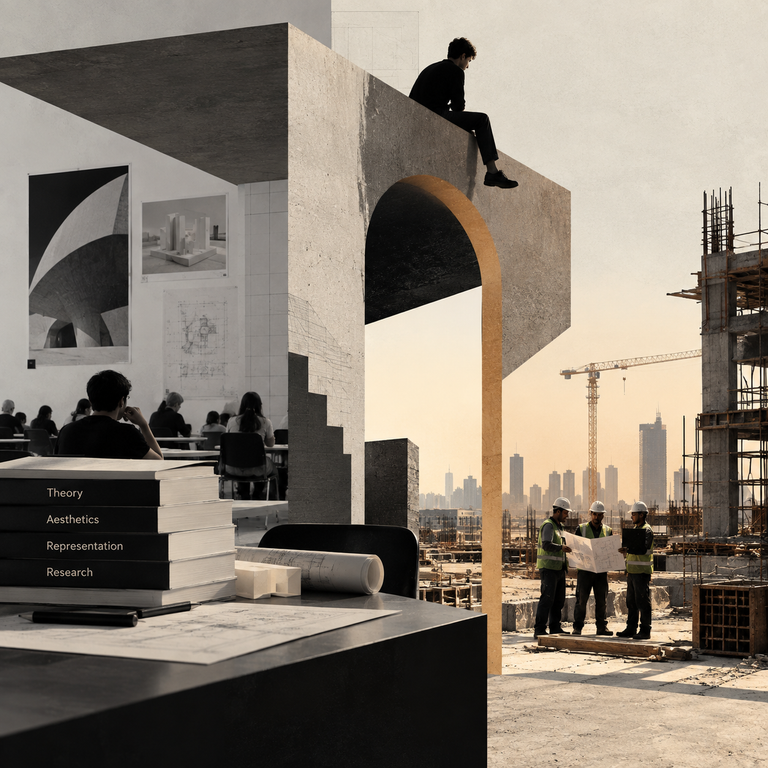
The Cognitive Handoff

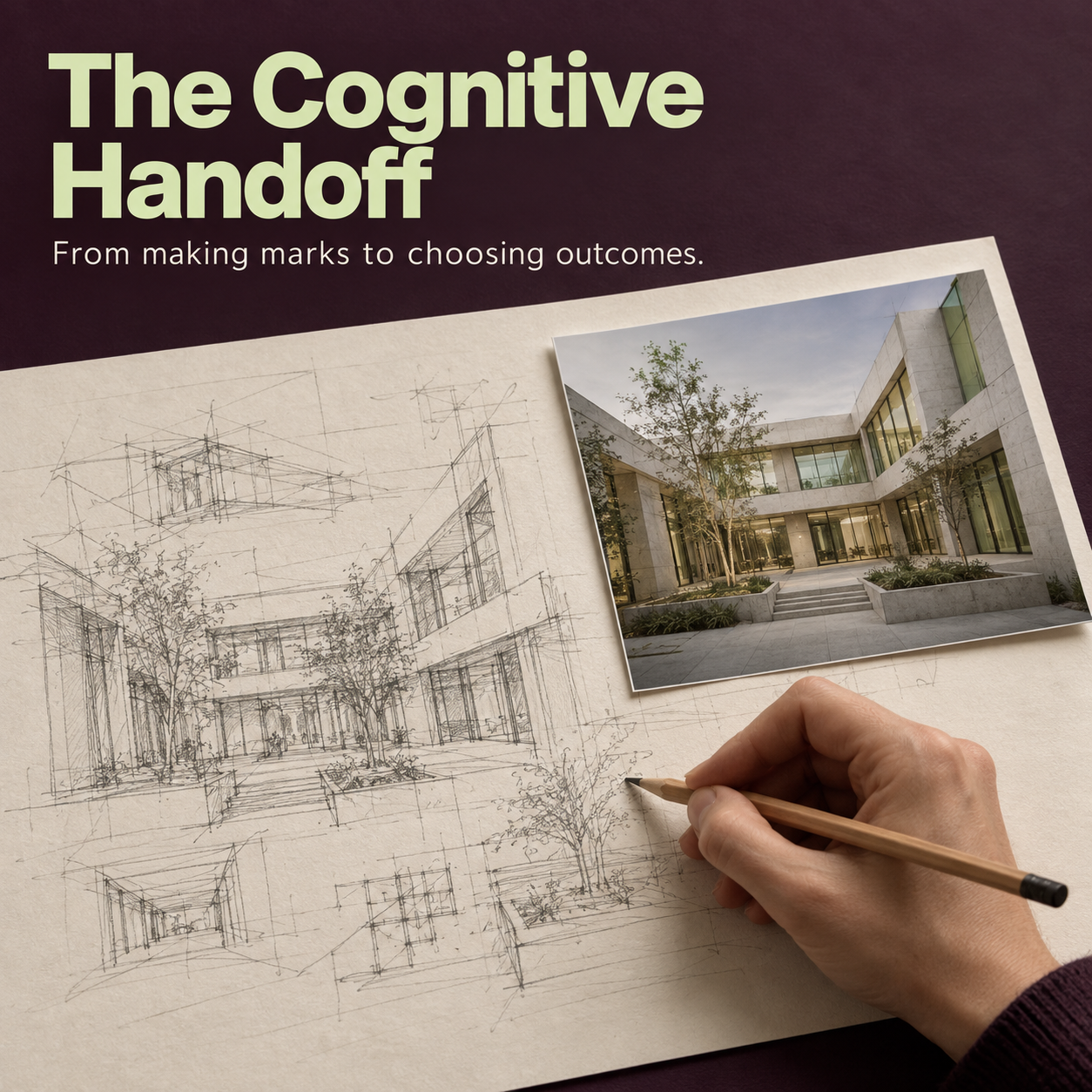
Traditional design sketching functions as a cognitive loop between the mind and hand, where thinking and making occur simultaneously. The ambiguity and unfinished nature of hand drawings allow designers to constantly reinterpret their marks, enabling unplanned discoveries during the creative process rather than simply recording pre-existing mental ideas.
Generative artificial intelligence alters this dynamic by presenting highly resolved, finished outputs. This shift moves the designer’s role from making and reinterpreting ideas toward evaluating pre-made options. While AI tools can increase individual idea novelty, they risk reducing solution diversity and the cognitive benefits of drawing.
Every architect who has spent real hours at a drawing board knows a particular moment that is almost impossible to describe to anyone who has not lived it. You are drawing, following a line you intended, and the pen does something slightly other than what you planned, a curve runs a little further, two marks cross where you did not mean them to, and in that small accident an idea appears that was not in your mind a second before. You did not think it and then draw it. You drew, and the drawing thought it for you, or with you, and you sat back and recognized something you had not known you were looking for. Artists have a rough phrase for this, they say the hand is faster than the mind, and I want to begin by taking that phrase seriously and then correcting it, because the correction is the whole subject, and because the correction is what lets us ask the only question about artificial intelligence and design that actually matters.
The phrase is wrong as stated, and I should say so plainly rather than repeat it as though it were a proven fact, because it is not. The hand does not outrun the mind in some measurable race, and there is no basis for the numbers people sometimes attach to this, no credible claim that the hand is some multiple faster than thought. What actually happens is subtler and more interesting than a race. The hand does not beat the mind. It thinks alongside it. The drawing is not a transcription of a finished idea that the mind completed first and the hand merely recorded. The drawing is part of the thinking itself, a loop in which the mind proposes, the hand produces a mark, the eye reads the mark, and the reading changes what the mind proposes next, around and around, so fast and so continuously that the discovery feels like it came from the hand when it really came from the loop. The idea was not waiting in the mind to be drawn. It was produced by the act of drawing, and that is a completely different claim, and a true one.
A Term, Offered as a Hypothesis and Not a Discovery
I want to give this shift a name, and I want to be honest about the status of the name, because the worst thing a writer can do is dress a guess as a finding. So let me propose, tentatively, as a lens rather than a proven mechanism, the term the cognitive handoff. By it I mean the transfer of part of the process that turns an idea into a visible form, away from the continuous back and forth between the brain and the hand, and onto an external generative system that returns a near finished result. It is a hypothesis about a change in where the thinking happens, not a neurological fact, and I offer it in that spirit. The honest version of the two situations is not two proven diagrams of the brain but two conceptual models of a loop. In the traditional model the loop runs from the mind to the hand to the drawing and back to the mind. In the machine model it runs from the mind to a prompt to a generated output and back to the mind. These are models for thinking with, not descriptions of neurons, and in real practice the hand and the machine will often overlap in the same session rather than replacing one another cleanly. But the distinction is real enough to reason about, and reasoning about it carefully is more useful than either the panic that says the machine destroys creativity or the enthusiasm that says it merely accelerates it.
The reason the distinction matters is that it is not fundamentally about speed, and this is where almost every discussion of the subject goes wrong. People compare how fast you can draw a facade by hand against how fast a system can generate one, and declare the matter settled, and they have measured the least important thing. The real question is about discovery. In the old loop, the designer regularly discovers ideas that were not in the mind before the pen moved. The genuine question about the machine is whether it allows discoveries of the same kind through dialogue and iteration, or whether it changes the very nature of what discovery is. That is the gap worth investigating, and the speed comparison is a distraction from it.
Why the Hand Was Never Just a Hand
To understand what might be handed off, you have to understand what the hand was actually doing, and here the evidence is stronger than most designers realize. Drawing is best understood not as a motor skill but as a cognitive tool, a way of making invisible mental content visible so that it can be inspected and transformed. The hand in this account is not a printer attached to the mind. The research on handwriting finds that writing by hand, with fine and spatially precise movement, produces far richer patterns of connectivity across the regions of the brain associated with sensorimotor integration and memory than typing does, and that people who learn shapes by hand recognize them better, for weeks afterward, because the motor memory of having made the shape is reactivated when they later see it. The making leaves a trace that the seeing then draws upon. This is not proof of a drawing specific mechanism, and the studies use letters and characters rather than freehand design sketches, so some of this is inference rather than demonstration. But the direction is clear enough. The fine continuous movement of the hand is doing cognitive work, not just recording a decision already made.
The design research adds the functional half of the story. The sketch is valuable for three reasons at once. It is a high bandwidth output, carrying the fine grained spatial intentions of the mind into visible form in a continuous stream. It is a persistent external buffer that holds spatial content so the working memory does not have to, which is why blindfolded architects gesture constantly to sustain what they cannot draw and report the task becoming exhausting after only about twenty minutes, the gesture unable to do what the permanent sketch does. And, most importantly for the question of discovery, the sketch is ambiguous, a display rough enough to be reinterpreted, so that the designer can look at the same marks and suddenly see them as something else, the seeing as that produces the unplanned idea. The sketch keeps several possible meanings in play at once, and the discovery happens precisely in that openness, when the mind reads a new possibility out of marks that did not fully commit to any single one. The design emerges in the gap between what was intended and what was made, and the gap exists because the sketch is imperfect and unfinished and therefore still negotiable.
What the Machine Changes
Now place the generated image beside the sketch and the difference becomes sharp, and it is not the difference the speed talk predicts. The empirical record on artificial intelligence in design is genuinely mixed and should be reported honestly rather than bent to a conclusion. On one hand, access to machine generated ideas reliably raises the judged novelty and usefulness of a single artefact, with the largest gains for less experienced people, and compresses the workflow into a series of small fast loops. On the other hand, the same studies find that it lowers the variety across a set of solutions and makes outputs more similar to one another, an individual gain paid for by a collective loss of diversity. These are different things that are constantly confused, the novelty of one object and the range across many, and the machine appears to raise the first while lowering the second. In the studies that compare it directly against sketching, the generated condition produced lower variety and fluency, and crucially about half the designers changed their cognitive style when they moved to the machine, with the normally expert like focused designers doing worst, falling into anchoring and prompt fixation, one of them saying that he became so fixated on making the system generate what he wanted that he forgot he could simply have sketched it himself.
That sentence is the whole matter in miniature, and it points straight at discovery. The generated image tends to be too resolved to be reinterpreted. It arrives nearly finished, and a finished image invites you to select it or reject it, not to see it as something else, because it has already committed to being one thing. Where the sketch keeps multiple outcomes alive in its ambiguity, the rendered output closes them down into a single resolved proposal, and so the cognitive work of the loop migrates from making and reinterpreting toward evaluating and choosing. Designers describe exactly this shift, from what they call a history path, a layered revisable process that scaffolds memory and allows deliberate reflection, to a generation cycle, where each output is a fresh sample with no visual continuity to the last, pushing decisions toward fast intuitive judgment and leaving fewer openings for the slow reinterpretation in which unplanned ideas are born. The handoff, if it is real, is not a handoff of speed. It is a handoff of the moment of discovery, from a process that generates surprises inside the designer to a process that presents finished options for the designer to judge.
The Honest Uncertainty
I have to be careful here, because the temptation is to turn this into a lament, and the evidence does not license a confident verdict. A great deal is simply not yet established. The direct evidence on memory and learning for machine mediated creation is essentially absent, and the prediction that it weakens the encoding that the hand provides is an inference from the handwriting studies, not a demonstrated result. The studies that do exist are small, often a handful of participants in a single session in a single narrow domain, watches or chairs or journal covers or a first year studio, and they rely heavily on self report. The constructs are inconsistent, with novelty and variety and fluency and fixation all treated loosely as creativity. And the causal direction in the cognitive style findings is unclear, because a change in style might be a cause of tool use or a consequence of it. So the cognitive handoff must remain, for now, a hypothesis, a frame that organizes a set of suggestive findings and generates testable questions, not a proven mechanism I can assert. Anyone who tells you the science has settled whether the machine helps or harms creative discovery is overstating what we know.
But the hypothesis earns its keep by being testable, and the questions it raises are the right ones. Does a stylus on a tablet reproduce the rich brain connectivity of the hand while a prompt does not. Do designers remember their own decisions and constraints less well after generating than after drawing, when time is held equal. And the most important one for everything I have argued, does deliberately making the machine’s output ambiguous again, partial, unrendered, sketch like, multi variant, restore the capacity for reinterpretation and reduce the anchoring. If it does, then the loss was never in the machine as such but in the resolution of its output, and the cure is to design generation that stays open rather than closing down, to make the system produce sketches rather than photographs. That is a question architecture can actually act on.
The Architectural Stakes
For architecture the mismatch is sharpest, because architecture has always thought through exactly the ambiguous revisable mark that the generated image abolishes. The studies of machine generation in architecture find that it produces visually high quality facades and interiors but, by the researchers own assessment, cannot yet produce a complete design action, that the outputs sit at the stage of a concept image and that the system has little capacity to produce the conceptual sketches through which architects actually think. The studio experiments that worked best were the ones that sandwiched the machine between conventional phases, research and sketching before, and sketching again after, so that the high bandwidth channel of the hand was preserved and the machine supplied breadth rather than replacing the thinking. This is the practical shape of a sane response, not substitution but sequencing, sketch then generate then sketch again, keeping the hand in the exploratory loop where discovery lives and using generation for the breadth and the rendering it genuinely provides.
So the deeper worry is not that the machine makes ugly buildings, because it often makes striking ones, but that it quietly relocates the act of discovery out of the designer and into a process of selection among finished options, and that a generation of architects trained primarily to prompt and choose may never develop the particular intelligence that only grows in the loop between the mind and the hand. The cities we build are the record of how architects thought, and if the thinking shifts from generating surprises to selecting proposals, the projects of the future may be more polished and less discovered, more resolved and less reinterpreted, and the loss will be invisible precisely because the outputs will look better than ever. The most serious architectural research of this moment should therefore study not whether the machine is faster, which is obvious and unimportant, but whether it preserves or abolishes the discovery that was the real gift of the hand, and whether that discovery can be rebuilt inside the dialogue with the machine or only outside it.
I return, at the end, to the moment at the drawing board, the line that ran a little further than intended and became an idea. That moment was never evidence that the hand is faster than the mind, and I will not pretend it was. It was evidence that thinking and making were, for the designer at the board, a single continuous act, and that discovery lived in the imperfect gap between intention and result. The cognitive handoff, if it is happening, is the handing of that gap to a machine that returns results too finished to leave a gap at all, and the whole future of design cognition may turn on whether we can teach the machine to hand the gap back, to stay unfinished long enough for us to see something we did not plan. The news will keep marveling at how fast and how beautiful the generated images have become, and the competitions will keep rewarding the polish, and the quieter and more important measure of the construction culture we are building will be whether anyone is still discovering anything they did not already intend. The genuine sustainability of design as a form of thinking depends less on the speed of the tool than on the survival of that small, ancient, irreplaceable moment when the making teaches the maker something the maker did not know, and the one honest thing I can say about the machine is that we do not yet know whether it preserves that moment or ends it, and that finding out is the most important question the discipline currently has.
✦ ArchUp Editorial Insight
The essay’s governing discipline is its refusal to let a useful phrase stand as a proven fact — it corrects the artists’ claim that the hand is faster than the mind before building on it, establishing instead that drawing is a loop in which mind proposes, hand marks, eye reads, and the reading changes the next proposal, so the idea was produced by the act rather than waiting in the mind to be transcribed. That correction is the analytical engine, because it converts the automation question from the trivial one everyone asks, which tool is faster, into the one that matters: whether the machine preserves or abolishes discovery, the moment the making teaches the maker something unplanned. The most structurally precise observation is that the sketch’s value lies in its ambiguity — a mark rough enough to be reinterpreted, holding several possible meanings in play — while the generated image arrives too resolved to be reinterpreted, committed to being one thing, so the cognitive work migrates from making and reinterpreting toward evaluating and choosing. This is the same decoupling of finished surface from generative process this archive traced in The Value Is in the Verb, Not the Noun and I Miss the Render, where the visualization’s confidence outran its coherence and the quality-control function embedded in slow work was quietly lost. What distinguishes this piece sharply from the AI panic it could have become is its intellectual honesty about its own evidence: it names the cognitive handoff explicitly as a hypothesis and a lens rather than a neurological finding, reports that the studies are small and the constructs loose and the causal direction unclear, and concedes that the memory prediction is inference from handwriting research rather than demonstration — the rare case where the forensic register this archive values is applied by the author to his own thesis. The structural stakes it reaches are the formation concern this archive has tracked from Between Two Films to The Consulting Pyramid Is Collapsing From the Bottom Up: a generation trained primarily to prompt and choose may never develop the intelligence that grows only in the loop between mind and hand, and the loss would be invisible precisely because the outputs look better than ever — the cities becoming more polished and less discovered, the deficit undetectable in exactly the images that conceal it, with the one honest conclusion being that the discipline does not yet know whether the machine preserves that ancient moment or ends it, and that finding out is the real research question, not the speed comparison that distracts from it.
Ibrahim Fawakherji — ArchUp
Sources
- Fan JE, Bainbridge WA, Chamberlain R, Wammes JD. Drawing as a versatile cognitive tool. Nature Reviews Psychology, 2023.
- Zhang H, Wei J, Qian CZ. Reimagining intuition: how AI image generation technologies reshape graphic designers’ creative patterns. Thinking Skills and Creativity, 2026.
- Van der Weel FR, Van der Meer ALH. Handwriting but not typewriting leads to widespread brain connectivity: a high density EEG study. Frontiers in Psychology, 2024.
- Longcamp M, Boucard C, Gilhodes JC, et al. Learning through hand or typewriting influences visual recognition of new graphic shapes. Journal of Cognitive Neuroscience, 2008.
- Neural encoding of handwriting in the human motor cortex. Nature Human Behaviour, 2025.
- Cooper D. Imagination’s hand: the role of gesture in design drawing. Design Studies, 2018.
- Self J, Evans M, Kim EJ. A comparison of digital and conventional sketching: implications for conceptual design ideation. Journal of Design Research, 2016.
- Zhang X, Fan H, Zhou J, et al. Impact of image generation tool on designers’ cognitive styles and design performance during product conceptual design. Journal of Engineering Design, 2026.
- Lee S, Kang S. The influence of generative AI with prompt engineering on creative design in architectural education. Journal of Asian Architecture and Building Engineering, 2025.
- Zou J, Zhao X, Siu KWM, Zhao T. Enhancing design ideation: comparing AIGC engaged and traditional brainstorming in educational contexts. Educational Technology Research and Development, 2026.
- Liu H, Zhang X, Zhou J, et al. Cognitive styles and design performances in conceptual design collaboration with generative AI. International Journal of Technology and Design Education, 2024.
- Doshi AR, Hauser OP. Generative AI enhances individual creativity but reduces the collective diversity of novel content. Science Advances, 2024.
- Lee BC, Chung J. An empirical investigation of the impact of ChatGPT on creativity. Nature Human Behaviour, 2024.
- Hou G, Wang X. Emotional valence and arousal: the impact of AI generated image stimuli on design creativity. International Journal of Technology and Design Education, 2024.
- Bai L, Liu X, Su J. ChatGPT: the cognitive effects on learning and memory. Brain-X, 2023.
- Çelik T. The effect of artificial intelligence on creativity in conceptual design in architectural education. AI and Society, 2024.