Shell Book Pavilion: Redefining the Kinetic Public Realm

Stability of Public Spaces and Rethinking
Most Cities public spaces tend to maintain a fixed state throughout the day; they appear the same in the morning and at noon, with the expectation that the user adapts to this stability. Within this context, the “Shell Book Pavilion” in Beijing emerges as a case that goes beyond this conventional model, redefining the relationship between the user and public space.
The Pavilion as a Kinetic Structure
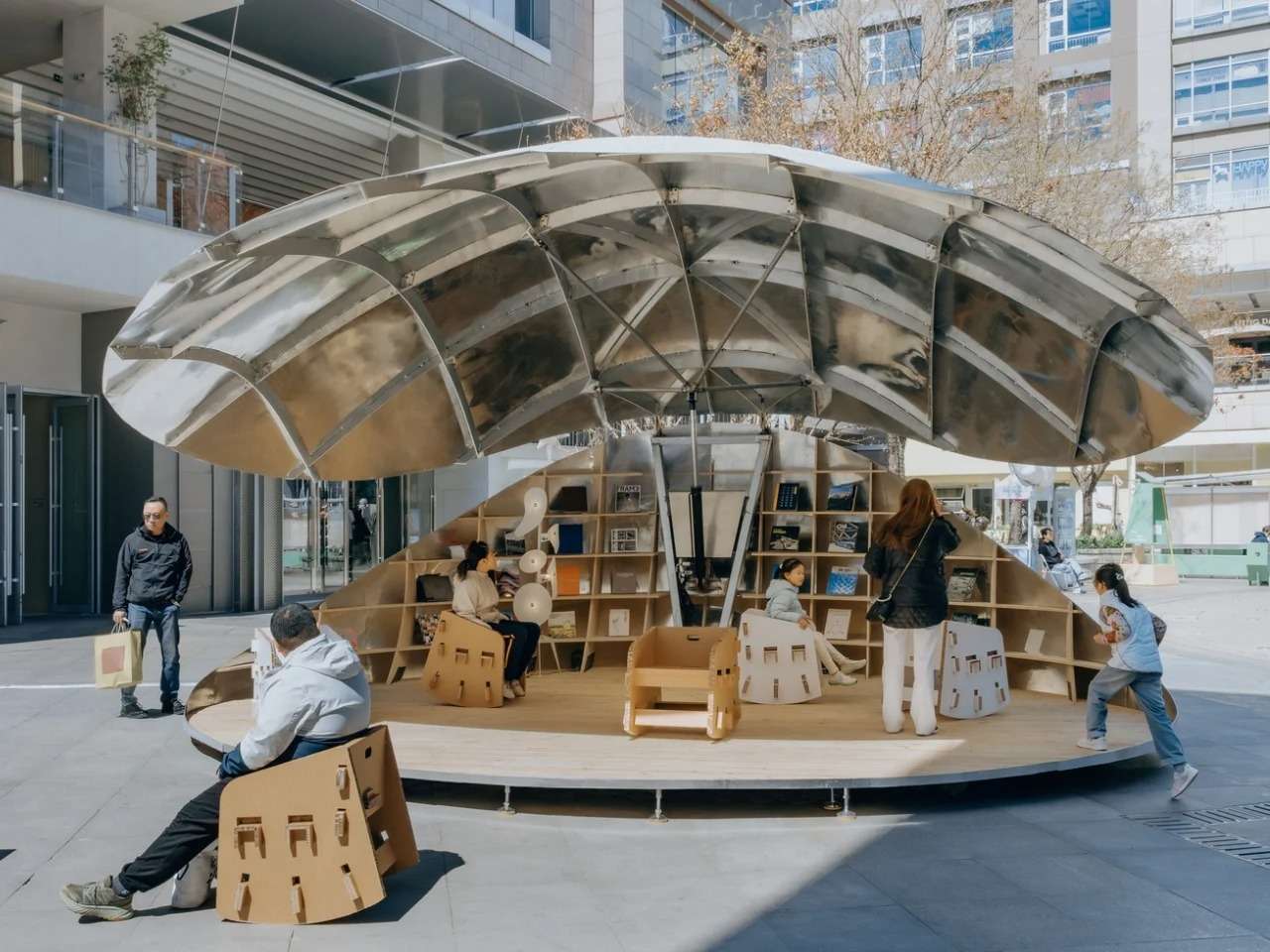
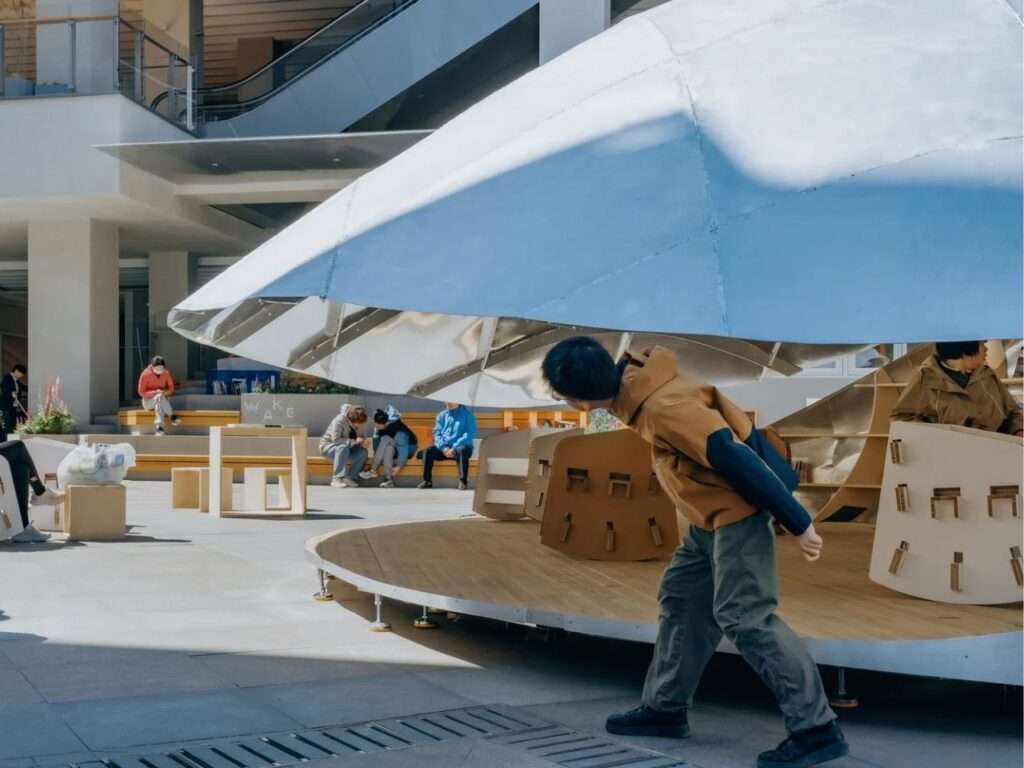
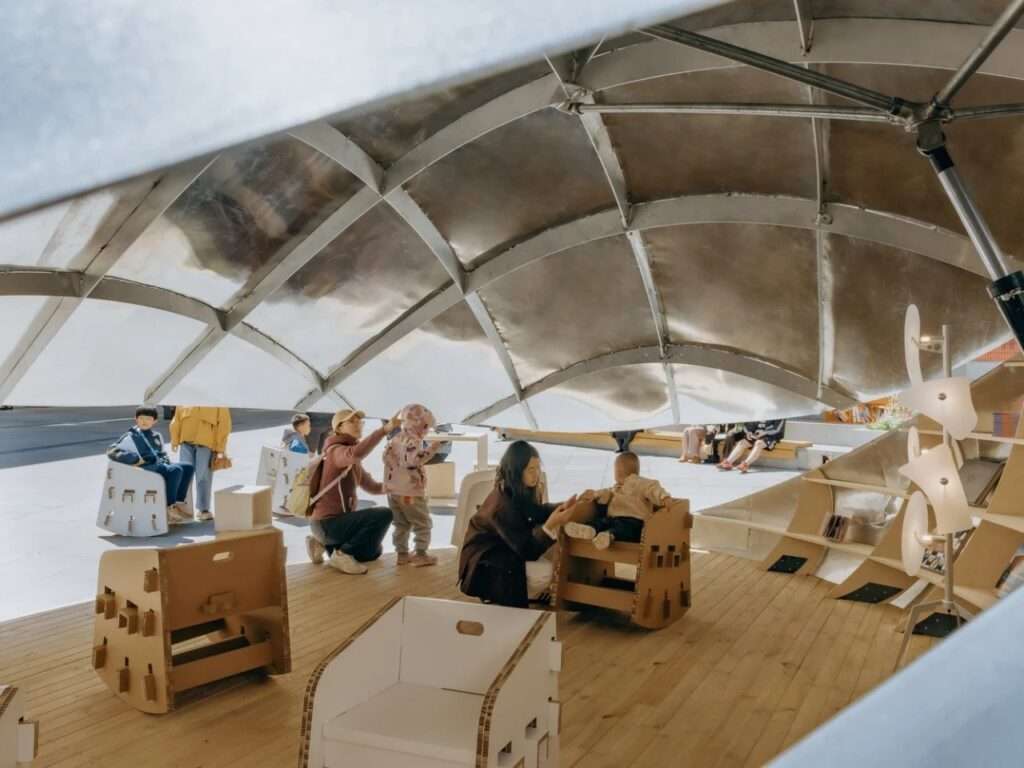
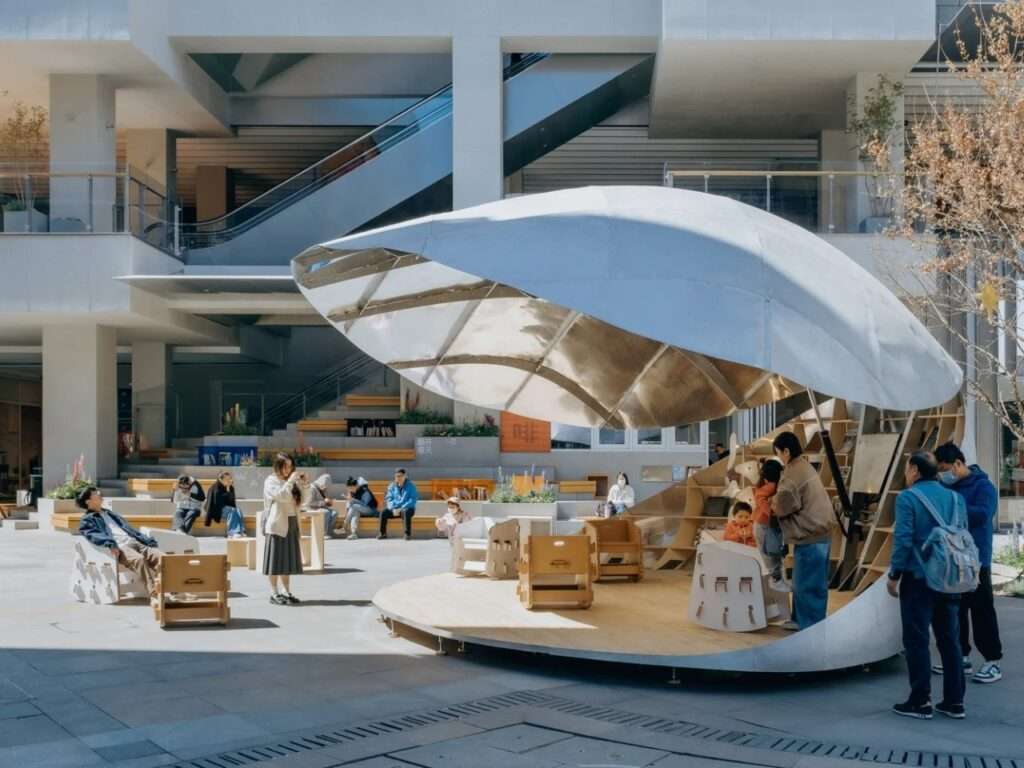
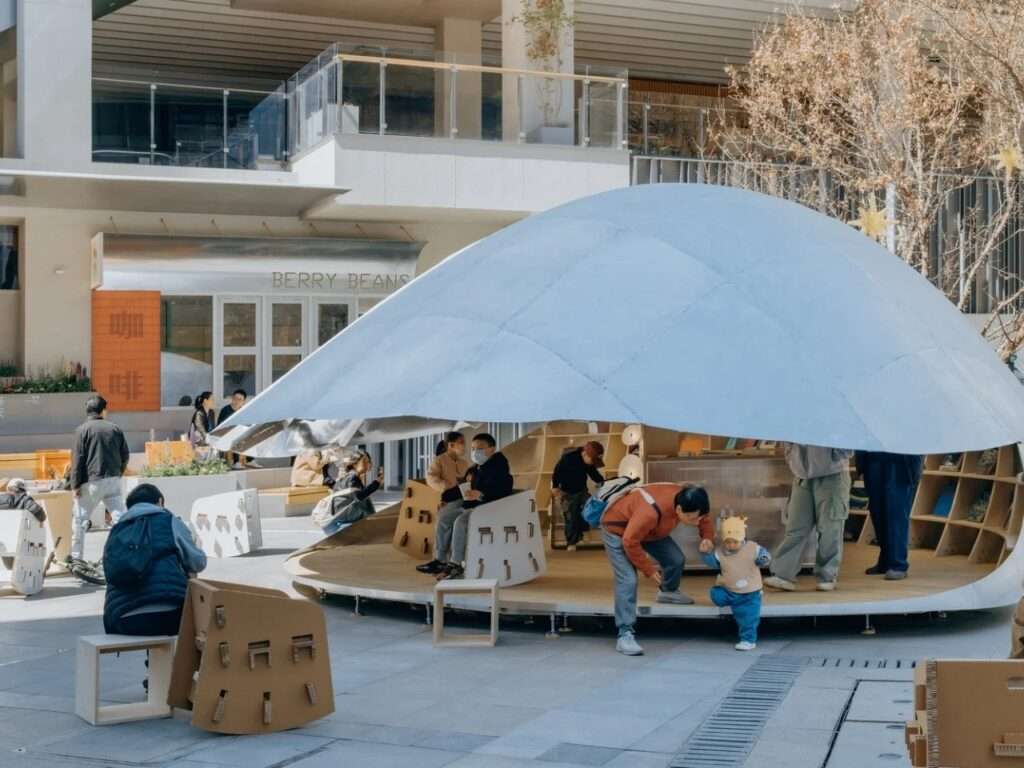
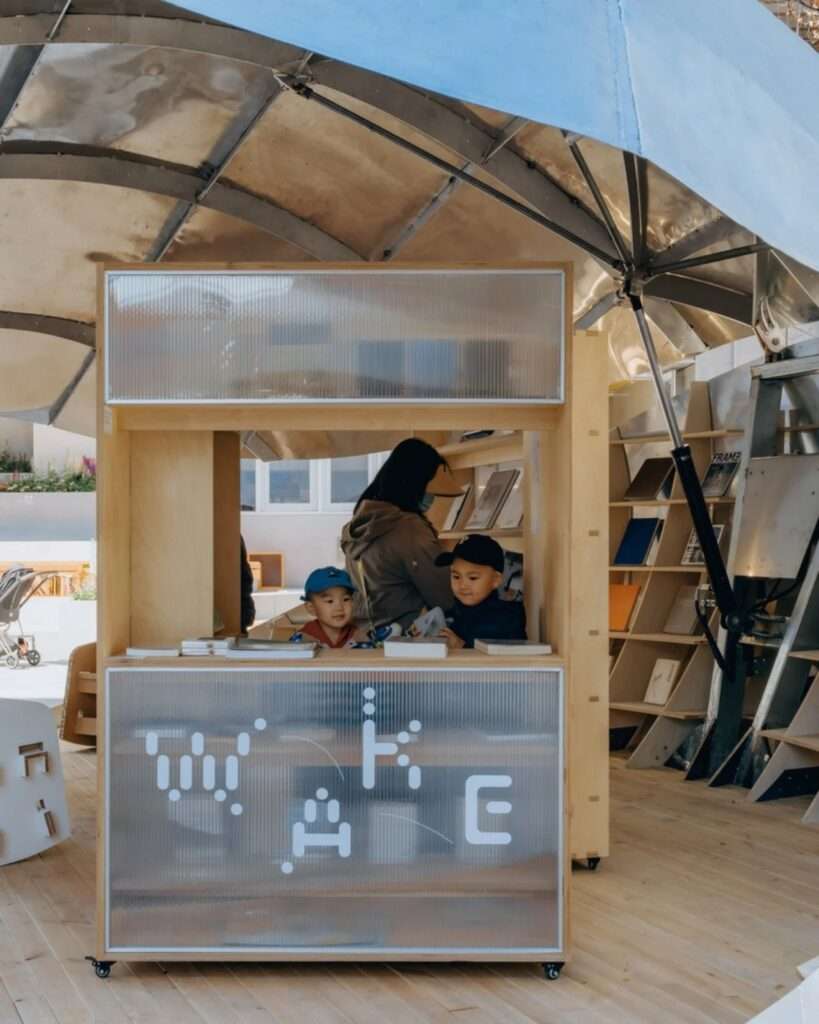
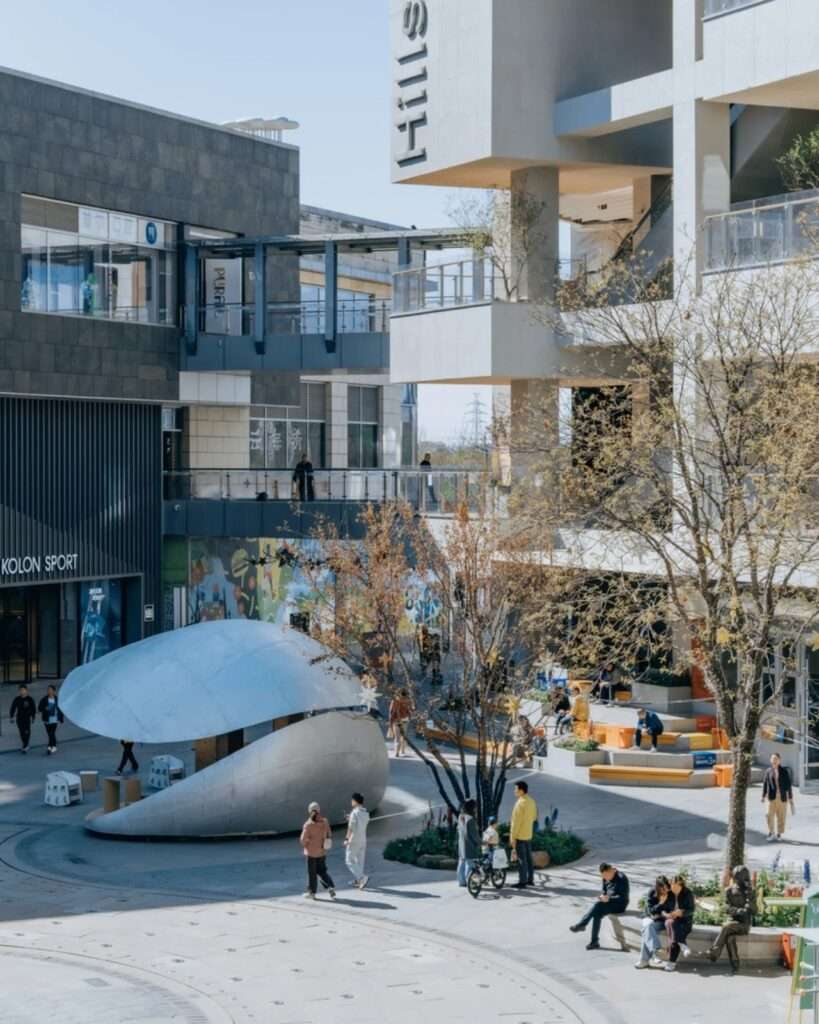
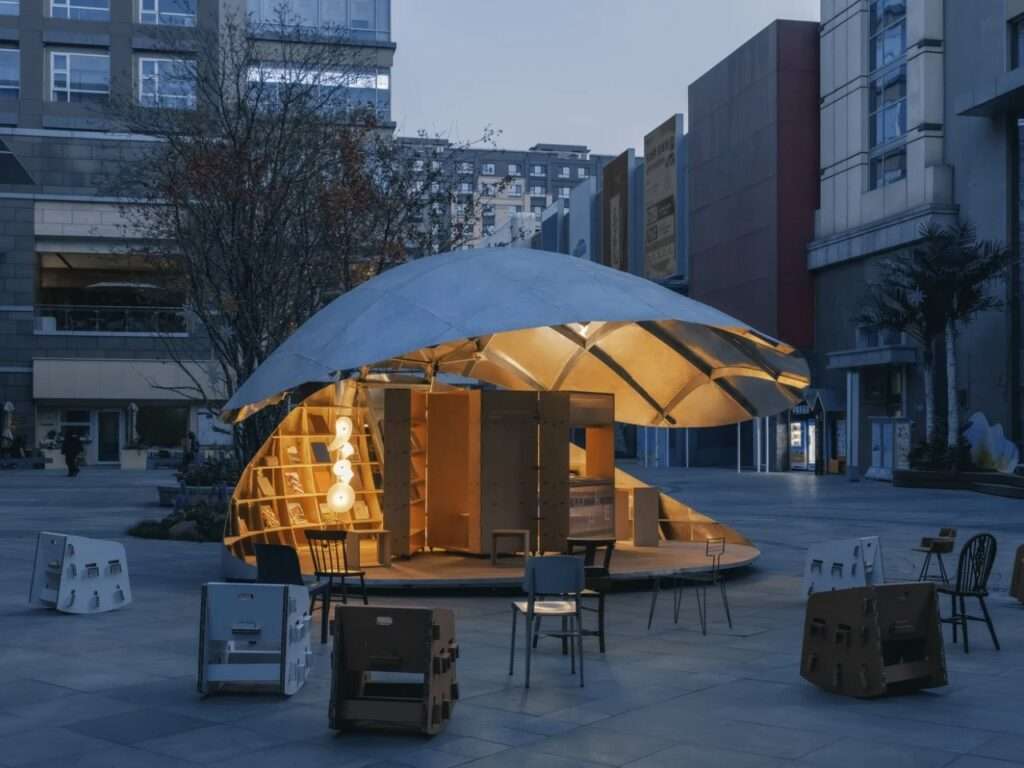
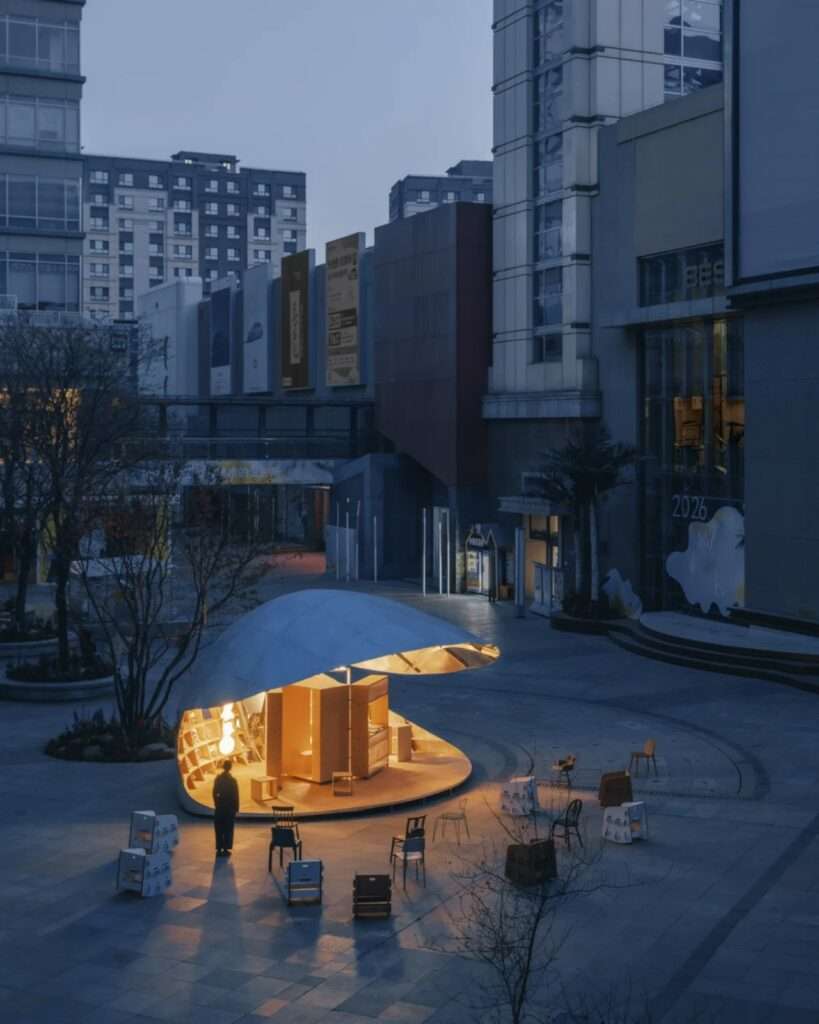
The project is located within Xiangyun Town commercial plaza in Beijing, with an area of 43 square meters. The pavilion is characterized as a shell-shaped structure that can physically open and close through a vertical motion system. Its Design changes throughout the day; when elevated, it transforms into an open canopy, while when lowered, it becomes a quieter and more enclosed space. In this way, it is not treated as a static element, but as a structure that changes according to time and use.
Contextual Reference and Spatial Response
The concept emerged from earlier observations on the same site, where the natural rhythm of movement and its relation to daily use was noted. Based on this, the design approach was developed as a response to context rather than an imposition upon it. As a result, the pavilion relies on a direct functional presence within the plaza, shaped through interaction with users more than through formal stability. You can explore similar Research on spatial behavior.
Material Structure and the Absence of a Fixed Orientation
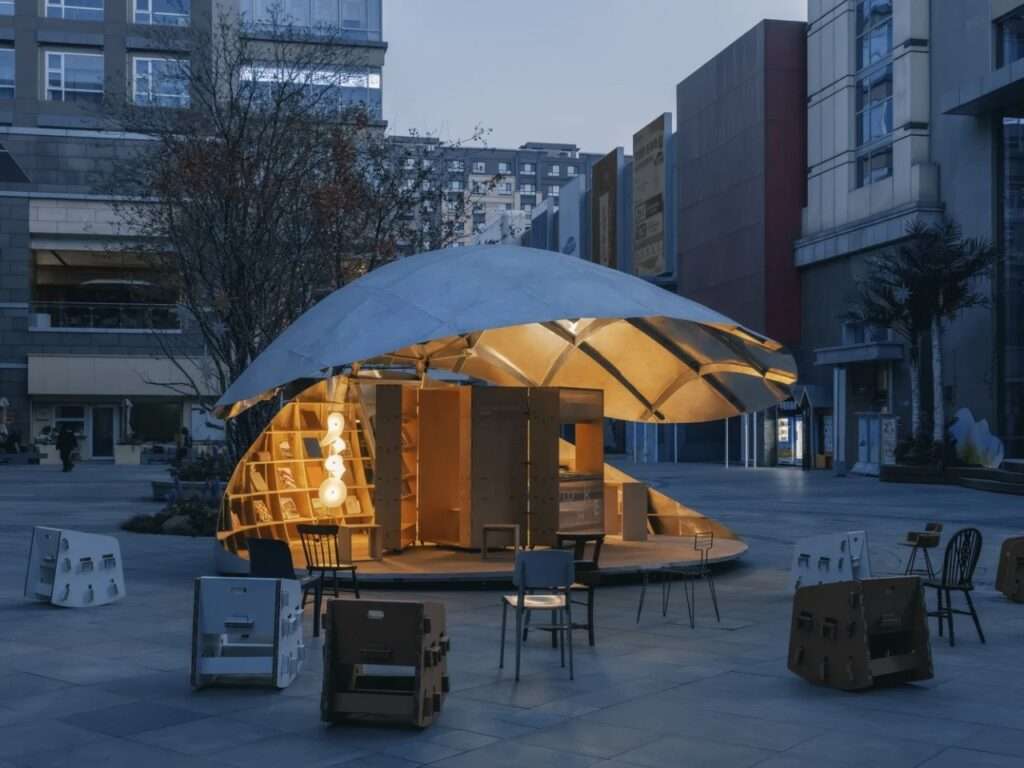
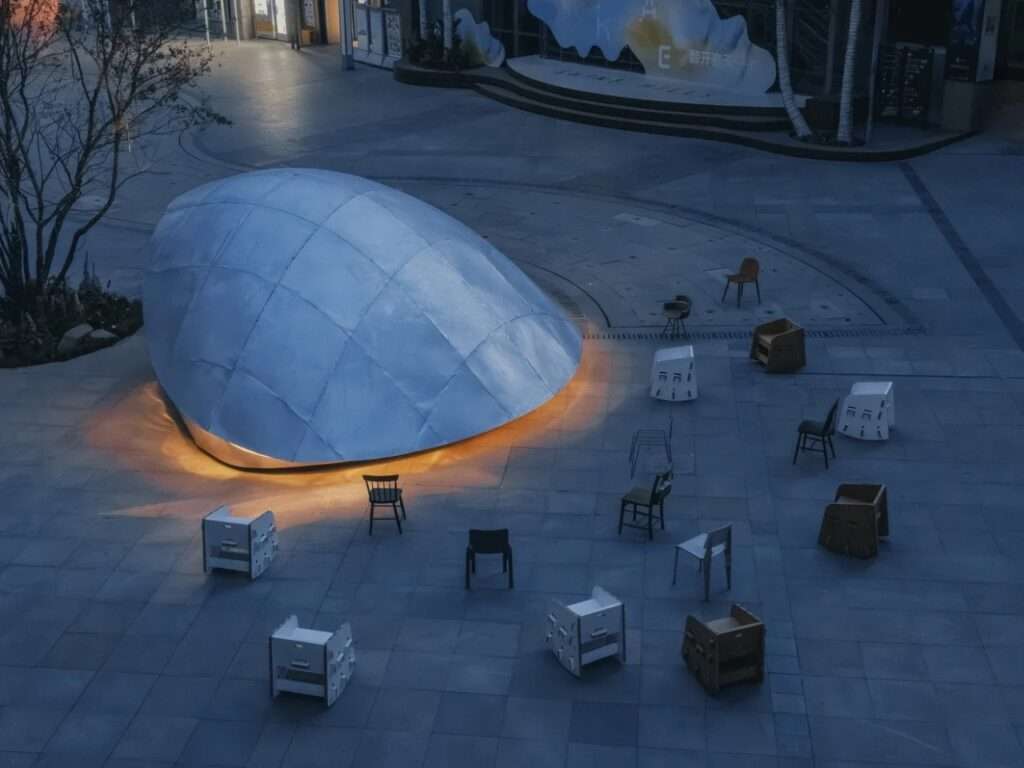
The pavilion is constructed from an aluminum shell-like structure, deliberately rejecting the idea of a fixed front and back facade. The architectural mass can be read from any direction, aligning with the nature of public squares that are used from multiple axes in a non-linear manner. In this context, spaces that require a fixed viewing angle become less efficient as public environments, as they impose conditions on user experience instead of responding to movement. The choice of Building Materials like aluminum plays a key role here.
Social Extension Beyond Spatial Boundaries
A system of movable seating surrounds the pavilion, expanding its impact beyond its physical footprint. As a result, the functional influence of the project exceeds its actual 43-square-meter area. This is reflected in user behavior, where presence is not limited to the interior of the structure but extends into its surroundings, enabling longer spontaneous stays and pauses, which demonstrates the effectiveness of the space in generating unplanned use. More examples of Projects with similar social strategies can be found online.
Formal Metaphor and Material Treatment
The design relies on the shell as a formal reference, interpreted in a direct manner without exaggeration. The use of aluminum as a construction material reduces organic associations and recalibrates the relationship between concept and form, ensuring the structure remains clear and unembellished. In this way, the space appears as a balanced element between formal expression and visual stability within the urban context. For further reading on Construction techniques, see related resources.
Scale versus Ambition in Public Space
The central tension in the “Shell Book Pavilion” lies in the contrast between its small scale and the clarity of its architectural ambition. The project is a 43-square-meter structure within a commercial district, not a large-scale cultural institution. However, its presence suggests that influencing neighborhood experience is not necessarily dependent on project size, but rather on the clarity of the idea and the precision of its execution within context. Compare this with other Buildings that prioritize neighborhood integration.
Redefining Reading Spaces
Public reading spaces are undergoing continuous transformations in their use and role. In this framework, the pavilion does not directly respond to these transformations, but instead provides a simple environment for sitting and reading. The space shifts according to time; it opens to receive users and gradually returns to calmness as movement decreases. In this way, the project responds to daily rhythms rather than imposing a new behavioral model of reading. See how Interior Design principles influence such adaptive spaces.
Project Representation Between Image and Experience
Photographs of the pavilion present a strong visual presence of the structure under natural lighting, reflecting a coherent visual reading of the composition. At the same time, this coherence indicates the design’s ability to operate in three-dimensional reality, not only in two-dimensional visual representation. Therefore, the evaluation of the project is not limited to its imagery, but extends to its actual usability within context. Stay updated with Architectural News on similar interactive pavilions.
✦ ArchUp Editorial Insight
In the Xiangyun Town commercial district in Beijing, the Shell Book Pavilion operates as a spatial outcome of urban development policies that prioritize activating commercial flow over producing independent cultural value, where small parcels of land are transformed into tools for regulating user behavior within public space. The allocation of 43 square meters reflects an urban efficiency logic rather than architectural ambition, relying on lightweight aluminum systems and a kinetic mechanism that reduces operational costs and long-term risks. The vertical shell movement acts as a regulatory response to shifting usage density and shading requirements, redistributing user flow within the plaza instead of concentrating it at a single point. The project does not appear as an individual architectural gesture as much as it reveals a balance between commercial attraction goals, maintenance constraints, and flexibility requirements within a standardized urban fabric. You can review Architects Lobby discussions for more insight on urban policies and Archive of similar case studies.