The Data Center

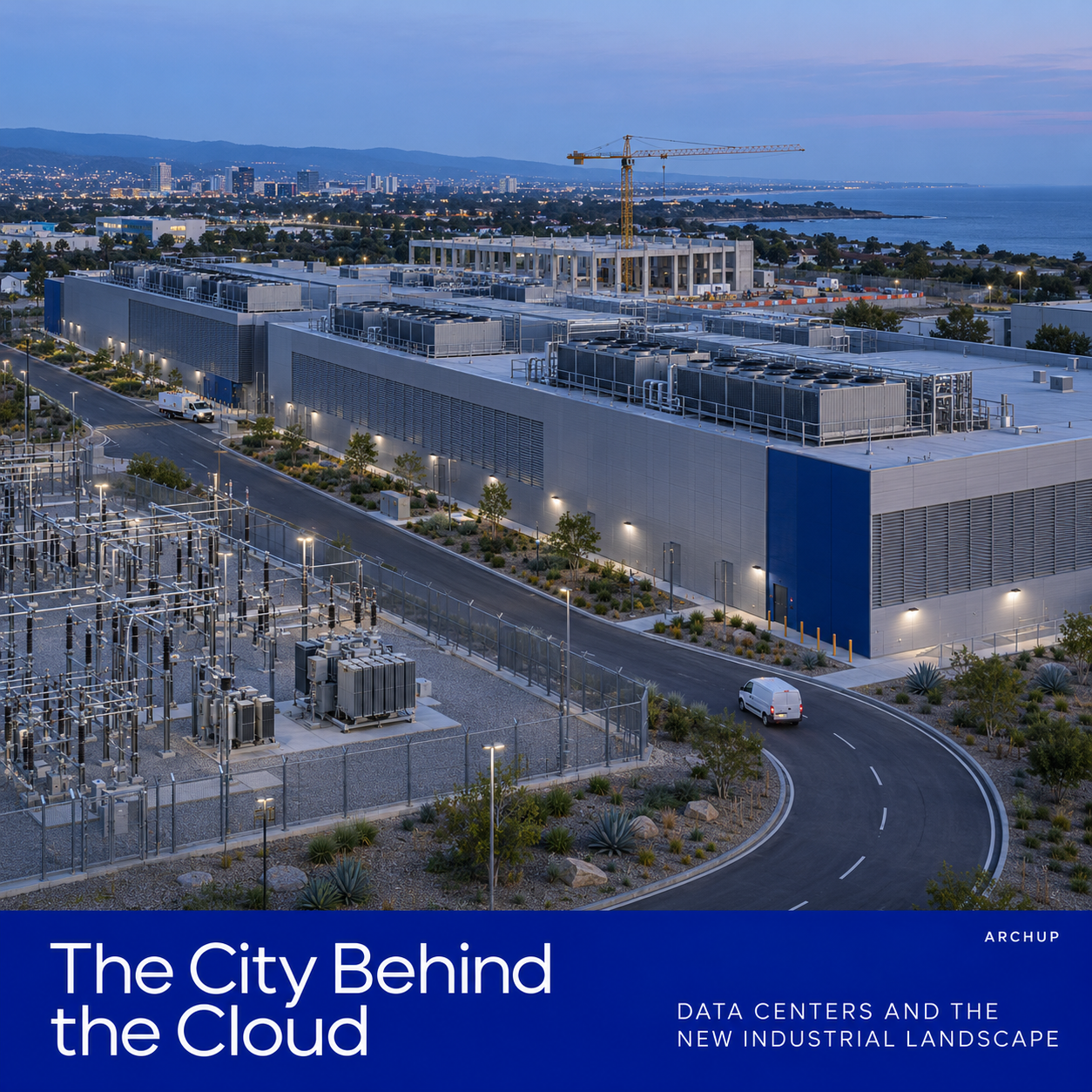
The rapid expansion of data centers represents a major shift in global construction and energy consumption. Functioning as essential infrastructure rather than traditional architecture, these windowless facilities prioritize power and heat management over aesthetics. Like historical industrial booms, data centers cluster near established energy grids and urban peripheries.
Despite high resource demands, data centers generate few local jobs and face rapid technological obsolescence. Their growing impact on electricity and water grids has spurred investments in reliable power sources like nuclear energy. Sustainable planning requires integrating waste heat into urban networks rather than treating facilities as isolated structures.
The building that thinks and does not want to be seen
A few days ago I was reading the indices of architectural projects around the world, those numbers that tell you where capital is moving and where the cranes are turning, and I noticed something that would not have appeared on the chart a few years ago. The traditional work, the towers and the complexes and the offices, looked oddly quiet, unhurried, while a vast current of money and construction was pouring toward a single kind of building that almost no one used to count as architecture at all, the data center. These flat windowless boxes, with no facade worth the name, have suddenly become the single largest customer of electricity in the world, and the single largest project on the desk of every major contractor, and the question that held me was not what these buildings are, but what kind of boom they represent, which earlier revolution they resemble, and where they are taking the practice of those of us who design and build. Because the answer is more tangled than it looks, I begin with an admission the honest research forces on anyone, that nobody knows for certain the scale of what is coming, and that every number in this subject must be read with caution.
Infrastructure disguised as a building
The first thing to understand is that a data center is not a building in the sense we were trained to mean, but infrastructure disguised as a building. It is a stack of systems, redundant electrical distribution, cooling that rejects an enormous heat load, a fabric of networking and storage, and physical security, all wrapped around racks of servers. As its loads grew from a few kilowatts per rack to a campus of several hundred megawatts, it crossed the threshold from equipment in a room to critical infrastructure for the whole economy. And here is the first reversal of our architectural instinct, that the design problem in this building is not the facade or the space or the light, but power and heat. An architect approaching a data center discovers that the aesthetic question has withdrawn entirely, and that its place has been taken by the electrical substation, the cooling plant, and the water line. The building we spent centuries teaching students to articulate with light and shadow has become a mute mass whose only function is to keep computation alive.

This mute mass has an older lineage than we think, descending from two bloodlines that fused. A computing line that began in the machine rooms attached to mainframes, with their raised floors and air conditioning, then grew into server farms, then into what came to be called the warehouse scale computer, where the whole building became a single designed machine. And an older, more spatial line, the line of telecommunications, the wire centers and switches, then the carrier hotels and interconnection points born in the nineteen nineties to make networks meet. The telling detail is that many of these early buildings were never built for the purpose at all, but were recycled factories and stores and offices turned into what was then called cyberbuildings. From this comes the double nature that still marks the industry, purpose built shells alongside the adaptive reuse of an older industrial and commercial stock, and the construction of a data center is as often a conversion as it is a new build.
A boom whose grandmothers we know
To understand the boom I went back to the booms that preceded it, because history here is clearer than any forecast. Data centers are the fixed capital through which a general purpose technology is delivered, exactly as the grid was the fixed capital of electrification, which makes them siblings of the railway, electricity, and the factory system. The resemblance is not a loose metaphor but a structural one. As the railway had its junctions and the telegraph its exchanges, today’s network has its interconnection points where value accumulates, turning a flat network into a hierarchy. As nineteenth century industry locked onto coalfields and railheads, data centers cluster where electrical capacity and fiber and technical labor already exist, so much so that the strongest statistical predictor of how many data centers a city holds is its installed power capacity, followed by technical employment and broadband quality, with a marked pull toward the sites of retired coal plants. New projects are twice as likely as operating ones to sit in communities that lost their coal, the same logic that bound the industry of the past to the seam and the rail. There is the land speculation and the subsidy race too, for as dark fiber was laid in the boom of the nineties against a demand that had not yet arrived, so today the substations and the pre certified megasites are banked against tax exemptions that stretch across decades.
But honesty demands that the analogy not be pressed harder than it can bear, because the differences are more dangerous than the likeness, and they are exactly what should worry the contractor and the investor. The first difference is a mismatch of lifespan and obsolescence. Transmission lines and railways and dams are built over decades and depreciate over thirty to fifty years, while the fleet of processors that fills a data center is economically obsolete in three to six. We are looking, then, at infrastructure with a physical life of half a century, financed against revenue cycles of five years, a financial fragility of a kind the earlier booms never knew. The second difference, more serious socially, is that these buildings employ almost no one. A data center consumes resources on the scale of a small city while running a few dozen workers. The old factory produced a good and produced with it a working class that organized and consumed and voted locally, while the data center produces the output without producing the society, weakening the classic industrial multiplier and reducing the local political economy to a fiscal bargain over taxes and grid costs. When a local official rejoices at the arrival of a great data center expecting jobs, he makes the very error the evidence warns against, counting the old factory while receiving the building of the future that has no workers in it. The projects that reshape a regional economy used to arrive with a workforce, and these do not.
Why it wants firm power, not cheap power
There is a subtle technical difference with an enormous effect on where this work goes, and it deserves explaining because it inverts our intuition. In most heavy industry electricity price is king, and aluminum smelters and railways chase cheap power wherever it hides. The data center, by contrast, spends electricity as a relatively small share of its cost, and the larger driver is the utilization rate, keeping the expensive machines running at full capacity for as many hours as possible. For this reason these buildings do not chase cheap power but firm, guaranteed power, the supply that never fails, because an hour of a stalled processor costs far more than any difference in the price of a kilowatt hour. This explains a phenomenon that would have looked insane a few years ago, that the great technology firms now contract to restart nuclear reactors, and that nuclear power has become a procurement strategy rather than only an environmental choice. The last difference is that the product of these buildings, computation, moves at the speed of light with no transport cost, so the only constraints left on siting are power, water, fiber, and permitting, which are precisely the variables that have become a field of fierce political struggle.
Energy, water, and heat, the truth beneath the numbers
There is no speaking of this boom without looking at its footprint, and here balance is required. Globally the data center share of electricity is still small, somewhere near one to one and a half percent of world demand, but locally it is enormous and concentrated to the point of choking. In some states and countries the data center share exceeds a fifth of national consumption or more than a quarter of a state’s electricity. Water is another story, usually hidden, for evaporative cooling drinks quantities comparable to hospitals and golf courses, and fewer than a third of operators even measure their water at all. Heat is the great paradox, for a data center is in essence a resistive heater that also computes, so nearly all the power that enters leaves as low grade heat. This heat we treat as a problem is in truth a wasted resource, able to warm residential districts as in the Nordic model, or to be turned to carbon capture and water purification. The architectural lesson is plain, that a design which treats heat as an enemy to be expelled squanders a fortune, while a design that treats it as a byproduct to be sold turns a burden into an asset.
Where these buildings actually go
The popular image of a remote rural cloud is entirely wrong. The numbers say the overwhelming majority of data centers sit in metropolitan or near metropolitan areas, as peripheral extensions of cities rather than escapes from them. The boom, in its most sober population projections to mid century, reinforces existing urban hierarchies rather than producing decentralization, for the great cities that gather power and fiber and demand will gather the computation too. For the contractor and the planner this means the battle will not be in the wilderness but on the edges of cities, where farms and suburbs are converted into warehouses and substations and data centers, and where the map of land and water and electricity is redrawn. More troubling, local planning authority is being steadily stripped and raised to higher levels, through laws that override zoning, siting boards, and utility commissions that decide where large loads may connect to the grid. Planning itself shifts from a deliberative practice into administrative coordination, a change in the balance of power that everyone working in this field must grasp, because the cities that will host this build out are losing the very tools with which they used to shape it.
Out of all this new typologies are taking shape that the architect must learn. The hyperscale shell, flat and blind and monumental, where the problem has migrated from the facade to the substation. The data park, an adaptive reuse of an old industrial building wired into a district heating network. The small edge node in the urban core, the industry now bimodal, a vast campus on the periphery and small nodes at the center. The underground heat hub, the building buried tens of meters below the surface to exploit the stable coolness of the earth, freeing the land above for housing and parks and shortening the heat networks. And the chiller free facility running on high temperature liquid cooling, which can be placed almost anywhere and export usable heat. These are not fantasy but typologies that exist today, and each is an opportunity for a contractor and an architect who understand that the rules of the game have changed.
The measure that separates an asset from a burden
What then decides whether a data center is a blessing on its city or a curse? A comparison between two Nordic models gives the answer precisely. One city received a vast campus and had to invest heavily in high voltage lines and water, then its free cooling design closed the door on heat reuse, so it became a single purpose burden. Another city planned mixed use data parks in advance, fragmented in ownership, connected to a low temperature district heating network, so its data center sells cooling as a service and returns its heat to the city. The difference was not in the technology but in the planning, in the diversity of uses, in the fragmentation of ownership that allows staged regeneration and heat matching, and in the presence of a heat network prepared in advance. This is exactly the place of the architect and the planner in this boom, not in beautifying a box that does not want to be beautified, but in designing the symbiosis at the district scale, in making the building that thinks a part of the city’s metabolism rather than a parasite upon it. The most serious architectural research on this subject is no longer about the object at all, but about the system it either joins or refuses.
A boom with no face and an open fate
I return to the index I began with, to those numbers in which I saw traditional architecture slowing while the money rushed toward the blind boxes. What I saw was not the end of architecture but a shift in the meaning of what we build and for whom. We stand before a genuine boom in the rank of the railway and electricity and the factory, but a boom with no face, buildings that do not want to be seen, that consume like cities and employ like kiosks, financed over five years and built for fifty. Honesty compels me to say that its fate is open, for the serious research is explicit that no one knows how much these centers will consume even a few years from now, that the utilities and firms have an interest in inflating the forecasts, and that three futures lie ahead, an acceleration that swallows everything, an intelligent integration in which these buildings become a partner to the city selling heat and water and flexibility, or a retrenchment in which the promises dissolve and leave stranded shells and half built substations. No one knows which will come, and to claim certainty here is a betrayal of the reader. But what I do know, and end with, is that the role of the architect and the contractor in this boom will not be decided by the ability to draw a facade for a building that has none, but by the ability to make this silent giant a part of the city’s fabric rather than a scar on its edge. The industry news will keep announcing each new megasite as a triumph, and the design competitions will keep rewarding the buildings that photograph well, while the quieter measure of our sustainability will be whether anyone taught the building that only wants to compute how to give the city back some of what it takes. Architecture has not died, but it is being called to a harder task than beautification, to take into its calculations a building whose whole purpose is to calculate.
✦ ArchUp Editorial Insight
The essay’s governing reframing is that the data center is not a building but infrastructure disguised as one, which inverts the architectural instinct entirely: the design problem has migrated from facade, space, and light to power, heat, and water, and the aesthetic question has withdrawn so completely that the building the profession spent centuries teaching students to articulate with light and shadow has become a mute mass whose only function is to keep computation alive. Its most structurally precise contributions are the two mismatches that distinguish this boom from the railway and electrification it superficially resembles: the fatal divergence of lifespan, infrastructure with a physical life of fifty years financed against processor cycles of five, a financial fragility the earlier booms never carried; and the social rupture, a building that consumes resources on the scale of a city while employing a few dozen workers, producing the output without producing the society, so the official who welcomes a data center expecting jobs is counting the old factory while receiving the future building that has no workers in it. This severs the industrial multiplier that bound the old factory to a working class, and reduces the local political economy to a fiscal bargain — the same liability structure this archive traced in When the City Has More Buildings Than People, where the built form arrives decoupled from the human economy it was once assumed to carry. The sharpest governance observation is that local planning authority is being stripped upward through laws that override zoning and siting boards, converting planning from a deliberative practice into administrative coordination — precisely the institutional self-defeat this archive examined in Who Really Builds Our Cities, the city losing the very tools with which it might have shaped the build-out it hosts. What keeps the piece honest is its refusal of forecast certainty, naming openly that the utilities and firms have an interest in inflating demand projections and that three futures remain genuinely open; its structural verdict is the one this archive has reached repeatedly from The Hidden Cost of Breathing onward, that heat treated as an enemy to be expelled is a squandered asset while heat sold back to the city turns a parasite into a partner, and that the difference between the blessing and the burden was never the technology but the planning — whether anyone, at the district scale and before the fiscal bargain was struck, taught the building that only wants to compute how to give the city back some of what it takes.
Ibrahim Fawakherji — ArchUp
Sources
- Kant K. Data center evolution. Computer Networks, 2009.
- Hennessy JL, Kozyrakis C, Falcão G. Special Issue on The Past, Present, and Future of Warehouse Scale Computing. IEEE Micro, 2024.
- Uzaman SK, et al. A Systems Overview of Commercial Data Centers. International Journal of Information Technology and Web Engineering, 2019.
- Malecki EJ. The Economic Geography of the Internet’s Infrastructure. Economic Geography, 2002.
- Ancona C, Lauber Bonomo O, Rozhkov A, Porfiri M. Urban infrastructure and fossil fuel industrial legacy drive US data center siting. Nature Cities, 2026.
- Cáceres CR, Sandberg M, Sotoca A. Planning data center locations in Swedish municipalities: a comparative case study of Luleå and Stockholm. Cities, 2024.
- Kollar J. Planning Under Preemption: State Power and Local Authority in the AI Data Center Era. Journal of the American Planning Association, 2026.
- Kristiansen Nøland J, Hjelmeland M, Korpås M. Will Energy Hungry AI Create a Baseload Power Demand Boom? IEEE Access, 2024.
- Lane J, Owen-Smith J, Weinberg BA. How to track the economic impact of public investments in AI. Nature, 2024.
- de Vries A. The growing energy footprint of artificial intelligence. Joule, 2023.
- Chen S. How much energy will AI really consume? The good, the bad and the unknown. Nature, 2025.
- Lee D. Meeting the energy challenge posed by data centres is central to a green future. Nature, 2025.
- Zhang Y, Li H, Wang S. The global energy impact of raising the space temperature for high temperature data centers. Cell Reports Physical Science, 2023.
- Díaz-Marín CD, Berquist ZJ. Flipping the switch: carbon negative and water positive data centers through waste heat utilization. Energy and Environmental Science, 2025.
- Han T, et al. Designing and regulating clean energy data centres. Nature Reviews Clean Technology, 2025.
- Luers A, et al. Will AI accelerate or delay the race to net zero emissions? Nature, 2024.
- Mytton D. Data centre water consumption. npj Clean Water, 2021.
- Castelvecchi D. Will AI’s huge energy demands spur a nuclear renaissance? Nature, 2024.
- Zhang X. Underground data centers as urban energy infrastructure. Nature Cities, 2026.
- Miller C. Global chip war for strategic semiconductors. Nature Reviews Electrical Engineering, 2024.