The Filter Collects Dust. Does It Clean the Room?

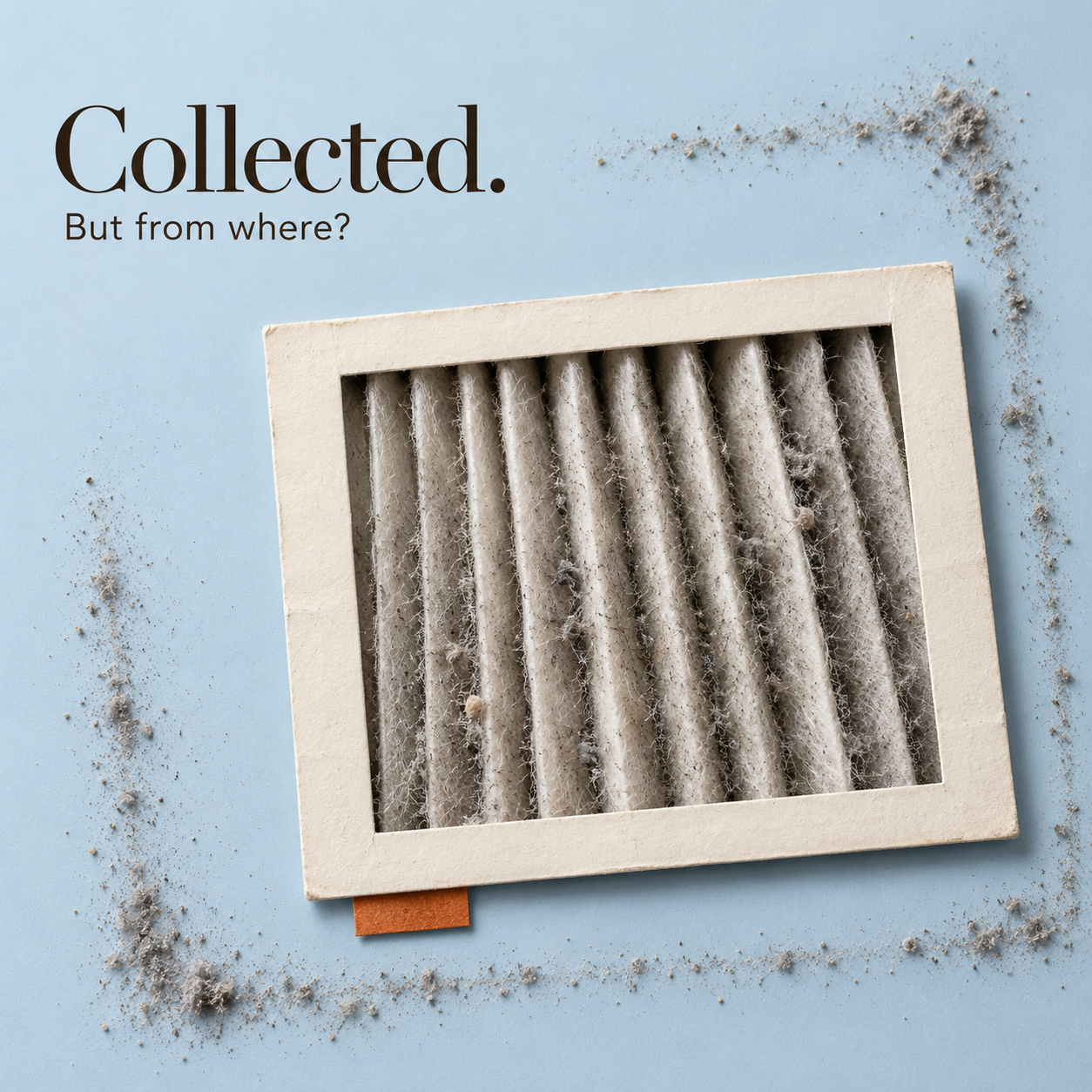
A portable air cleaner may collect a grey layer of dust while the shelf beside it still needs wiping. That is not, by itself, proof that the device failed—or proof that it cleaned the whole room. The architectural question is more precise: what material is being removed, from which air, under which operating conditions?
This research examines fan-driven, filter-based portable air cleaners. It is a critical reading of published evidence, not an ArchUp product test or a ranking of brands.
Airborne particles are not the dust already on the sofa
The EPA’s technical review explains that larger particles can settle before reaching a filter; routine surface cleaning therefore remains necessary. Some smaller allergen-bearing particles stay airborne longer and are more accessible to filtration. Visible hair and lint should not be treated as equivalent to all pet-related airborne particles. [2]
Consequently, the claim “removes dust” needs an object and a boundary. Does it concern airborne particle concentration, material collected on a prefilter, or dust deposited on furniture? A photograph of a dirty filter cannot establish the reduction achieved throughout a dwelling.
What a residential experiment actually found
Lu and colleagues enrolled 29 homes in a randomized crossover study, comparing two consecutive 24-hour periods with a filter installed or removed. Pooled PM2.5 reductions were 78.8% in primary rooms and 57.9% in secondary rooms, with analysis subsets of 23 and 22 respectively. These were measured airborne concentrations, not lint removal or clinical outcomes. Short monitoring and changing daily sources limit generalization. [1]
The useful conclusion is that filtration can produce a real effect. The unsupported extension would be to promise the same percentage for another model, a different floor plan, or a household using a different operating routine.
The number on the box needs a room and a speed
EPA guidance uses clean air delivery rate (CADR) to match particle removal capacity to the space served. Ratings generally describe the highest speed; lower settings process less air. Gas removal requires appropriate sorbent media and is not established by a particle CADR. Clear airflow and filter maintenance matter. [3]
For a designer, this suggests a small equipment schedule rather than a generic “air purifier” symbol: identify the intended room, the operating setting, the power point and the space needed to remove the filter. Ask the supplier for performance at the setting the occupant intends to use. Treat a closed bedroom and an adjoining living area as separate assessment locations rather than assuming that a single floor-area claim settles both.
A proposed room-level acceptance check
The following is an ArchUp proposal for documenting performance, not a validated test standard. Agree on the question before collecting readings: reducing airborne particles in the occupied zone is a different objective from reducing visible cleaning work.
- Record the device, filter condition, fan setting and intended operating hours.
- Mark device and independent monitor locations on a simple plan, alongside doors, windows and furniture.
- Compare repeated periods while recording cooking, cleaning, window opening and other changes; do not attribute every difference to filtration.
- If another room is part of the claim, measure there too.
- Record noise acceptability and access for servicing as operational observations, separately from particle readings.
Do not generate smoke or dust deliberately for an informal household demonstration. A consumer monitor can support comparison, but its readings alone do not certify overall indoor air quality or health protection. The purpose of this record is to expose what was actually tested and what remains unknown.
✦ ArchUp Editorial Insight
The purchasing decision often ends with a product specification, while the operating decision begins with a person deciding where the machine can stand and whether its sound is tolerable. When these decisions are separated, a technically credible device can be assigned an unverified spatial promise. This is a procurement risk, not evidence that a particular manufacturer is misleading buyers. ArchUp proposes that a residential brief distinguish the purchase of equipment from acceptance of an occupied-room outcome. The distinction extends the question of who funds continuing air-quality maintenance: someone must also retain responsibility for the operating setting, replacement filter and accessible location after handover. Otherwise, a room may be labelled as served even though the agreed performance was never checked there. A modest correction would put the intended room and operating assumptions beside the device on the handover record, with unresolved claims explicitly left open. This would make the promise reviewable when furniture moves or use changes, instead of allowing a portable appliance to become a permanent explanation for an environmental condition no one has measured.
References
- Lu, F. T., Laumbach, R. J., Legard, A., et al. “Real-World Effectiveness of Portable Air Cleaners in Reducing Home Particulate Matter Concentrations.” Aerosol and Air Quality Research, 24(1), 230202, 2024.
- U.S. Environmental Protection Agency. Residential Air Cleaners: A Technical Summary. Third edition, July 2018.
- U.S. Environmental Protection Agency. Guide to Air Cleaners in the Home. Second edition, 2018.