Who Owns the Museum Visit? Architecture, Attention and the Freedom to Choose

A route is already an argument
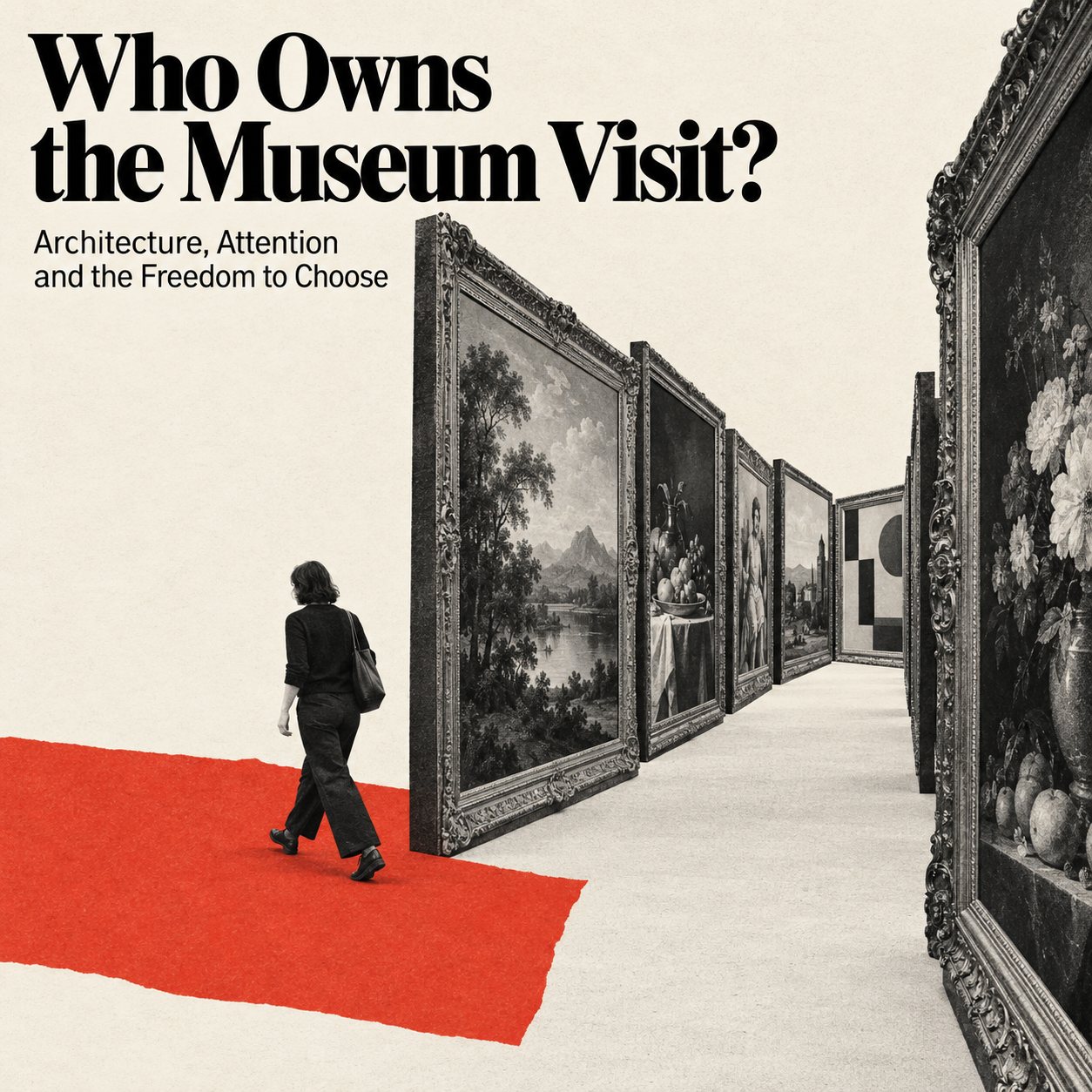
Who decides when a museum visitor has seen enough? The question appears to belong to curators, educators or visitors themselves. Yet it is also embedded in a floor plan. A doorway can offer another route. A gallery can require passage through the next exhibition before an exit becomes visible. A seat can permit a pause without ending the visit. Before any interpretation is read, the building has distributed choices about movement, attention and time.
This is a useful starting point for examining museum architecture beyond the familiar opposition between a spectacular exterior and a neutral container. Neither description explains how a visitor negotiates the institution. The relevant question concerns the relationship between the sequence a museum proposes and the alternatives it permits. A carefully composed journey can clarify a collection. The same journey can become restrictive when participation has only one acceptable pace or direction.
The research overview examined for this article brings together work on museum space, embodied experience, urban context, environmental education and social use. It is a secondary synthesis, not a substitute for independently inspecting each underlying study. This article uses that material as its research basis and distinguishes its reported findings from ArchUp’s editorial interpretation. It makes no clinical claims about sensory conditions and offers no universal numerical threshold for a successful museum. The argument instead concerns how spatial decisions make different forms of participation possible.
The visitor imagined by the plan
A plan can appear flexible because it contains few partitions. That appearance does not establish that visitors can understand their options. Equally, a sequence of enclosed rooms can offer considerable autonomy if exits, shortcuts and opportunities to return are clear. The useful distinction is therefore between geometric openness and practical choice. The former describes a spatial condition. The latter describes what a visitor can actually do within it.
The research overview reports that Li, Wei and He discuss sequential, radial and hall arrangements in their study of museums in Hefei. It also describes Machin and Almazan’s analysis of changing plan configurations in Japanese art museums. These are ways of examining spatial organization rather than a ranking in which one arrangement automatically produces a better experience. Their presence in the same research record invites a more precise reading of architecture: a layout organizes relationships among rooms, but its consequences depend on how those rooms are occupied and interpreted.
ArchUp’s reading is that every plan implies an expected visitor. A long sequence may assume sustained attention and enough time to complete it. An arrangement around a central hall may assume that repeated orientation is helpful. An open gallery may assume that visitors can construct their own order. Making these assumptions explicit provides a stronger basis for discussion than treating freedom as a visual characteristic of the drawing.
Embodied experience is not a mandate for intensity
The overview presents Kali Tzortzi’s work as an account of museum space understood through embodied experience. Its discussion of the Moesgaard Museum emphasizes spaces in which visitors stop and occupy a setting, rather than simply move between objects. The implication is not that circulation has become irrelevant. It is that dwelling within a room can itself be part of how a museum communicates.
This distinction matters when sensory engagement is translated into a design brief. Engagement need not mean the continuous addition of sound, imagery or movement. A spatial experience can also depend on distance, enclosure, stillness or the opportunity to remain beside one object. The source supports discussion of a broader experiential vocabulary. It does not establish that a more intense environment is more educational, more memorable or more inclusive for every visitor.
For architectural projects, the analytical task is to identify what each intervention is intended to accomplish. Does a change in scale distinguish one interpretive chapter from another? Does a place to sit support sustained looking? Does a darkened room belong to the work, or merely to the institution’s preferred atmosphere? These are questions about purpose and proportionality. A related critical perspective appears in ArchUp’s reading of the Fondation Louis Vuitton and the encounter between architecture and art, where the relationship between the building, the artwork and the visitor becomes the subject of interpretation. They also expose an unresolved tension: the experience designed by the institution may differ from the experience a visitor wants. A meaningful account of embodiment leaves room for that difference instead of assuming a single desirable emotional response.
Narrative has value, and so does interruption
Zolotova, Likholet and Fedotova are presented in the overview as examining exhibition space through narrative, metaphor and theatrical organization. This framework helps explain how rooms can carry an argument through sequence. A collection need not be encountered as unrelated objects. Spatial transitions can establish relationships, contrast interpretations and make a complicated subject more legible.
There is a reasonable case for directed routes. Some exhibitions depend on chronology or on information introduced earlier. Visitors may prefer a clear beginning and a manageable order to the burden of making repeated choices. To describe all directed movement as institutional control would overlook these practical and interpretive benefits. Guidance can be a form of assistance.
The countervailing question is whether the narrative survives interruption. Can a visitor leave a demanding section, reach a quieter space and rejoin the exhibition without starting again? Can someone bypass a presentation without losing access to the rest of the collection? These possibilities need not erase the curatorial argument. They can make its structure more forgiving. ArchUp’s interpretation is that the strongest spatial narrative distinguishes between presenting a sequence and enforcing completion. In that distinction, design becomes an arrangement of permissions as well as an arrangement of objects. The visitor’s ability to interrupt the script can be compatible with the institution’s ability to tell a coherent story.
The building can teach without claiming success
The research overview describes Cole, Lindsay and Akturk’s study of eight science museums with environmental certification. As reported there, the study examines how building features are interpreted for visitors and identifies substantial reliance on passive signage. The relevant contribution concerns the relationship between environmental architecture and environmental education. A feature intended to reduce resource use does not automatically explain itself to the people who encounter it.
This provides a productive distinction within sustainability. A building’s performance, the visibility of its systems and a visitor’s understanding are separate matters. An exposed installation can be visible yet difficult to interpret. An attractive display can communicate an environmental intention without establishing how the building actually performs. A technical improvement may remain invisible while still being operationally valuable.
ArchUp’s reading is that architectural interpretation becomes more credible when these claims are kept separate. A display can explain what a system is designed to do, what information is available about its operation and what remains uncertain. The museum then becomes a place where environmental decisions are examined rather than simply celebrated. This approach also gives visitors different levels of engagement. One person may read a short explanation; another may investigate the underlying logic. Neither needs to complete a prescribed lesson for the building to offer a useful encounter with environmental knowledge.
The route begins outside the museum
The overview’s account of Carl Grodach’s comparative work places flagship museums within their urban settings. Its discussion of museums in Los Angeles and San Jose challenges the assumption that architectural prominence alone can generate surrounding activity. The examples point toward the importance of connections, neighboring uses and regional circumstances. They do not provide a formula that guarantees regeneration when a particular urban arrangement is copied.
This qualification changes the scale of the visitor question. The freedom to choose a route inside a building has limited significance if approaching the entrance is difficult or the threshold is hard to interpret. The relationship between museums and cities includes the mundane transition from street to institution. An entrance can communicate openness, uncertainty or a requirement to commit before the visitor understands what is available.
An architectural analysis can therefore follow the visit outward. Where does the public route end? Which activities are available before admission? Can someone meet another person without entering the exhibition? These questions do not assume that all museums have the resources or mission to provide the same amenities. They identify the terms on which the institution participates in urban life. The relevant outcome is not simply more footfall. It is a clearer understanding of who can use which parts of the building, for what purposes, and with what obligations.
Social space is not an empty residual
Elaine Heumann Gurian’s work, as summarized in the source, connects the mixture of museum uses with community building. This makes the foyer, gathering area and informal meeting place analytically significant. Such spaces need not be treated as leftover volume between the entrance and the real cultural content. They can be part of the institution’s public function.
There are competing considerations. A museum may need controlled access to protect collections, manage capacity or separate activities. An event in a shared hall can support social life while complicating another visitor’s attempt to find a route. Public use does not eliminate the need for boundaries. It makes the location and operation of those boundaries more consequential.
The architectural question is how different uses coexist without making one group an obstacle to another. This can be examined through routes, adjacencies and the ability to separate activities at different times. It also belongs in discussions of construction, because a promise of flexibility requires physical provisions that remain useful when the exhibition changes. Calling a room multifunctional does not establish that it can accommodate incompatible demands. ArchUp’s essay on the Louvre’s architectural aging and visitor pressure offers a complementary professional reading of how sustained use brings the physical building and its maintenance into view. ArchUp’s interpretation is that the social value of museum space depends partly on whether informal occupation is genuinely accommodated or merely tolerated until a more profitable or prestigious activity takes its place.
Digital participation still occupies physical space
Capece and Chivăran’s discussion, as presented in the overview, considers emerging technologies and the sensory dimension of museums. Digital interpretation can introduce additional ways to encounter a work, but it does not remove the visitor from the building. Screens, projections and interactive elements still have locations, queues, approaches and points of departure. Their architectural consequences remain part of the visit.
There is a defensible argument for immersive installations. They can support forms of presentation that conventional display cannot easily accommodate. There is also a defensible concern that technological participation can become the assumed mode of access. The useful question is not whether technology belongs in a museum, but whether the institution understands the alternatives available when a visitor does not participate in a particular format.
For the analysis of cultural news, this shifts attention from the announcement of a new system to the conditions of its use. Does the installation add an interpretive option, or replace other ways of engaging? Can its spatial footprint change without undermining the surrounding exhibition? Is there a legible route past it? These are editorial questions derived from the research themes, not findings from an evaluation of any specific installation. They keep the discussion anchored in the relationship between a device, a room and the range of visits that room can support.
Context is more than a visual agreement
Farahat and Osman’s work is described in the source through different strategies for inserting museums into historic settings. These include resemblance, abstraction, contrast and reduced visibility through placement within the ground. The range is useful because it shows that contextual response does not have a single formal language. A building can acknowledge its surroundings through several different architectural decisions.
However, a strategy discussed favorably in particular cases is not a universal answer. Reduced visual prominence does not, by itself, establish that a museum is easy to enter, navigate or operate. Similarly, a conspicuous intervention is not necessarily disconnected from its surroundings. These judgments require separate arguments. Treating appearance as a proxy for all aspects of contextual performance collapses questions that deserve individual attention.
This is particularly relevant to architectural competitions. A proposal can communicate a convincing urban image while leaving the experience of arrival, movement and return comparatively underexplained. A useful reading of competition material asks what the drawings actually establish. Perspective views can show intended relationships of form. Plans and sections can clarify access and spatial sequence. Operational claims require their own support. No single representation answers every question. The museum’s public character emerges from the interaction of these decisions, including the less visible ones that determine whether the intended experience remains available in ordinary use.
From a compelling account to a testable question
The research collected in the overview spans different settings, methods and publication dates. Bringing these studies together is useful for forming questions, but it does not turn them into a single controlled experiment. An interpretation of one museum, a comparison of urban cases and a study of environmental communication address different kinds of evidence. Their conclusions cannot be combined as if they measured the same outcome.
For architectural-research, the productive next step is to make the proposed relationship explicit. If an alternative route is intended to improve visitor autonomy, what would count as evidence? A plan demonstrates that the route exists. Observation could establish whether visitors use it. Interviews might explain whether they understood it as an option. None of these observations alone proves that the change improves every dimension of the visit.
This distinction also limits promotional language. Longer visits need not mean better understanding. A busy hall need not demonstrate a stronger community relationship. The absence of a complaint does not establish that every visitor found the arrangement comfortable. These are reasons to define the question carefully, rather than reasons to dismiss evaluation. The architectural argument becomes stronger when the intended benefit, the evidence available and the remaining uncertainty are visible together.
The public museum as a right to revise the visit
A museum does not become public solely because it admits visitors. Its public character is also expressed in the extent to which visitors can revise the encounter offered to them. They may want to linger where the institution expected movement, move quickly where it expected contemplation, or return after deciding that a particular sequence was not right for them. Architecture gives these decisions practical form.
The sharpest implication of the research themes is therefore not a preference for open plans, immersive rooms or multipurpose halls. It is a different unit of architectural judgment: the visitor’s ability to change course without forfeiting the visit. A museum can retain curatorial authority while distributing that ability generously. Its strongest spatial argument may be the one that remains coherent when the public declines to follow it exactly.
Sources
- Capece S, Chivăran C. The Sensorial Dimension of the Contemporary Museum between Design and Emerging Technologies. IOP Conference Series: Materials Science and Engineering. 2020;949(1):012067.
- Tzortzi K. Museum architectures for embodied experience. Museum Management and Curatorship. 2017;32(5):491 to 508. DOI: 10.1080/09647775.2017.1367258.
- Zolotova AS, Likholet EV, Fedotova NN. Current Trends in the Museums and Exhibitions Exhibition Space Formation. IOP Conference Series: Materials Science and Engineering. 2019;698(3):033021.
- Grodach C. Museums as Urban Catalysts: The Role of Urban Design in Flagship Cultural Development. Journal of Urban Design. 2008;13(2):195 to 212. DOI: 10.1080/13574800801965742.
- Farahat BI, Osman KA. Toward a new vision to design a museum in historical places. HBRC Journal. 2018;14(1):66 to 78. DOI: 10.1016/j.hbrcj.2016.01.004.
- Cole LB, Lindsay G, Akturk A. Green building education in the green museum: design strategies in eight case study museums. International Journal of Science Education, Part B. 2020;10(2):149 to 165. DOI: 10.1080/21548455.2020.1723182.
- Gurian EH. Function Follows Form: How Mixed Used Spaces in Museums Build Community. Curator: The Museum Journal. 2001;44(1):97 to 113.
- Li Z, Wei Q, He H. A brief analysis of spatial constitution and functional organization of museum architecture: A case study on museums in Hefei. Frontiers of Architectural Research. 2013;2(3):354 to 361. DOI: 10.1016/j.foar.2013.06.005.
- Machin H, Almazan J. Evolution of Contemporary Japanese Art Museums Through the Analysis of the Plan Configuration. Journal of Architecture and Planning (Transactions of AIJ). 2017;82(735):1309 to 1318. DOI: 10.3130/aija.82.1309.