A State of the Competition: 75 Calls in October 2026, Read Through Fifteen Doors

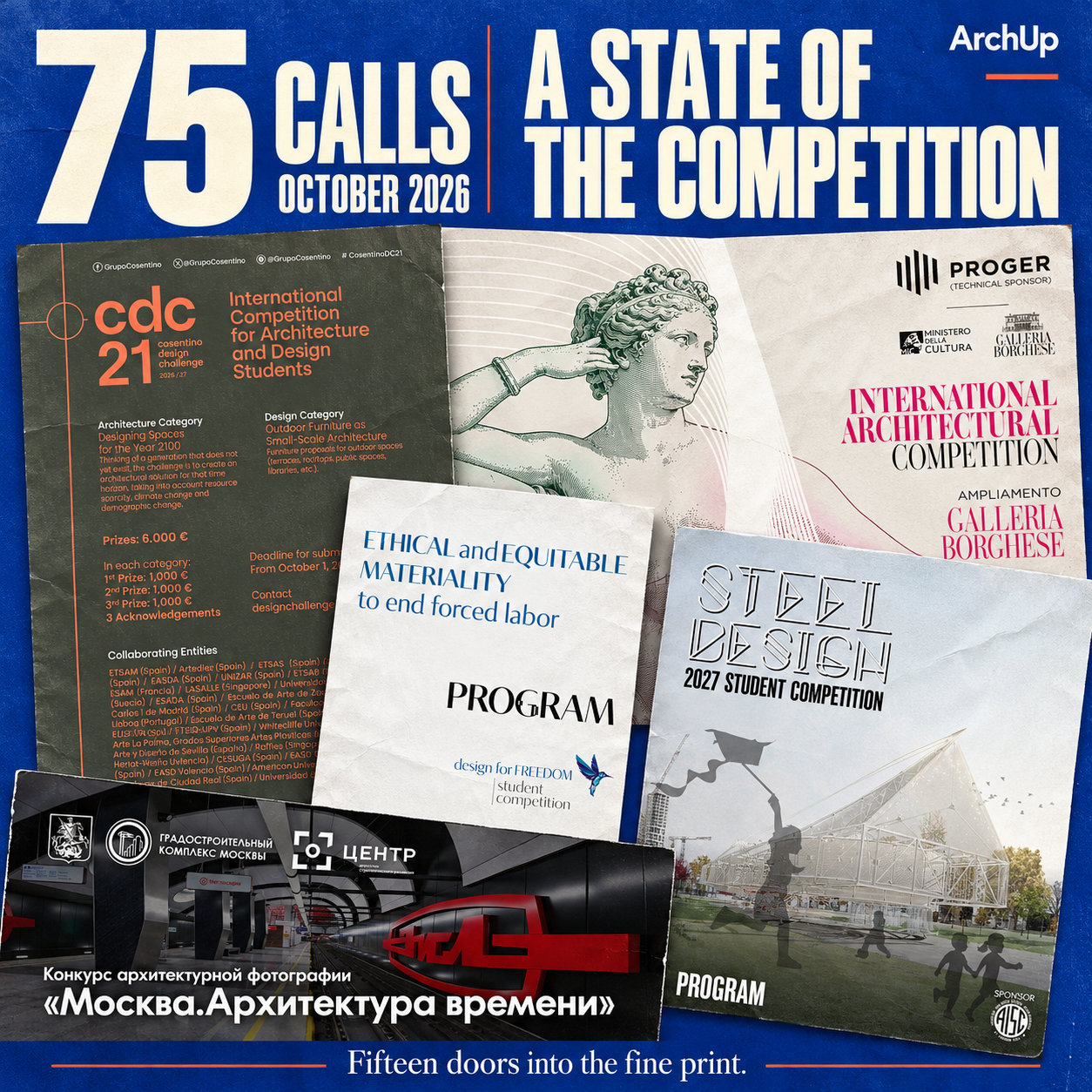
In October 2026 ArchUp published seventy-five architecture competitions, a little under one every working half-day. They came from most of the map. Italy, Germany, Spain, Switzerland, France, Denmark, Bulgaria, the Netherlands and Türkiye carried the European weight, Montenegro alone running three national calls. North America supplied the bulk of the institutional student programmes. East and South Asia arrived through Korea, Japan, China and India, Latin America through Colombia and Argentina, and Russia through Moscow. One call sat in the Arab world, a UNESCO shelter at Jericho, and none in the Gulf. This report does not rank them and does not recommend paying any fee. It takes fifteen of the seventy-five, one for each angle a reader might arrive from, and reads each against its own published terms. Where a call carries a condition worth knowing before you commit weeks of work, the condition is named. Nothing here is an endorsement.
Where a real building is on the table
For an office chasing a genuine commission. Project Competition Svanemølleværket DTM 4.0 turns a former Copenhagen power station into the national technology museum. What is open now is only prequalification: up to eight teams may be invited to pitch and three to the anonymous design stage, with applications closing 9 November 2026. It is a route to a building, not an open call, and the early door is credentials, not design.
For heritage specialists at the top of the threshold. Ampliamento della Galleria Borghese is a two-stage extension of one of Rome’s most constrained museums, procured privately by Proger as technical sponsor with the Order of Architects’ platform. The turnover, experience and multidisciplinary thresholds are high, and phase one closes 13 November 2026. Read it as a restricted professional procedure, not an early-career opportunity.
For practitioners working where construction carries political weight. The UNESCO Protective Shelter at Tell es-Sultan, Jericho asks for a structure over an excavated trench in the State of Palestine, organised with the Palestinian Ministry of Tourism and Antiquities and endorsed by the UIA. It is open but professional: the lead architect needs eight years of experience, and the winner carries a design-development and supervision appointment.
For those who still trust the open, anonymous public model. The Budva Coastal Zone competition is an open, anonymous, single-stage international call from Montenegro’s planning ministry across roughly 42.7 hectares of waterfront. The caveat is structural rather than hidden: the selected design is intended to feed a planning document after approval and revision, and no construction appointment or date is promised.
For students and emerging practice
For the academic studio inside an institution. The 2027 Steel Competition, the twenty-seventh ACSA and AISC student cycle, requires structural steel and at least one long-span element, with a free entry and a faculty sponsor. Its boundary is eligibility: it is built for students at member schools, not an open international call, and the brief serves a teaching calendar as much as a design one.
For the student who wants the brief to carry an ethic. The 2027 Design for Freedom Competition, run by ACSA with Grace Farms, ties a building proposal to evidence of how its materials are sourced, against forced labour in construction supply chains. Registration, by a faculty sponsor, closes 7 April 2027, and eligibility is limited to ACSA member schools, so the research ambition sits inside a narrow gate.
For recent graduates working on a monument. W PRIZE 2027 – Château d’If, from Fondation Wilmotte, asks for a light, reversible, temporary intervention at the Marseille fortress without permanently altering it. One detail to settle before planning: the call states registration closes “at midnight on 1 February 2027” without naming a time zone or whether midnight opens or ends the day. Confirm the portal time directly.
For young multidisciplinary teams in the public realm. Streetlife 2026–2027 asks teams to take a neglected site anywhere in the world and treat it as public space within one hectare. It carries no implementation, and it separates its dates: registration closes 30 November 2026, the submission follows on 11 December 2026, and a valid order number is required before the later date.
Recognition, research and the wider field
For women and non-binary practitioners. W Awards 2027, run by The Architectural Review and the Architects’ Journal, is free to enter across three categories, with the research category open to any gender. The practical caution is eligibility: the three prizes differ sharply, one limited to practice founders born after 1 January 1982, another to UK-based project architects, so confirm which, if any, fits before you prepare work.
For the researcher rather than the designer. The Re:Paris Prize from Van Alen Institute selects one United States–based designer for a twelve-month research cohort with a US$35,000 award and required field research abroad. It is a study fellowship, not a commission, and its eligibility is geographic, so most of the world reads it as context rather than an open door.
For an established practice measured on a body of work. The 2028 Global Award for Sustainable Architecture judges sustained practice under the theme Architecture Is Circularity and names five laureates. It asks for evidence across projects, research and writing rather than a single scheme, which places it among sustainability recognitions, not design briefs, and offers no commission.
For the edge of the category, where architecture is not a building. Moscow. Architecture of Time is an architectural photography call across nineteen specified sites, each entry a series plus a short essay. Worth noting for transparency: the regulations separate the commissioning company from the public institution supporting it, a structure entrants should simply be aware of before submitting images.
Read the fine print before you pay
For anyone entering a brand’s brief. The 21st Cosentino Design Challenge is a student call with a rights clause that deserves slow reading: the published rules state that awarded entrants grant the company exclusive exploitation and industrial-property rights, and that winning works and special mentions become company property. The brief may suit you; the clause is the part to decide on first, not the theme.
For the paid-platform ideas model. Urban Forest Pavilion, one of several calls from the same platform this month, opens at a USD 53 fee and states that the cash prize depends on the number of registrations, while naming no competition-specific jury. It is representative of a wide October cluster: you pay into a pool whose reward it helps set, and you are assessed by people the call does not identify.
For the speculative, future-facing design call. Urban Air Mobility Terminal of New York invites students and young architects to adapt waterfront aviation infrastructure for electric vertical flight. Before developing anything, resolve a contradiction in the call itself: the introduction names Newport Helistop in Jersey City while the brief names the Downtown Manhattan Heliport. These are different sites, and the boundary must be confirmed with the organiser.
Fifteen doors into one month, and the same instruction stands at every threshold. The promising brief and the punishing clause arrive in the same document, and the distance between an open public project and a paid pool with no named jury is now measured in paragraphs most entrants never reach. The month was global, busy and, in places, genuinely civic. It was also a reminder that in 2026 the first act of design is reading the terms, and that the one region commissioning the most building across its cities was very nearly absent from the public contest that tests everyone else.