The Sequence and the Eight


Ibrahim Fawakherji — ArchUp
Three weeks ago, in the office building where I work, the marble floors were polished. The team did a clean job. The surface came up smooth and reflective, the kind of finish that takes skill and time to produce correctly. Then, the following week, a second contractor arrived to apply wood stain to the wall paneling. The sanding process that staining requires distributed fine wood dust across the entire floor. The polish was gone before anyone had properly used it.
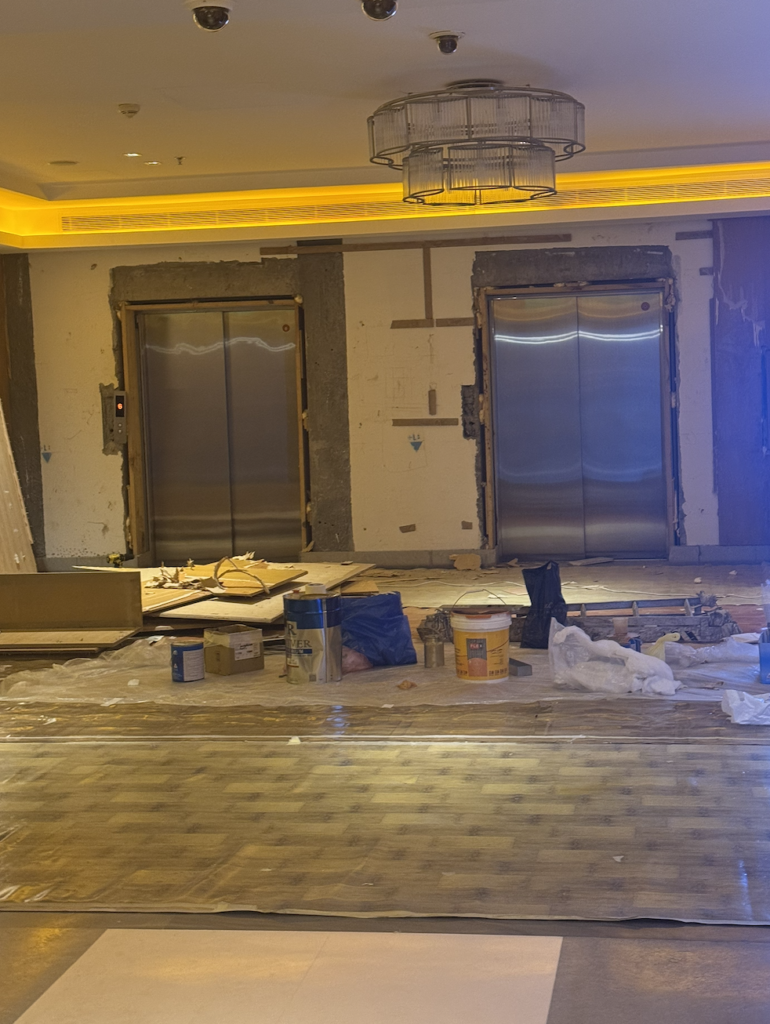
This was not a failure of craftsmanship. Both contractors did their work competently within their own scope. The failure was sequential. One phase was completed before the conditions for its preservation were in place. In construction, this category of error has a name: it is a sequencing problem, and experienced site managers will tell you that more projects are damaged by wrong sequencing than by wrong materials or wrong methods. The order in which things happen is not a logistical detail. It is a structural condition that determines whether the individual components add up to a functioning whole or undermine each other in the act of assembly.
I have been thinking about sequencing in a wider sense since that morning on the marble floor.
There is a verse in the Quran that I find myself returning to in this context, not as theology, which belongs to people more qualified than I am, but as an observation about the structure of distributed load. The verse from Surah Al-Haqqah states that the throne of God will be carried on that day by eight. I am not offering interpretation. What I am offering is the architectural and administrative impression the number produces on a person who spends his days thinking about load distribution and structural integrity. Eight. Not one, not four, not however many are available. Eight, presumably positioned to distribute the weight with a precision that reflects design rather than convenience. The lesson I take, entirely at the level of the observable world, is that even the most significant load requires correct distribution to be carried without failure. Concentration of load at a single point is a structural pathology. It does not matter how strong the point is.
The pizza provides a more accessible version of the same geometry. A circle divided into eight equal slices is a stable system. Every sector carries an equivalent share. When you take three slices from one side and leave them unmatched on the other, the circle loses its logic. The system still exists formally, but the distribution has been violated, and what you have is no longer a balanced whole. You have a remainder and a deficit occupying the same space.
The Wheel of Life, which life coaching frameworks have used for decades as a diagnostic tool, is structurally identical to the pizza and makes the same argument in a different vocabulary. Divide your daily productive hours into sectors: health, relationships, professional work, learning, rest, community, creative practice, spiritual life. If one sector expands beyond its proportion, the others contract. The wheel does not roll smoothly when its segments are unequal. This is not a metaphor. It is a description of how attention and energy actually behave as finite resources. Research on cognitive bandwidth, particularly the work emerging from behavioral economics on scarcity and mental load, confirms that the depletion of one domain creates measurable deficits in adjacent domains regardless of whether the person is aware of the transfer.
The AI tools that have entered professional practice over the past few years have introduced a specific and underappreciated version of the sequencing problem. The transition from GPT to Gemini to Claude to DeepSeek to Kimi and back again, which many practitioners have been performing on a cycle of weeks rather than months, is not a process of learning. It is a process of perpetual beginning. Each tool has its own logic, its own vocabulary, its own strengths and failure modes. Developing genuine expertise with any of them requires sustained engagement with a single system long enough to understand where its outputs are reliable and where they require verification. The practitioner who switches platforms every time a new model is announced is not upgrading their capability. They are resetting it. The cognitive cost of context switching, which neuroscience research on task switching consistently finds to be underestimated by the people experiencing it, accumulates invisibly. The attention paid to navigating a new interface is attention not available for the work the interface is supposed to support.
This is the sequencing problem applied to professional development. The correct sequence is to develop genuine competence with a tool before evaluating whether a different tool offers something the current one cannot. The actual sequence that the current landscape encourages is continuous evaluation without the depth that makes evaluation meaningful. The result is a practitioner who knows many tools superficially and none of them well, which is precisely the condition most likely to produce the hallucination problem discussed in an earlier piece: outputs that appear confident and are in fact unreliable, with a user who lacks the depth of experience to identify where the reliability ends.
Brain Rot, the term that has entered cultural vocabulary to describe the cognitive degradation produced by sustained exposure to fast-switching, low-density content, is the downstream consequence of sequencing failure applied to attention itself. The Architectural Research on cognitive load confirms what the term describes informally: the brain habituated to rapid context switching loses facility for sustained engagement. The rabbit hole that social media platforms engineer is a deliberate sequencing of stimuli designed to prevent the user from completing any single engagement before the next one begins. The result is a person who has consumed enormous quantities of content and processed almost none of it to depth.
The question this raises for children, which I will approach carefully because it sits at the boundary between analysis and prescription, is whether the hours spent with devices are damaging the wheel not because devices are inherently harmful but because the sequencing of a child’s day has been reorganized around a single sector at the expense of the others. Six hours of screen time is not six hours of learning, or six hours of social engagement, or six hours of physical activity. It is six hours extracted from every other sector simultaneously. The wheel cannot roll when one segment has absorbed the circumference.
I am not making a case against any particular technology. I am observing that every system, biological, architectural, professional, or temporal, has a sequencing logic that must be respected for the system to function as designed. Violating that logic does not necessarily produce immediate visible failure. The marble floor looked fine for a week. Then the sawdust arrived.

The productive hours in a day are finite. Research in occupational psychology places the effective cognitive capacity of a knowledge worker at somewhere between four and six hours of genuinely demanding work. The remaining hours serve recovery, relationship, physical maintenance, and the kind of unfocused thinking that produces the connections that focused work cannot. This is not a lifestyle recommendation. It is a description of how the human system actually operates, confirmed repeatedly across different research traditions. Ignoring it does not increase capacity. It depletes it faster while producing the illusion of productivity.
The eight who carry the throne are not eight because eight is an arbitrary or symbolic number in this context. They are eight because the load requires distribution, and distribution requires plurality, and plurality requires coordination, and coordination requires that each element knows its position and holds it. The failure mode is not weakness in any individual carrier. It is imbalance across the system, one position taking more than its share, another compensating by taking less, the whole losing the stability that only correct distribution can maintain.
Every project I have ever seen fail has failed this way. Not from a single large error but from a sequence of small imbalances that accumulated until the system could no longer absorb them. The marble floor and the sawdust. The foundation and the finish work. The learning and the switching. The child and the screen. The professional and the tools.
The sequence is not a bureaucratic formality. It is the condition under which any system, built or human, performs what it was designed to perform.
When the sequence fails, everything that follows it costs more than it should.
And the repair, if it comes at all, always begins by returning to the step that was skipped.
✦ ArchUp Editorial Insight
The polished marble floor destroyed by sawdust the following week is not a metaphor the article borrows from construction — it is a procurement failure that the construction industry produces with such regularity that it has a technical classification, and the article’s most structurally precise contribution is its extension of that classification outward into every system governed by the same logic: attention, professional development, childhood, and the cognitive bandwidth of a knowledge worker whose productive hours are finite and whose sequencing errors are invisible until the damage is already done. The AI platform-switching the essay identifies as perpetual beginning rather than genuine learning is the professional equivalent of the compressed construction crisis examined in The Taptab Illusion — in both cases, the timeline imposed by external pressure overrides the internal logic of the process being attempted, and what accumulates is not progress but the compounding cost of skipped steps, which eventually arrives as a failure that appears sudden but was encoded at the moment the sequence was violated. The article’s deepest structural observation, however, is not about tools or attention but about load distribution: the eight who carry the throne carry it because concentration of load at a single point is a structural pathology regardless of the point’s strength, which is the same finding that A Building Becomes an Asset reached through COBie data and facilities management research — every system that survives across time does so because its load was correctly distributed from the earliest phase, and the repair of a sequencing failure always costs more than the sequence it replaced would have required, because the marble must be repolished after the sawdust has already settled.