I Went to See Calder, and Found a System Trying to Escape the Canvas

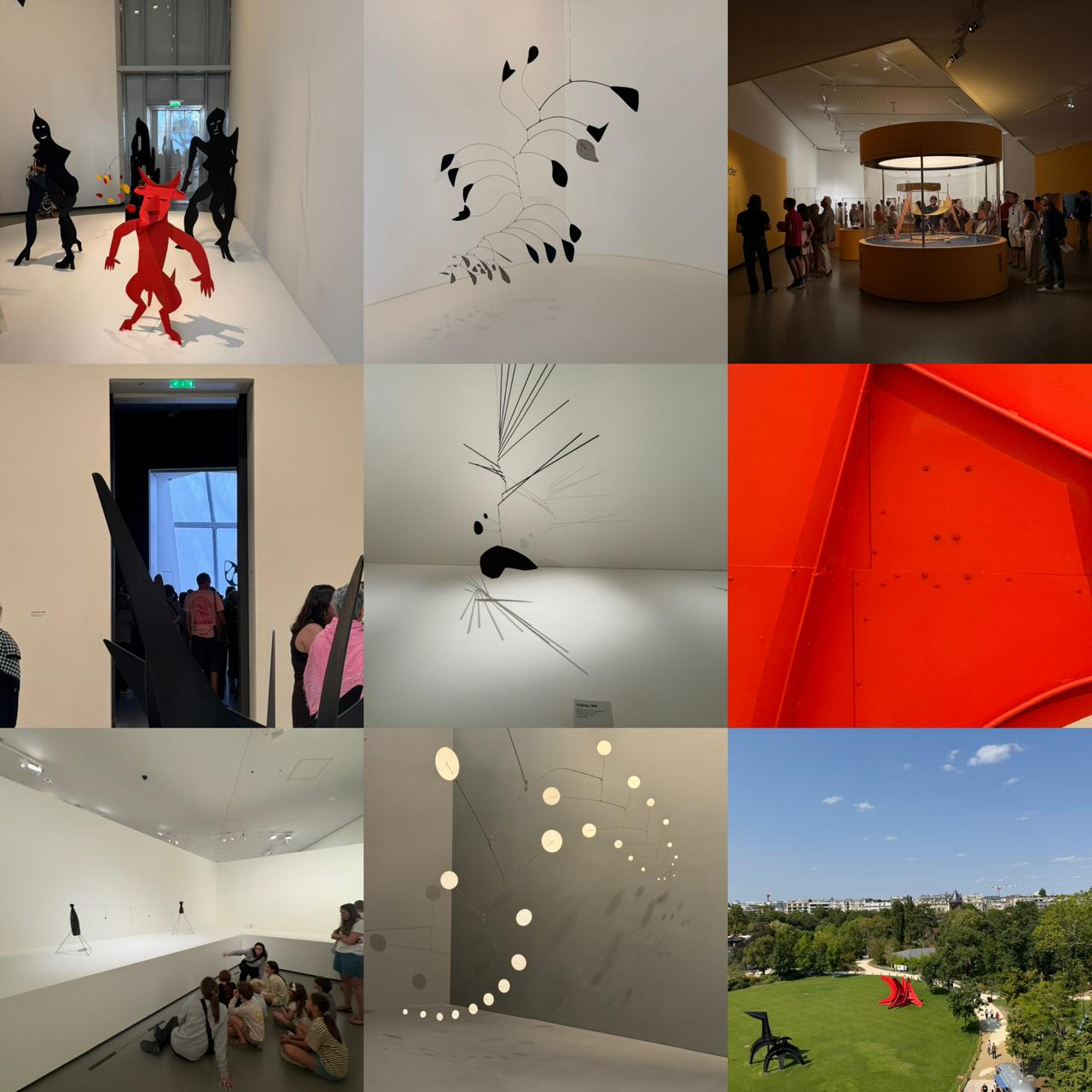
The exhibition traces Alexander Calder’s transition from representational paintings of industrial life to the development of kinetic sculpture. His early work illustrates a journey toward abstraction where line and color eventually became independent elements. This evolution led to the creation of the mobile as a system of motion and time.
Calder’s sculptures utilize precise engineering to engage with environmental forces like gravity and air. Rather than achieving static stability, these works maintain a state of controlled incompleteness that allows for continuous change. This approach shifts the viewer’s focus from static forms to the dynamic systems governing their movement.
Ibrahim Fawakherji — ArchUp
I went to the Fondation Louis Vuitton expecting Alexander Calder.
By that I mean I expected the Calder that already exists in the public imagination: thin black rods, suspended metal plates, red circles, yellow fragments, objects hanging in space with the particular confidence of things that appear effortless only because someone has solved the difficulty before you arrived.
That is the danger of seeing the work of an artist whose visual language has become familiar.
You recognize the result before you understand the route.
The exhibition corrected that quickly.
What interested me most was not the mobile.
It was the distance Calder had travelled before he was capable of making one.
The early paintings are almost disorienting if you arrive carrying the later Calder in your head.
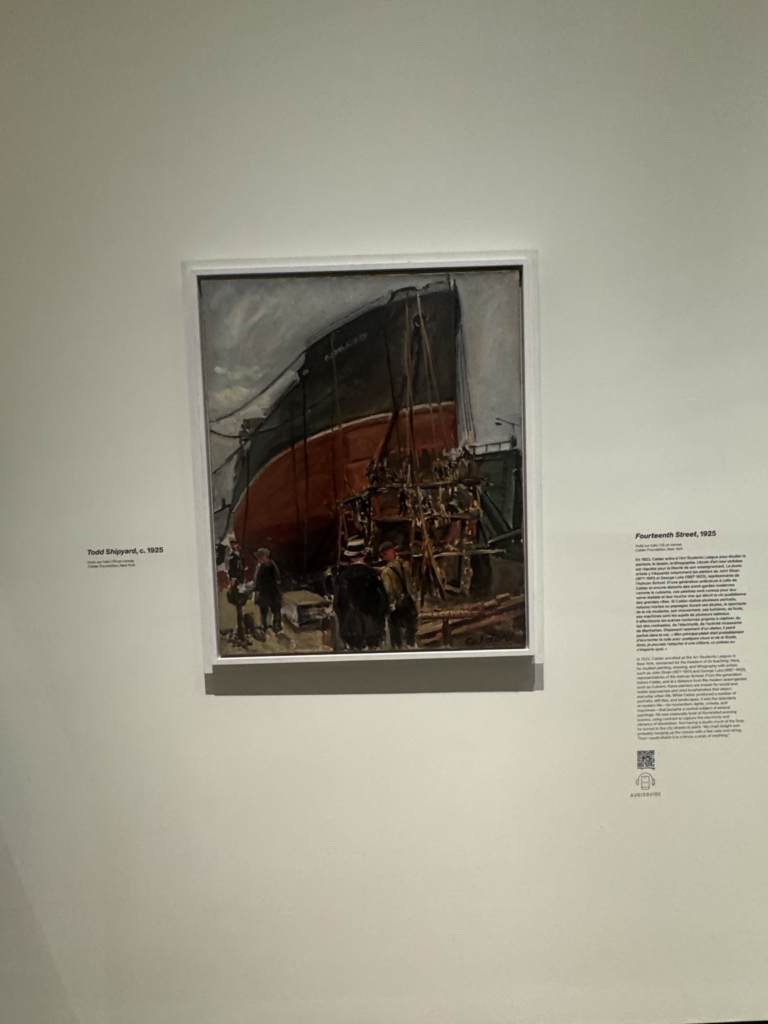
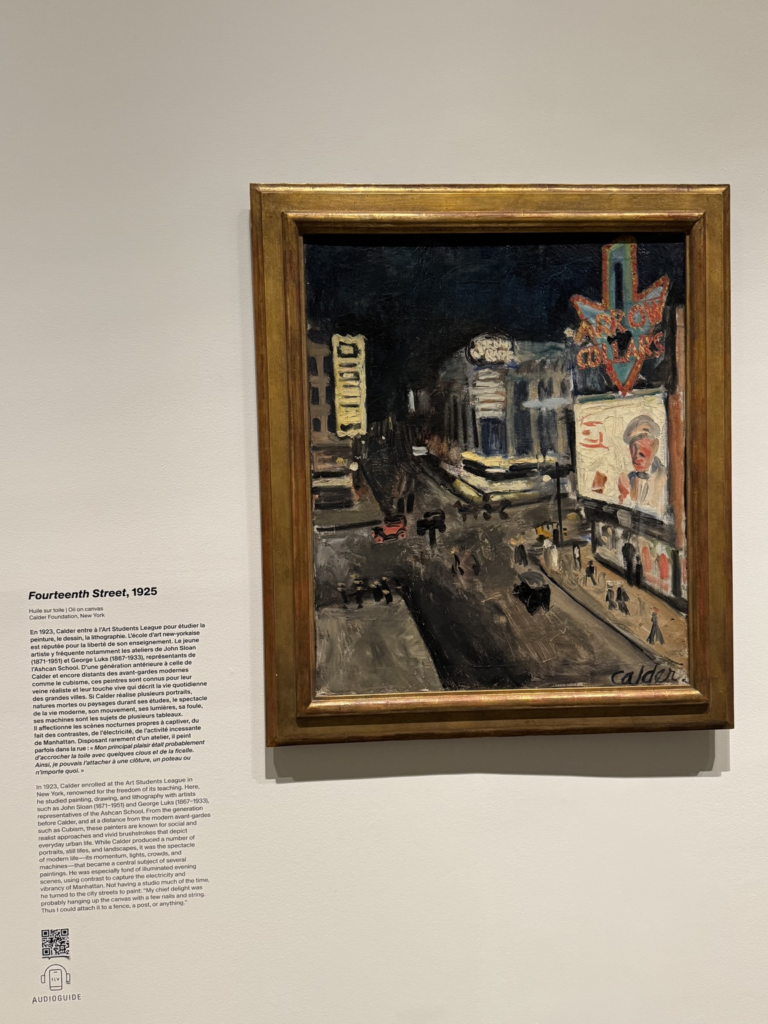
In Fourteenth Street, painted in 1925, there is still a street.
There are buildings, advertisements, traffic, people, light, perspective, weather, distance. The painting belongs to an observable world. Calder is standing somewhere and looking at something.
The same is true of Todd Shipyard, from roughly the same period. A ship occupies the composition with almost architectural weight. Workers gather below it. The object is large because it is physically large. The scene organizes the painting.
Nothing here suggests, at first glance, that the same person will soon begin removing almost everything.
That is what makes these works useful.
They allow you to see that abstraction was not Calder’s starting condition.
It was something he had to arrive at.
And I found myself asking a question that stayed with me through the exhibition:
At what point does an artist stop being interested in representing movement and become interested in making movement itself?
Because that appears to be what happened.
The shift becomes clearer in the section devoted to the non-figurative work.
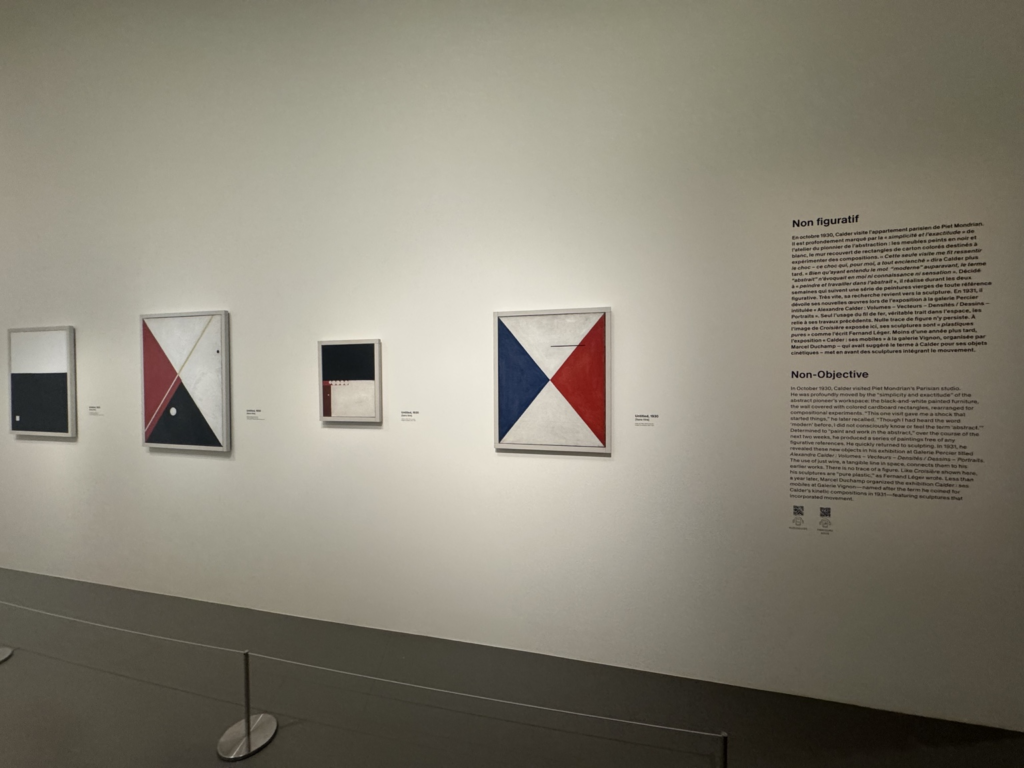
The exhibition places considerable weight on Calder’s encounter with Piet Mondrian’s Paris studio in 1930. What mattered was not simply that Calder saw abstract paintings. He encountered an environment in which color, geometry, furniture, wall surfaces and spatial organization had already begun to operate as a system.
That distinction matters.
You can copy an abstract painting without understanding abstraction.
What Calder seems to have recognized was that the rectangle, the line and the colored plane did not need to describe anything outside themselves.
They could simply act.
Once that happens, the consequences become difficult to contain.
If the black line has value without representing the outline of a person, why should it remain paint?
If the red shape has visual weight without representing an object, why should it remain attached to the canvas?
If the relationship between two elements is more important than the elements themselves, why should that relationship be frozen?
The mobile begins to look less like an invention and more like an inevitable escape.
The painting could no longer hold the system.
This is where Calder becomes much more interesting to me than the familiar description of him as the artist of mobiles suggests.
The mobile is not simply a sculpture that moves.
That definition is technically correct and conceptually inadequate.
A traditional sculpture can be complex, but it normally arrives before you as a resolved object. You move around it. You inspect different elevations. Your position changes; the sculpture does not.
Calder reverses the relationship.
The work becomes unstable enough to have its own sequence of positions.
The viewer is no longer the only moving body in the room.
In 13 Spines, from 1940, this becomes especially clear.
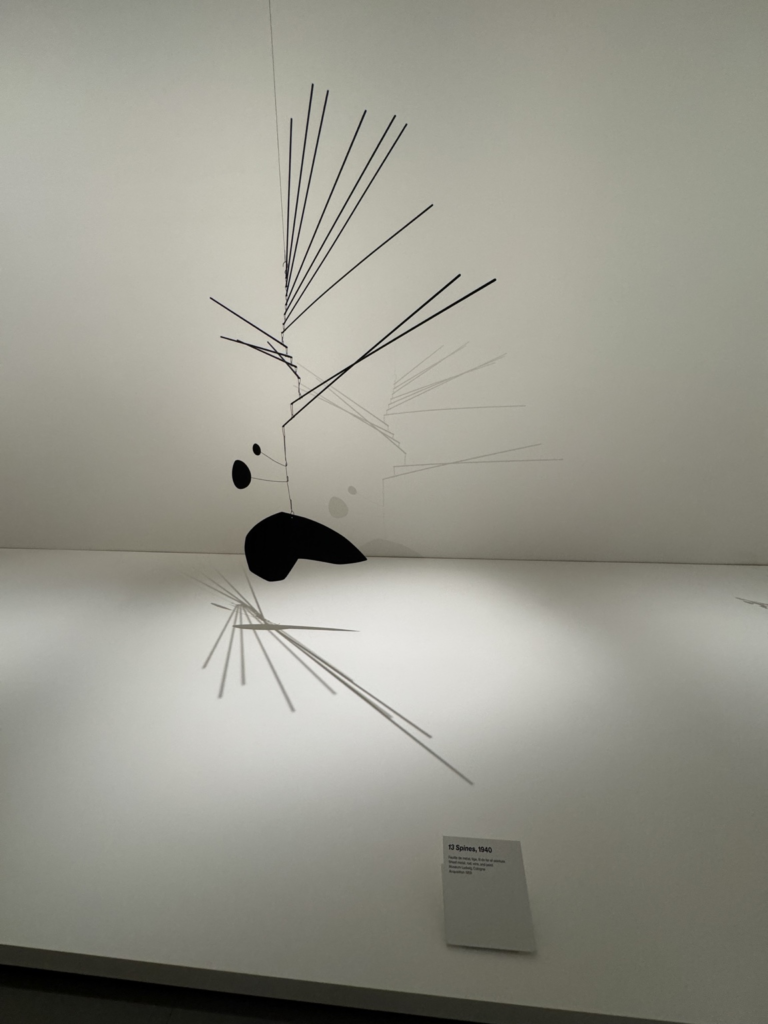
The physical material is almost absurdly limited: thin rods, small suspended forms, a dark lower mass and a carefully balanced structure.
But then the shadow appears.
And suddenly the work is no longer where the metal is.
Part of it exists on the wall.
Part of it exists on the floor.
Part of it exists in the empty volume between the rods.
And the next version of the sculpture does not yet exist at all. It will arrive when the air moves.
I stood looking at the shadow almost as much as the object.
The shadow is not decoration produced by the sculpture.
It is evidence that the sculpture has exceeded itself.
I think this is where the word “balance” becomes misleading.
We usually associate balance with stability.
Architecture reinforces this assumption constantly. The column stands. The slab is supported. The load arrives somewhere and is resolved. If the building moves unexpectedly, we begin asking serious questions.
Calder’s work depends on another kind of balance.
It is balanced precisely so that it can move.
The system is not successful because nothing changes.
It is successful because change does not destroy it.
That difference is more significant than it initially appears.
A rod becomes a lever.
A small piece of metal at one end can determine the position of a larger element elsewhere.
Distance becomes as important as weight.
Air resistance matters.
Gravity matters.
The location of the suspension point matters.
What appears casual is actually a negotiation between forces.
This is why Calder’s work has always seemed strangely close to engineering without ever becoming engineering.
The calculation disappears into the experience.
You do not look at the mobile and think about moments, centers of gravity or load distribution.
You see lightness.
But the lightness exists because the forces have been understood.
Then there are the paintings from the 1940s and 1950s.
I expected these to feel secondary after seeing the mobiles.
They did not.
The exhibition text makes an important point: these paintings should not be understood as representations of movement. They operate as parallel systems to the mobiles.
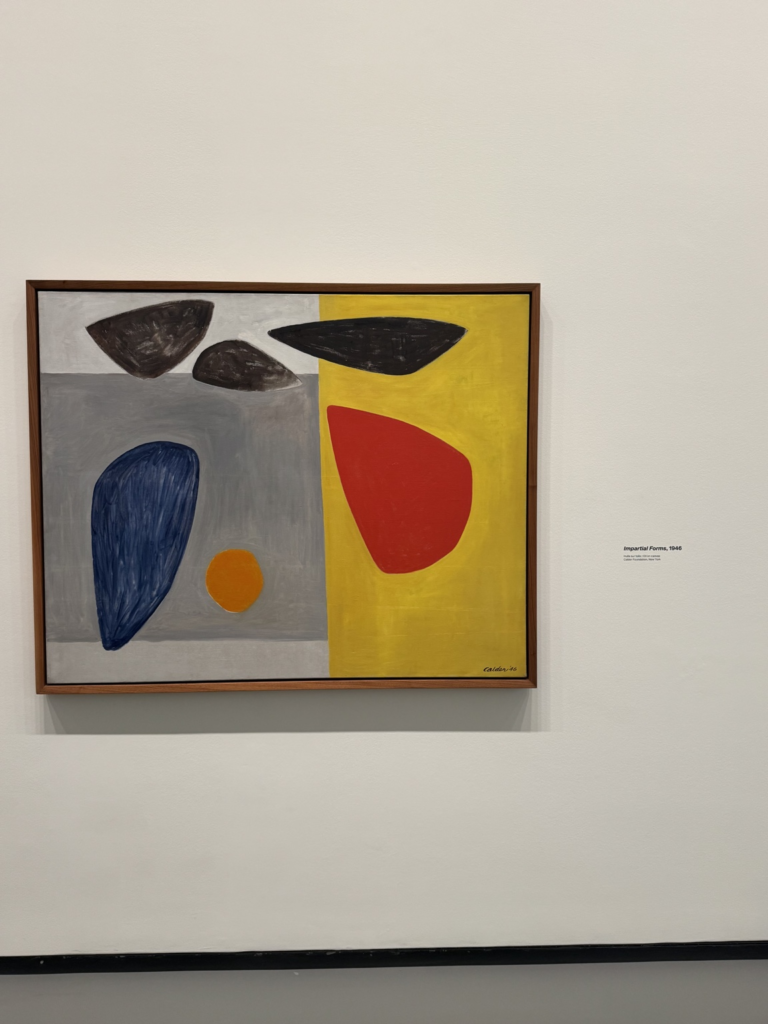
That distinction changed how I looked at Impartial Forms, painted in 1946.
There is a large yellow field, red, blue, black, gray and several irregular masses occupying the surface.
Nothing is visibly moving.
And yet after spending time with the sculptures, the painting begins behaving differently.
The forms appear weighted.
The black mass holds one region.
The red pushes against the yellow.
The small orange circle suddenly becomes disproportionately important.
The empty portions of the canvas begin functioning as intervals rather than background.
I stopped reading the painting as an arrangement of colored shapes.
I started reading it as a force diagram.
The interesting thing is that Calder appears to have brought knowledge back from sculpture into painting.
He moved from two dimensions into three, learned what actual balance could do, and then returned to the canvas with that information.
The canvas remained flat.
His thinking no longer was.
Color performs a similar transformation.
Calder’s palette can appear almost elementary: black, white, red, yellow, blue.
But elementary does not mean simple.
The exhibition describes color as a force rather than a symbol, and I think that is exactly right.
A red plane does not need to represent anything.
Its intensity changes the equilibrium of everything around it.
A small black object can visually outweigh a larger pale one.
Yellow can expand a region of the canvas without physically changing its dimensions.
This interests me because it means Calder was effectively assigning visual mass to color.
He was not only composing.
He was balancing.
The language of painting had entered the logic of mechanics.
The model for the 1939 New York World’s Fair made this even clearer.
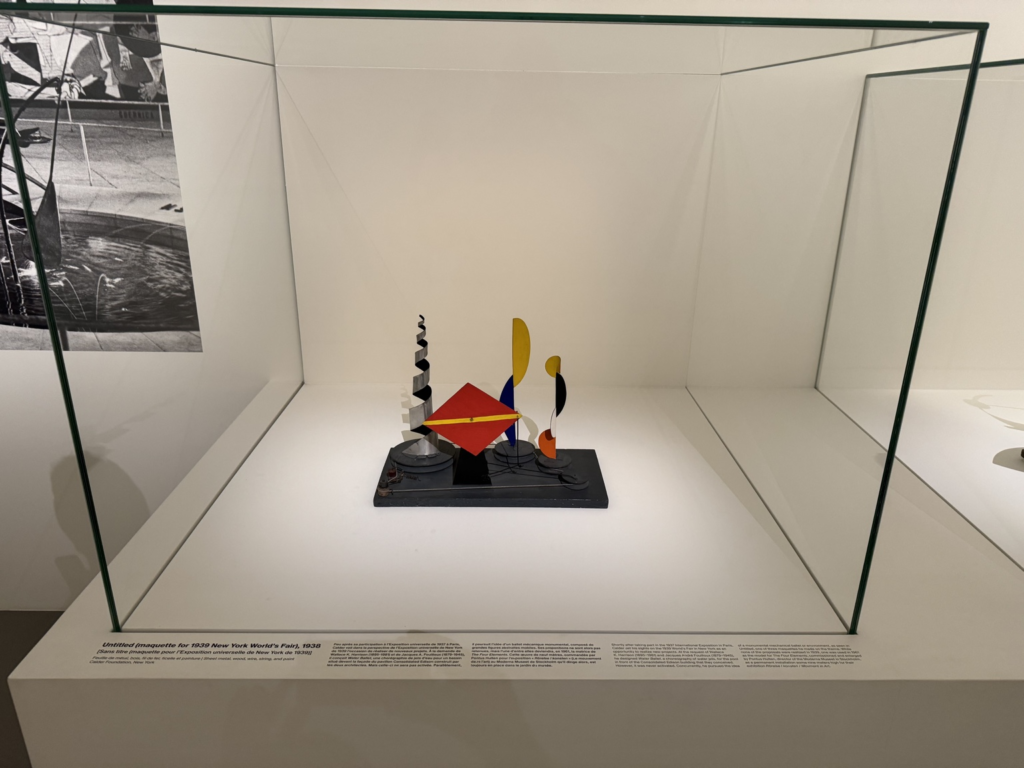
The maquette is small, almost modest compared with the mythology surrounding Calder’s later work.
But models expose something finished works often conceal.
They show hesitation.
They show testing.
They show scale before scale is resolved.
They show that the thing we eventually call an artwork passed through a stage in which it was still a problem.
This is familiar territory for anyone in architecture.
A model is not merely a small version of the final object.
It is a place where relationships are allowed to fail cheaply.
Calder’s maquette contains exactly that quality.
Forms are being positioned against one another. Heights are being tested. A spiral rises at one side while planes and vertical elements establish another system.
The final composition may look spontaneous.
The model reminds you that spontaneity can be designed.
Then comes Mercury Fountain.
And the entire discussion changes.
The work was connected to the Spanish Pavilion at the 1937 International Exposition in Paris, a politically charged environment that also included Picasso’s Guernica.
Calder was asked to produce a fountain associated with Almadén, the Spanish mercury-mining town.
The choice of mercury is already extraordinary.
Water normally makes a fountain legible.
Mercury makes it unsettling.
It is liquid and metallic at the same time. It reflects like a polished surface while behaving like a fluid. When it moves, the material appears almost mechanically alive.
Calder allowed that liquid metal to activate the work.
The fountain therefore does something different from the mobiles.
Air moves many of Calder’s suspended structures.
Here the material moves the structure.
The energy comes from inside the system.
But what I found more important was that the movement suddenly carries political and geographical weight.
Almadén is no longer an abstract word.
The material comes from somewhere.
The material represents labor, extraction, territory and conflict.
Movement, which elsewhere in Calder can feel almost cosmological, becomes historical.
The machinery has acquired a memory.
This made me reconsider the common tendency to describe Calder through lightness.
His work is visually light.
Conceptually, it is not.
A mobile can be playful and still contain a sophisticated understanding of instability.
A red disc can look cheerful while participating in a precise equilibrium.
A fountain can move beautifully while referring to a country at war.
A thin wire can produce a shadow much larger than itself.
There is always more weight in the system than the object admits.
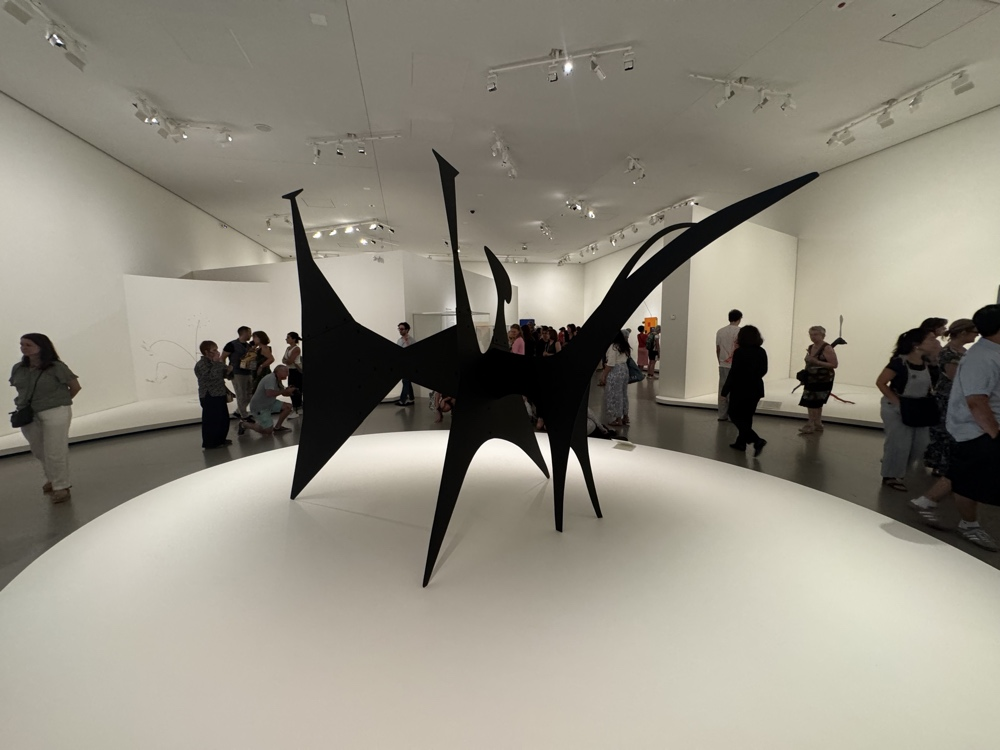
The Fondation Louis Vuitton itself complicates the experience in a useful way.
This is a Frank Gehry building, and it is difficult to forget that while moving through it.
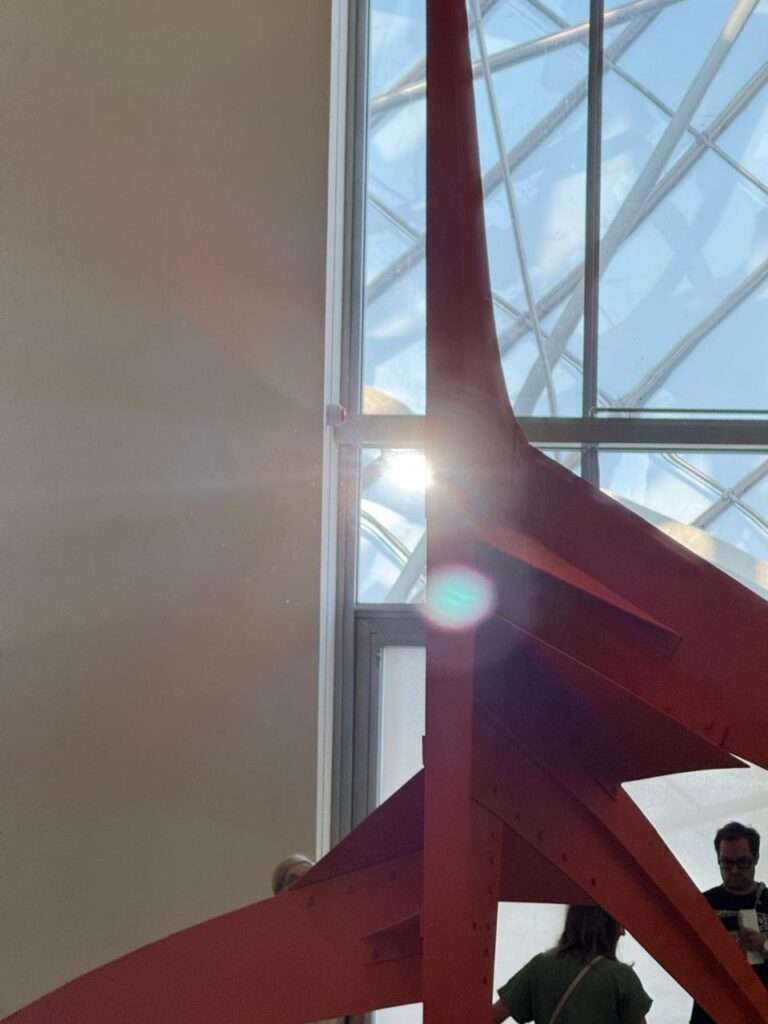
Gehry and Calder are very different, but they share one important resistance: neither allows the object to be fully understood from a single fixed position.
With Gehry, the building is stable and the visitor moves.
With Calder, the visitor may stand still and the work moves.
One uses circulation to destabilize the perception of architecture.
The other uses movement to destabilize the perception of sculpture.
I found this relationship more productive than any attempt to compare their formal languages.
The important similarity is not shape.
It is the refusal of the definitive view.
There is no elevation that completely explains Gehry’s building.
There is no single instant that completely explains a Calder mobile.
Both require time.
And perhaps that is what I had underestimated before seeing these works together.
Calder did not simply add movement to sculpture.
He added time.
A conventional object can be photographed and, within limits, the photograph can represent it.
A Calder mobile resists that reduction.
The photograph records one temporary settlement of the system.
A second later, the same object may have reorganized itself.
The artwork is therefore not any individual configuration.
The artwork is the set of possible configurations.
That is a very different idea.
The material object is only the mechanism that makes those possibilities visible.
I entered the exhibition expecting to look at Calder’s forms.
I left thinking about his systems.
The progression from the New York street paintings to abstraction, from abstraction to suspended structures, from suspended structures back into painting, and from air-driven movement to the material motion of Mercury Fountain does not read to me as a sequence of stylistic experiments.
It reads as one long question.
How little can an artist control and still remain the author of the work?
Calder determines the dimensions, the material, the balance, the connection, the color and the limits of movement.
Then he stops.
Air takes over.
Gravity takes over.
Time takes over.
The room participates.
The viewer arrives after the system has already begun.
That surrender is carefully engineered.
Which may be the most interesting contradiction in the entire exhibition.
Calder constructed objects with extraordinary precision so that he could give up control over what they would look like next.
I have spent much of my professional life around architecture, where uncertainty is generally treated as something to be reduced.
We calculate loads because we do not want structural uncertainty.
We coordinate drawings because we do not want construction uncertainty.
We specify materials because we do not want performance uncertainty.
We design circulation because uncontrolled movement becomes operational failure.
Calder does almost the opposite.
He builds enough order to make uncertainty possible.
That distinction stayed with me.
Perhaps the real lesson of the mobile is not movement.
It is controlled incompleteness.
The work does not need to arrive at one final position to be complete.
Its completeness lies in its ability to continue changing without losing its identity.
I cannot think of many better definitions of a living system.
I went to the Fondation Louis Vuitton to look at art.
I ended up looking at gravity, leverage, air, shadow, balance, probability and time.
Calder had simply given them color.
✦ ArchUp Editorial Insight
The mobile is not a sculpture that moves — it is a governance model, and the article’s most structurally precise contribution is its identification of what Calder was actually engineering: not an object but a set of conditions within which change could occur without destroying the system’s identity, which is a fundamentally different design problem from the one that most built environments attempt to solve. Architecture’s relationship to uncertainty has historically been adversarial — the load is calculated, the movement is suppressed, the tolerance is minimized — because the institutional and financial frameworks governing construction have treated uncertainty as liability rather than as a design parameter, which means that every building whose program becomes obsolete, every structure whose occupants change in ways the brief did not anticipate, every district whose social composition shifts beyond what the zoning assumed, fails not because the building was poorly designed in technical terms but because it was designed to resolve uncertainty rather than to accommodate it, and the resolution became brittleness. What the article identifies as Calder’s central achievement — building enough order to make uncertainty possible, engineering precision in the service of controlled incompleteness — is the exact structural intelligence that this archive has found consistently absent in the cases it has examined: the developer who exits before the building’s operational uncertainty materializes in A Building Becomes an Asset, the heritage district that reconstructs a surface without reconstructing the adaptive capacity that generated it in Makkah and Jeddah, the platform that prices certainty while producing hallucination in Who Pays for the AI Hallucination — in every case, the system failed at precisely the point where Calder would have begun: the moment it was asked to continue changing without losing its identity, and discovered it had been designed to do neither.
Ibrahim Fawakherji — ArchUp